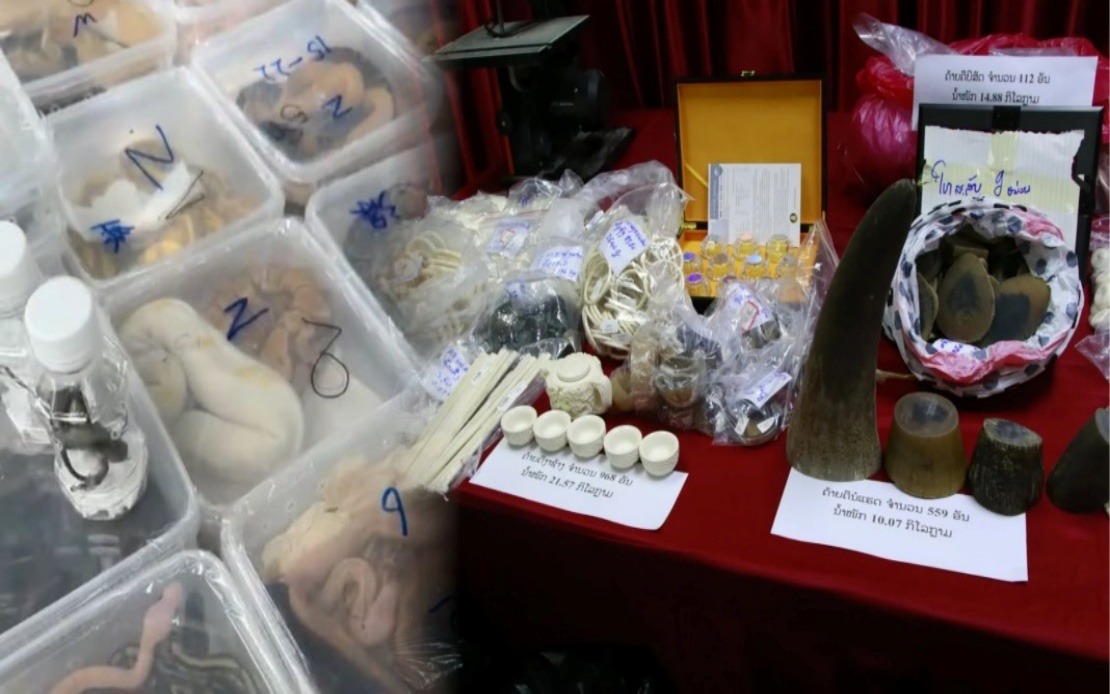
Laotian authorities have dealt a significant blow to an organised wildlife trafficking operation that has been funnelling endangered species across Southeast Asian borders, recovering nearly 300 live animals and substantial quantities of illegal wildlife products in a series of coordinated enforcement actions last week. The busts, which occurred in Luang Prabang and Champasak provinces, reveal the extent to which criminal networks are exploiting the Mekong region's porous borders to move protected fauna and derivatives worth millions of dollars annually.
The Lao Wildlife Enforcement Network uncovered 60 kilogrammes of suspected illegal merchandise during an operation in Luang Prabang, a major tourist hub where such activities can operate with relative impunity. The haul included items ranging from ivory-like objects and animal gallbladders to pangolin scales and what authorities believed to be rhino horns, all prohibited under international wildlife protection agreements. Officers also confiscated elephant skin powder, bear gallbladder, preserved hornbill heads, and tubes of traditional herbal remedies that contained wildlife-derived ingredients, illustrating how smugglers conceal contraband within seemingly legitimate commercial channels that appeal to regional and international buyers.
Four days after the Luang Prabang seizure, wildlife rangers stationed at the Vang Tao International Checkpoint in Champasak Province intercepted a consignment of 294 live animals being transported across the border toward Thailand. The cache included turtles, pythons, green snakes, gold-ringed cat snakes, and various lizard species—creatures typically sourced from Laotian forests and destined for underground pet markets, traditional medicine producers, or exotic animal dealers throughout Asia. The checkpoint, which straddles the crossing to Ubon Ratchathani Province in Thailand, has emerged as a critical interdiction point precisely because it handles high volumes of cross-border traffic where contraband can be concealed among legitimate shipments.
These operations reflect a broader pattern of trafficking activity across the region. Earlier in May, Thai authorities arrested a woman operating a traditional medicine and souvenir shop in Nakhon Phanom, in Thailand's northeast, after investigators recovered more than 100 protected wildlife remains suspected of having been smuggled from Laos. The May 16 seizure along the Thai–Lao border meanwhile disrupted an attempt to move 130 kilogrammes of cut elephant ivory and animal carcasses, demonstrating that traffickers employ multiple routes and strategies simultaneously to reduce the risk of total operational collapse should any single shipment be intercepted.
Laos occupies an extraordinarily vulnerable position within these trafficking networks due to its geographic situation. The country shares borders with five nations—Cambodia, China, Myanmar, Thailand, and Vietnam—creating a transit maze through which contraband can be routed with multiple options for redirecting shipments if particular corridors become too dangerous. Wildlife experts have consistently identified landlocked countries with extensive international boundaries as particular trafficking hotspots, and Laos exemplifies this vulnerability. Its limited law enforcement resources relative to the scale of the Mekong region's wildlife trafficking operations mean that even successful busts represent only a fraction of the total contraband moving through the territory.
The international dimension of these seizures underscores why Southeast Asian nations cannot address wildlife trafficking unilaterally. The animals and products intercepted in Laos were destined for markets across the region and beyond, responding to demand originating in countries as distant as China and Vietnam, where traditional medicine practitioners continue to purchase wildlife derivatives despite legal prohibitions. International passenger buses, such as the one intercepted carrying animals between Pakse and Bangkok, provide ideal cover for smugglers because they blend into legitimate tourism and commerce flows that authorities cannot practically subject to intensive scrutiny.
The United Nations Office on Drugs and Crime captured the scale of this challenge in its World Wildlife Crime Report 2024, which documented that illegal wildlife trade persists despite two decades of coordinated international enforcement efforts. The report identified corruption as a fundamental enabler of smuggling operations, a critical observation for Southeast Asia where border officials, police, and customs personnel may be susceptible to bribery from networks operating with substantial financial resources. When the global wildlife trade generates nearly US$10 billion annually—placing it alongside human trafficking, narcotics, and arms smuggling in terms of criminal revenue—the incentive structure for corrupting officials becomes substantial and systematic.
For Malaysia specifically, these developments carry implications extending beyond abstract environmental concerns. Laos and Thailand serve as transit zones through which wildlife sourced from across Southeast Asia, including Malaysia's own protected species, may be channelled toward international markets. The traditional medicine and pet trade that drives demand for these products maintains robust consumer bases throughout Malaysia, meaning that enforcement actions in neighboring countries form part of the same ecosystem affecting Malaysian biodiversity. Furthermore, as a transit hub for regional trade, Malaysia itself risks becoming an unwitting smuggling corridor if trafficking networks identify local ports and borders as more permeable than those of neighboring countries.
The sophistication displayed by these trafficking networks deserves particular attention. The integration of live animal smuggling with the trade in processed wildlife products, the use of legitimate commercial channels like traditional medicine shops and international transport networks, and the apparent coordination across multiple countries suggest that these operations function as organized criminal enterprises rather than opportunistic poaching. This professionalization means that single enforcement actions, however dramatic, function as temporary obstacles rather than permanent disruptions unless accompanied by sustained international cooperation, intelligence sharing, and capacity building among law enforcement agencies.
The animals rescued during the Champasak Province operation now face uncertain futures. Rehabilitation facilities across Southeast Asia lack sufficient capacity to properly care for hundreds of reptiles and other wildlife species simultaneously, particularly when the animals originate from various ecosystems and may carry diseases or behavioral issues stemming from trafficking. This creates a secondary consequence of trafficking itself: successful law enforcement generates a humanitarian challenge for protecting discovered animals, a reality that can paradoxically discourage aggressive enforcement when authorities lack supporting infrastructure.
Laotian authorities' willingness to pursue these high-profile cases represents meaningful progress, yet sustainability requires institutional strengthening and resources that remain constrained across the region. Successful trafficking interdiction typically depends on intelligence and informant networks that take years to develop, financial incentives for rangers and border officials that often lag behind what smugglers can offer, and political commitment that must compete with numerous other pressing security and developmental priorities. For Malaysia and other ASEAN nations, supporting Laotian enforcement capacity—through training exchanges, intelligence sharing, and equipment provision—may ultimately prove more cost-effective than managing the ecological and economic consequences of unrestricted trafficking within the region.

