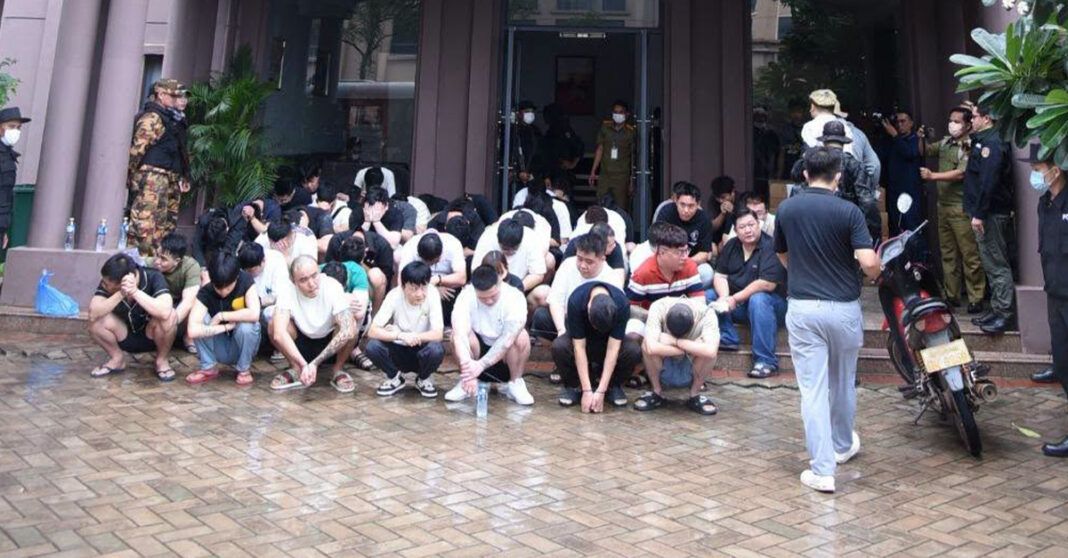
Vientiane police launched a significant enforcement operation on 8 August against an organized telecommunications fraud and online gambling syndicate operating from within the Thatluang Lake Special Economic Zone (SEZ), a strategically important economic enclave in the Lao capital. The raid resulted in the detention of 261 suspects representing seven different nationalities, underscoring the transnational character of sophisticated scam operations now targeting vulnerable populations across Asia. The scale of the operation highlights growing challenges faced by regional law enforcement in combating complex criminal networks that exploit porous borders and digital infrastructure to conduct large-scale financial crimes.
The composition of those detained reflects the increasingly cosmopolitan nature of modern fraud operations, with Chinese nationals comprising the largest contingent at 153 individuals, followed by 61 Vietnamese, 36 Thai, five Taiwanese, two Malaysian, two South Korean and two Myanmar nationals. This diverse workforce suggests a structured, multinational organization with the capacity to recruit talent across Southeast Asia and beyond, indicating sophisticated organizational capabilities typical of major criminal enterprises. The presence of smaller numbers from Malaysia, South Korea and Myanmar demonstrates how these networks extend recruitment efforts even into countries with more developed cybercrime enforcement mechanisms.
Police seized nearly 500 computers and laptops, along with 2,355 mobile phones from the facility, equipment representing the operational infrastructure through which the scam network maintained contact with victims and processed fraudulent transactions. The sheer volume of devices suggests an industrial-scale operation rather than a small-time fraud cell, with the seized technology likely capable of managing simultaneous conversations with hundreds or thousands of targets. Such equipment caches are typical of major call center operations that have become endemic to certain parts of Southeast Asia, where corrupt officials and permissive regulatory environments enable criminals to operate with relative impunity.
Authorities confirmed that the building housing the operation belongs to Lao Thatluang Investment Development Co., Ltd., raising important questions about corporate accountability and oversight mechanisms in the Lao Special Economic Zone system. The use of a corporate entity as cover for criminal activities points to potential weaknesses in company registration and monitoring procedures, or alternatively, suggests deliberate corruption within regulatory institutions designed to prevent such abuses. This creates particular concern for Malaysian investors and businesses operating in the SEZ, who may find themselves competing on an uneven playing field where criminal organizations enjoy equivalent or superior access to premium commercial facilities.
The timing and scale of this operation reflects a broader intensification of efforts by Lao authorities to dismantle scam networks that have become increasingly visible internationally and politically embarrassing for the government. Over a two-week period, Laos executed multiple coordinated raids targeting different nodes within what appears to be a distributed criminal ecosystem. On 10 August, authorities deported 41 Thai suspects to Thailand via the 1st Lao-Thai Friendship Bridge, building on an earlier transfer of 32 Thai nationals conducted just four days prior on 6 August, bringing the total number of Thai deportations to at least 73 during this enforcement period.
The earlier operation that contributed significantly to this deportation total occurred on 18 July, when police raided the ST Vegas complex in Dongphosy village, Hatsayfong district, Vientiane. That operation netted 589 suspected scammers in total, with Thai nationals forming the largest single group, followed by Lao, Vietnamese and Cambodian nationals. The pattern suggests that while Chinese nationals may dominate operations in certain facilities, Thai nationals represent a substantial proportion of active perpetrators engaged in ground-level scam execution, potentially explaining why Thailand has received particular attention in deportation efforts.
For Malaysian readers and policymakers, these developments carry significant implications. The detection of two Malaysian nationals among the detainees suggests that Malaysian citizens are being recruited into these operations, either as unwitting participants in employment schemes or as voluntary participants seeking quick income. This represents a security concern, as individuals convicted of fraud-related offences in Laos may face substantial prison sentences under local law, creating complications for Malaysian consular services and diplomatic channels. Additionally, the presence of scam operations in jurisdictions adjacent to Malaysia underscores the need for enhanced vigilance regarding phone and online fraud originating from the broader region.
The continued discovery of massive scam infrastructure in Laos also raises questions about whether current bilateral and multilateral law enforcement cooperation frameworks are adequately resourced and effective. While the Lao government's willingness to conduct large-scale raids and execute deportations is commendable, the apparent ease with which these operations establish themselves, potentially for extended periods before detection, suggests that underlying factors enabling their emergence require sustained attention. Corruption, inadequate regulatory capacity, and the profit motive driving complicit officials within relevant agencies likely remain significant obstacles to long-term suppression.
From a broader Southeast Asian perspective, the proliferation of telecom fraud and online gambling operations reflects a worrying trend of locating criminal infrastructure in jurisdictions perceived as having weaker enforcement or enforcement that can be circumvented through corruption. The economic integration of the region, combined with digital connectivity, has created unprecedented opportunities for organized crime to operate across borders while targeting victims worldwide. Malaysians and citizens of other developed Southeast Asian nations represent particularly attractive targets because of higher average incomes and greater likelihood of possessing disposable assets or access to bank credit.
The equipment and organizational sophistication evident in these raids demonstrates that scam operations have evolved from cottage-industry level activities into genuine criminal enterprises employing hundreds and generating millions in illicit proceeds. The fact that such major installations can be established and operated for what appear to be extended periods before detection suggests that prevention strategies focused on early intervention require strengthening across the region. Intelligence sharing between national police forces, coordination of financial investigations, and joint task forces may prove necessary given the transnational architecture of these networks.
Lao authorities have indicated that investigations remain ongoing, with particular focus on identifying the operation's masterminds and accomplices for prosecution under Lao law. This suggests recognition that detaining frontline workers alone will have limited impact on disrupting organized crime structures, and that attention must turn to the financiers, coordinators and corrupt officials enabling such operations. However, the history of previous crackdowns suggests that such high-level arrests may prove elusive, particularly if masterminds operate from jurisdictions outside Lao control or maintain sufficient insulation from direct operational involvement to avoid incrimination.

