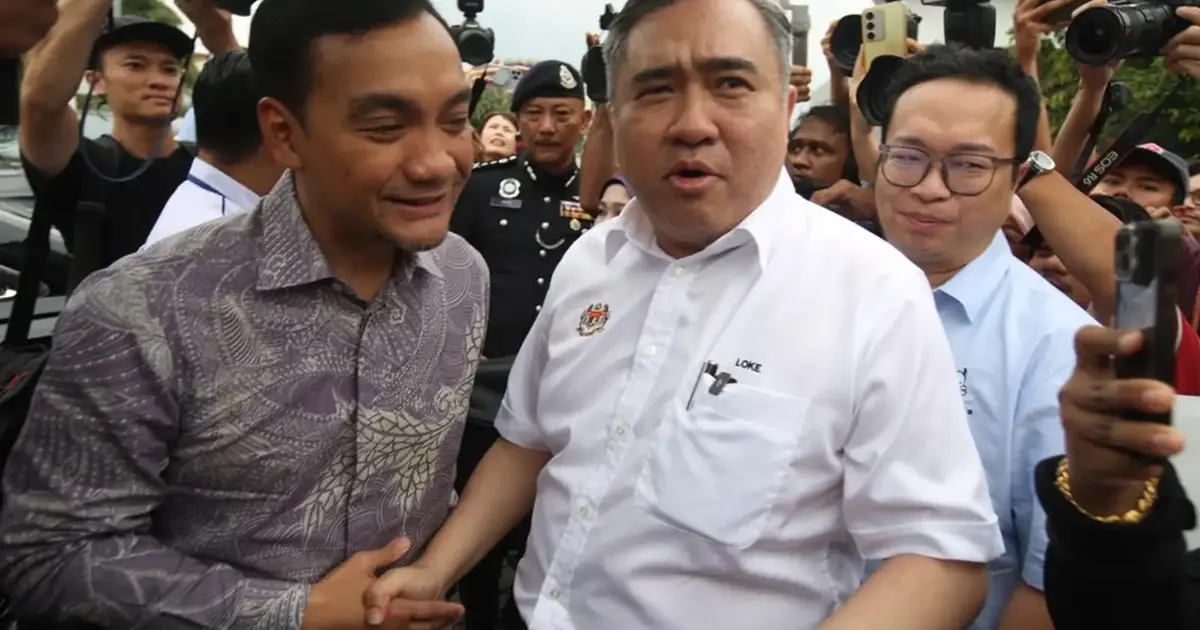
Transport Minister Anthony Loke and Johor Menteri Besar Onn Hafiz Sapian put aside their recent online tensions to maintain a cordial public appearance at an official gathering, signalling a willingness to preserve political decorum despite clear friction between the two leaders. The carefully managed encounter marked their first face-to-face engagement since the pair exchanged words on social media, an incident that had drawn scrutiny from political observers tracking the shifting dynamics between federal and state-level leadership in the country's southern corridor.
While the meeting proceeded without visible acrimony, Onn Hafiz seized the opportunity to offer a subtle riposte directed at the DAP leader during his remarks at the event. The Johor chief executive noted that he had been forced to reorganise his official calendar at relatively short notice in order to accommodate the Transport Ministry's invitation, a pointed reference that suggested frustration over the manner in which the engagement had been arranged. Such veiled criticism, delivered within earshot of assembled media and stakeholders, represented a characteristically understated form of political messaging that allowed both figures to maintain formal civility while simultaneously registering disapproval.
The underlying tension between Loke and Onn Hafiz reflects broader complexities within Malaysia's current political landscape, where federal ministers and state administrations controlled by different political coalitions must navigate competing interests while ostensibly working toward shared national objectives. The Transport Ministry falls under federal purview, yet critical infrastructure and development projects often require significant coordination with state governments, creating friction points where jurisdictional boundaries and political preferences intersect. For Johor particularly, which functions as an economic powerhouse and crucial logistics hub connecting to Singapore, such tensions carry material implications for regional commerce and connectivity.
Onn Hafiz's observation about schedule adjustments, while seemingly procedural, carried unmistakable political weight. It suggested that the Transport Ministry had not extended sufficient courtesy in its planning, or perhaps that the invitation itself was issued as a demonstration of federal authority rather than as a collaborative gesture between equals. Such protocol matters assume considerable significance in Malaysian political culture, where formal respect and advance consultation are understood as fundamental courtesies between senior officials. The public nature of his remarks meant that Loke would necessarily hear and understand the subtext, even as both men maintained the facades of professional cooperation required by their positions.
The earlier online exchange between the two leaders had drawn considerable public interest, with supporters of both figures engaging in robust debate across digital platforms. Such social media encounters, once largely confined to lower-ranking politicians or party operatives, have increasingly involved cabinet-level officials in recent years, reflecting the transformation of political communication in Malaysia. However, high-ranking figures like Loke and Onn Hafiz typically prefer to manage such disputes through more traditional channels, making their direct online engagement notable and their subsequent public meeting all the more carefully orchestrated.
For observers tracking Malaysia's political temperature, the episode illuminates the persistent tensions between the Pakatan Harapan-led federal government and state administrations governed by different political combinations. Johor, governed by Onn Hafiz's United Malays National Organisation-led administration, represents a significant power base that occasionally finds itself at odds with national-level policy directions or resource allocation decisions. Transportation and logistics, fields directly impacted by ministerial decisions in Kuala Lumpur, become natural flashpoints where such tensions emerge into public view.
The deliberate maintenance of cordiality at their public meeting suggests both leaders recognise the costs of sustained open conflict. Onn Hafiz requires functional relationships with federal ministries to deliver infrastructure and development projects that benefit his constituents and strengthen his political standing within Johor. Loke, conversely, needs cooperation from state administrations to implement transport initiatives that depend on local government support and expertise. This mutual interdependence creates natural incentives toward diplomatic engagement, even when genuine disagreements exist beneath the surface.
The Transport Minister's decision to proceed with the event despite the recent social media friction demonstrates confidence that the underlying relationship remains professionally viable. Neither figure benefits from prolonged public dispute, which could complicate future negotiations over funding allocations, project approvals, or inter-state coordination mechanisms. By meeting and exchanging measured remarks, they effectively reset their public positioning while neither conceding substantive points to the other.
Looking forward, this encounter suggests that while personalities and political differences may periodically surface online, the institutional imperatives of governance typically reassert themselves to restore working relationships. For stakeholders dependent on Transport Ministry and state government collaboration—businesses, logistics operators, and the travelling public—such maintenance of functionality remains essential. The subtext of Onn Hafiz's schedule comment, however, indicates that underlying grievances persist beneath the diplomatic veneer, and future interactions between these two leaders will likely continue to reflect the tensions inherent in Malaysia's federal structure and fractured political landscape.