Across Malaysia yesterday, communities gathered to mark Maal Hijrah 1448H/2026 with a unifying message: that the Islamic calendar's new year represents far more than a date change. The occasion served as a moment for reflection on personal and collective transformation, emphasising how the concept of hijrah—spiritual migration towards positive change—remains deeply relevant to contemporary Muslim life. Throughout these celebrations, organisers stressed that meaningful progress requires not merely individual piety but visionary leadership capable of elevating public welfare and establishing more resilient societies rooted in Islamic values.
The main ceremony, held in Kuala Lumpur under the theme "MADANI Dihayati, Ummah Diberkati" (MADANI Lived, Ummah Blessed), drew approximately 5,000 attendees and attracted significant government participation. Deputy Prime Minister Datuk Seri Fadillah Yusof and Minister in the Prime Minister's Department (Religious Affairs) Dr Zulkifli Hasan graced the proceedings, signalling the administration's commitment to celebrating Islamic milestones as occasions for reaffirming national values. The substantial turnout underscored public appetite for spiritual gatherings that connect religious observance to practical questions about governance, social cohesion and institutional excellence.
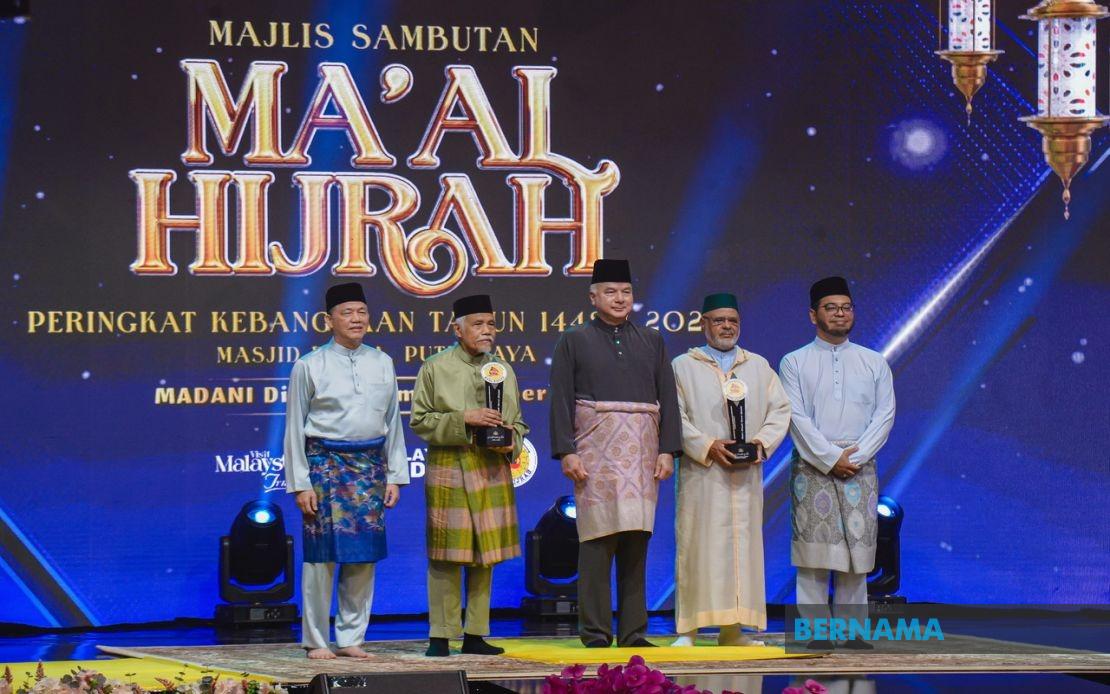
The presentation of national and international awards formed a centrepiece of the celebration, honouring individuals whose contributions embody the hijrah principle in action. Sultan Nazrin of Perak, in his capacity as Sultan, conferred the National Tokoh Maal Hijrah Award upon Prof Emeritus Datuk Dr Osman Bakar, the rector of International Islamic University Malaysia (IIUM), recognising academic leadership and scholarly advancement as vital expressions of Islamic civilisation building. This choice reflected a deliberate emphasis on how educational institutions serve as vehicles for transmitting knowledge and values across generations.
The international dimension of the awards ceremony extended Malaysia's influence within global Islamic discourse. Dr Ahmad Al-Raysuni, a respected Islamic jurisprudence scholar from Morocco, received the International Tokoh Maal Hijrah Award, positioning the ceremony within a broader Muslim world conversation about contemporary challenges and theological responses. Such recognition underscores Malaysia's aspiration to participate meaningfully in transnational Islamic intellectual circles whilst maintaining distinct regional identity.
Parallel celebrations in Sabah reflected how Maal Hijrah observances extend beyond ceremonial occasions in the capital to engage diverse communities across the federation. The Sabah event welcomed dignitaries including Tun Musa and his wife Toh Puan Faridah Tussin, whose arrival was marked by Chief Minister Datuk Seri Hajiji Noor and organising committee chairman Datuk Dr Mohd Arifin Mohd Arif, the state's Local Government and Housing Minister. This convergence of federal and state leadership demonstrated the integrative role such celebrations play in affirming shared values across Malaysia's political structure.
Recognition extended to grassroots community leaders whose influence operates beneath the formal apparatus yet anchors Islamic practice in daily life. Datuk Ag Sharin Alimin, a community activist and former director of Sabah's Islamic Religious Affairs Department, received the male category Tokoh Maal Hijrah Award, whilst Datuk Masnah Matsalleh, a retired state administration official, was honoured in the female category. These awards acknowledged that religious leadership encompasses not only clergy and scholars but administrators, activists and citizens who advance Islamic values through institutional service and community engagement.
A separate ceremony in another location further demonstrated the nationwide scope of Maal Hijrah commemoration. Ahmad Samsuri presented the Tokoh Maal Hijrah Award to 95-year-old Jusoh @ Muda Ismail, a Quranic teacher whose remarkable longevity and dedication to Islamic education embodied living continuity with revered scholars of previous generations. Notably, Jusoh carried the lineage of the late Tuan Guru Haji Mat Lintar, a renowned Quranic authority, having adopted and studied under this luminary. This intergenerational connection illustrated how Maal Hijrah celebrations function as moments for recognising the transmission chains through which Islamic knowledge and spiritual practice persist.
The thematic framework emphasising quality leadership carried particular resonance given Malaysia's ongoing governance conversations. By positioning hijrah—traditionally understood as the Prophet Muhammad's migration to Medina as a turning point for Islamic civilisation—as relevant to modern leadership challenges, the celebrations invited audiences to contemplate how institutions function, how power concentrates and how public resources serve collective welfare. The emphasis on "stronger civilisation" implied that material progress separated from ethical foundation remains incomplete, a message with implications for how Malaysia approaches development priorities.
Maal Hijrah observances in Malaysia have evolved beyond purely religious commemoration to encompass civic dimension. The gathering of government ministers alongside religious scholars, community leaders and ordinary citizens suggested implicit consensus that Islamic calendar milestones warrant recognition as occasions for national reflection. The awards structure particularly functioned to elevate exemplary individuals from various backgrounds—academia, religious administration, community activism, Quranic instruction—positioning Islam not as confined to mosque spaces but as permeating diverse professional and social domains.
The emphasis on ummah unity across multiple ceremonies held nationwide reflected contemporary consciousness that Malaysian Muslims occupy multiple, sometimes competing identity positions. As a federal system with distinct state governments, as minority and majority communities in different regions, and as part of broader global Muslim networks, Malaysian Muslims navigate complex belonging. Celebrations organised with both federal and state participation helped symbolically integrate these layers, suggesting that religious identity could serve as unifying force without eclipsing political federalism or regional distinctiveness.
Looking forward, the prominence given to leadership quality and civilisational advancement at these celebrations establishes benchmarks against which Malaysian institutions might be measured. The awards to academics, administrators and religious scholars rather than political office-holders subtly distinguished between formal power and exemplary contribution, inviting audiences to think critically about what constitutes genuine leadership. This intellectual dimension elevated Maal Hijrah beyond festive observance toward engagement with substantive questions about institutional purpose and social direction that occupy Malaysian public discourse.