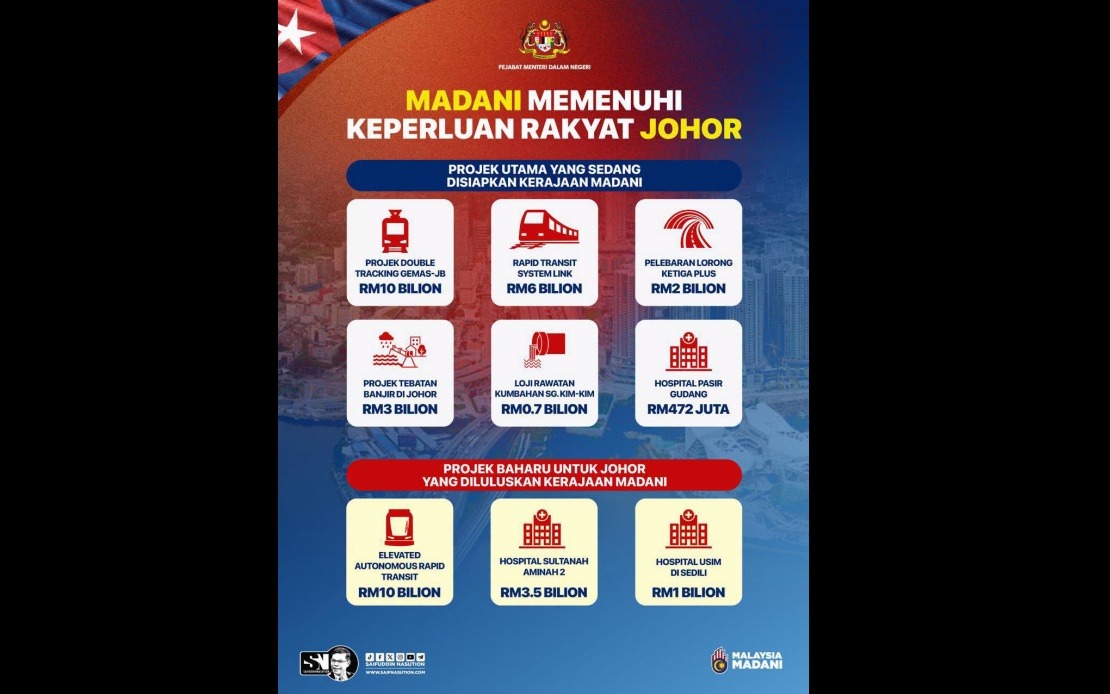
The Malaysian government has reiterated its commitment to delivering equitable and sustainable development throughout the nation, framing economic growth as a comprehensive endeavour extending beyond individual states. Pakatan Harapan's secretary-general Datuk Seri Saifuddin Nasution Ismail conveyed this message during remarks in Johor Bahru on 29 June, emphasising that the administration under Prime Minister Datuk Seri Anwar Ibrahim views development as a shared national responsibility that must benefit citizens across all regions.
At the heart of this policy framework lies a strategic focus on infrastructure investment, public transportation networks, healthcare expansion, and disaster mitigation—sectors identified as foundational to improving living standards. The government's approach reflects recognition that modern development requires interconnected systems addressing mobility, health security, and environmental resilience simultaneously. These priorities align with broader Southeast Asian trends toward integrated urban development models that prioritise citizen welfare over purely economic metrics.
Johor occupies particular significance within this development agenda, serving both as a major economic contributor and as a test case for the government's regional approach. The state's geographic position, spanning critical transportation corridors and serving as Malaysia's gateway to Singapore, makes its infrastructure modernisation strategically consequential for the entire region. Recent announcements underscore the scale of commitment, with several high-profile projects at various stages of implementation.
Among the most advanced initiatives is the Gemas-Johor Bahru Electrified Double Tracking Project, which promises to transform rail connectivity throughout the southern corridor. Running parallel to this effort, the Rapid Transit System Link addresses urban mobility challenges in key population centres, while the planned third lane expansion of the PLUS Highway responds to intensifying traffic demands along one of Southeast Asia's busiest commercial routes. These transportation investments carry implications extending beyond Johor's borders, affecting trade flows, commuter patterns, and regional connectivity across Malaysia and into Singapore.
Flood mitigation has emerged as an increasingly urgent development component following successive severe weather events across the region. The government's flood mitigation project in Johor, complemented by the Sungai Kim Kim Sewage Treatment Plant initiative, demonstrates recognition that infrastructure must address both growth and climate adaptation simultaneously. This dual focus reflects lessons learned from environmental pressures facing Southeast Asia as rapid urbanisation intersects with changing weather patterns.
Healthcare expansion forms another pillar of the development framework. The Pasir Gudang Hospital represents immediate capacity enhancement, while approvals for the Sultanah Aminah Hospital 2 and USIM Hospital in Sedili signal longer-term population health planning. These investments acknowledge that quality healthcare access fundamentally shapes human development outcomes and citizen satisfaction with governance.
The emerging Elevated Autonomous Rapid Transit system reflects technological ambitions within the development programme, positioning Johor as a testing ground for next-generation urban mobility solutions. Such projects carry significance for Malaysia's broader positioning within Southeast Asia's innovation landscape, potentially establishing technical expertise applicable across the region.
Home Minister Saifuddin Nasution's articulation of development metrics reveals an important analytical shift within government discourse. Rather than emphasising headline investment figures or GDP contributions, the administration has consciously reframed development measurement around tangible citizen benefits—employment generation, transportation efficiency, healthcare accessibility, and quality-of-life improvements. This reorientation suggests responsiveness to public sentiment regarding whether large-scale projects deliver practical advantages to ordinary Malaysians.
The emphasis on inclusive and sustainable growth carries particular resonance in Johor, where rapid urbanisation has created winners and losers within the development process. Industrial growth in areas like Pasir Gudang has generated employment opportunities whilst simultaneously creating environmental and health challenges. The government's integrated approach—combining economic expansion with environmental management and healthcare provision—attempts to address these tension points simultaneously rather than treating them as separate policy domains.
From a regional perspective, Johor's development trajectory influences Southeast Asian economic integration patterns. Infrastructure improvements affecting cross-border connectivity with Singapore and enhanced transportation networks throughout the southern peninsula position the state as a critical node within regional supply chains and commuter corridors. The successful implementation of these projects could establish models applicable elsewhere in Malaysia and potentially throughout Southeast Asia.
The MADANI framework's emphasis on concurrent pursuit of infrastructure, healthcare, and environmental projects suggests recognition that modern development demands integrated rather than sectoral approaches. Projects cannot be evaluated in isolation; rather, transportation improvements gain maximum value when coupled with healthcare access and environmental protection. This holistic conception of development represents an evolution from earlier, more narrowly-focused infrastructure emphasis.
For Malaysian citizens, particularly those in Johor, the practical implications involve tangible service improvements emerging across multiple life domains. Commuters will benefit from modernised transportation options, residents will gain access to expanded healthcare facilities, and communities will experience reduced flood vulnerability. The government's framing emphasises these concrete gains as the ultimate measure of development success, a pivot away from construction announcements toward outcome-focused assessment.
Looking forward, the government faces the familiar challenge of translating development commitments into timely implementation whilst managing regional expectations. Johor's projects will serve as visible indicators of the MADANI administration's capacity to deliver on its broader development promises across Malaysia, with implications extending throughout Southeast Asia's most densely integrated bilateral relationship.

