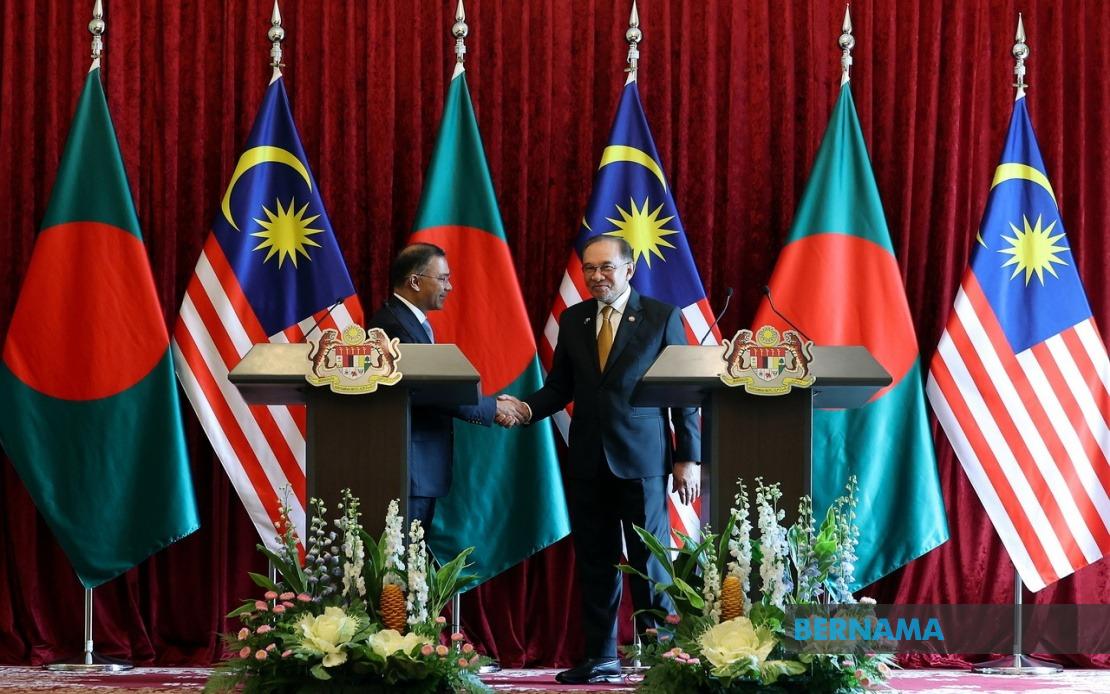
Prime Minister Datuk Seri Anwar Ibrahim and visiting Bangladesh Prime Minister Tarique Rahman have committed to moving beyond diplomatic rhetoric by fully operationalising their Defence Cooperation Memorandum of Understanding, signalling a shift towards tangible military and strategic collaboration between the two Muslim-majority nations. The commitment, formalised through a joint statement issued by Malaysia's Foreign Ministry on June 22, reflects a broader regional strategy to deepen ties across multiple sectors as both countries navigate an increasingly complex geopolitical landscape in South and Southeast Asia.
The defence partnership builds on an already robust foundation of military engagement that has evolved over decades, characterised by high-level official visits, structured training exchanges, and goodwill naval port calls that have kept channels of communication open between their armed forces. By moving towards full operationalisation of the MoU, the two nations are signalling intent to translate these courtesies into substantive capability-building and strategic alignment. The establishment of a bilateral Joint Committee on Defence Cooperation represents a crucial institutional mechanism that will provide the organisational framework and oversight needed to chart a comprehensive defence roadmap extending beyond ad-hoc engagements.
Central to this enhanced cooperation is a deliberate focus on capability development through structured military education and training. Both countries have agreed to expand seat allocations at their respective National Defence Colleges and Command and Staff Colleges, creating pathways for senior military officers to undergo professional development in each other's institutions. Such exchanges are particularly significant in Southeast Asia, where interoperability and shared understanding of military doctrine among neighbouring forces can substantially improve regional stability and reduce miscalculation risks. For Malaysia, access to Bangladesh's defence expertise offers insights into sub-continental security dynamics, while Bangladesh gains valuable exposure to Malaysia's maritime security practices and experience in managing complex regional interests.
The defence partnership explicitly encompasses joint participation in United Nations peacekeeping operations, an area where both nations have maintained strong commitments. Through coordinated tactical exercises, pre-deployment training collaboration, and knowledge-sharing on field challenges, the two countries aim to enhance their operational effectiveness in international peace support missions. Bangladesh's extensive peacekeeping experience, having contributed troops to numerous UN operations across Africa and Asia, complements Malaysia's own substantial engagement in global peacekeeping efforts. This collaboration signals that both nations view UN operations not merely as humanitarian obligations but as opportunities to strengthen bilateral relationships while addressing global security challenges.
Countering terrorism and violent extremism represents another pillar of the reinforced partnership, reflecting shared security concerns in a region vulnerable to transnational militant networks. Intelligence sharing and information exchange mechanisms, coupled with capacity-building initiatives and the dissemination of best practices, will enable both nations to respond more effectively to terrorism threats that do not respect borders. For Malaysia, which has grappled with extremist cells and foreign fighter returnees from conflict zones, access to Bangladesh's experience and intelligence capabilities adds valuable layers to national security frameworks. The formalisation of these arrangements through bilateral agreements demonstrates recognition that terrorism prevention requires sustained institutional cooperation beyond temporary crisis management.
Beyond the traditional defence domain, the bilateral relationship is expanding significantly into education and academic cooperation, reflecting a strategic recognition that long-term regional stability depends on people-to-people connections and shared human capital development. The approximately 11,000 Bangladeshi students currently studying in Malaysia constitute a substantial soft power asset for both nations, fostering cross-cultural understanding while creating networks of professionals who will shape bilateral relations for decades. The leaders' emphasis on expanding university-to-university partnerships and joint research programmes, particularly in technical and vocational education, signals an understanding that addressing the region's skills deficits requires collaborative approaches that leverage each nation's institutional strengths.
The education cooperation framework explicitly acknowledges the importance of aligning academic programmes with labour market demands in both countries, addressing a persistent gap between tertiary education outputs and employment requirements across Asia. By promoting mutually recognised qualifications and flexible learning pathways, both nations are creating mechanisms for credential recognition that facilitates graduate mobility within the region. This approach has practical implications for Malaysian industries facing skilled workforce shortages in sectors like manufacturing, healthcare, and infrastructure development, where qualified Bangladeshi professionals could meet immediate needs while reducing dependence on other sources of migrant labour. Simultaneously, Malaysian educational institutions gain access to growing Bangladeshi markets and opportunities to establish satellite campuses or articulation arrangements that expand their regional footprint.
Tourism cooperation emerges as a significant economic dimension of the enhanced partnership, with both leaders expressing enthusiasm about leveraging Malaysia's 'Visit Malaysia 2026' and 'Malaysia Year of Medical Tourism 2026' campaigns. Bangladesh's middle class has expanded considerably in recent years, creating a substantial and growing pool of potential tourists with disposable incomes and aspirations to travel. For Malaysia's hospitality, healthcare, and tourism sectors, Bangladeshi visitors represent an important and underexploited market segment. The joint commitment to enhance tourism promotion and cultural exchanges creates formal pathways for increasing visitor arrivals, which carries economic benefits for Malaysian businesses while strengthening people-to-people ties that form the bedrock of lasting bilateral relationships.
From a strategic perspective, the deepening Malaysia-Bangladesh cooperation reflects broader positioning by both nations within South and Southeast Asian affairs during a period of significant regional transformation. Bangladesh's strategic location at the intersection of South Asia and Southeast Asia, coupled with its growing economic influence and substantial military capabilities, makes it a valuable partner for Malaysia's regional diplomacy. The partnership also demonstrates Malaysia's continued emphasis on cultivating relationships with fellow Muslim-majority nations and developing alternative partnerships within the wider Indian Ocean region, diversifying its strategic interests beyond traditional ASEAN-centric frameworks while maintaining full commitment to regional organisations.
The institutional mechanisms being established through these agreements—the Joint Committee on Defence Cooperation, formal training exchange frameworks, and education coordination structures—suggest that both nations are approaching the relationship with long-term institutionalisation in mind rather than treating it as dependent on personalities or temporary circumstances. Such structural approaches tend to prove more durable and less vulnerable to political fluctuations, creating stable foundations for sustained cooperation. For Malaysia, this reflects a maturation of its foreign policy approach, recognising that strategic partnerships require ongoing investment in institutional capacity and regular high-level engagement to maintain momentum and prevent relationship drift.
Looking ahead, the success of these bilateral initiatives will depend substantially on implementation capacity and the allocation of adequate resources to the various mechanisms outlined in the joint statement. The establishment of joint committees and working groups creates the architecture for progress, but the real test will lie in whether defence ministries, educational institutions, and tourism boards dedicate sufficient personnel and budgets to making these frameworks functional. Regular high-level reviews and accountability mechanisms will be essential to ensure that commitments translate into visible outcomes for both nations' citizens and institutions. As Malaysia and Bangladesh move beyond the announcement phase into operational implementation, the partnership has potential to become a model for structured South-Southeast Asian cooperation, demonstrating how nations can deepen ties across multiple domains while respecting each other's core interests and constraints.

