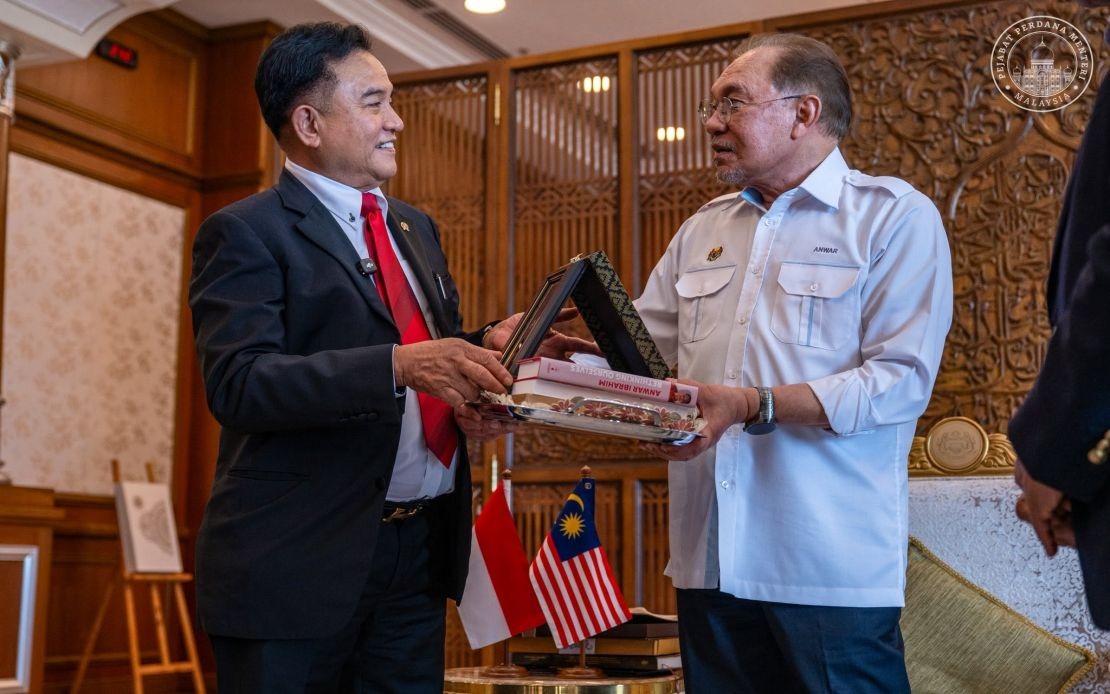
Prime Minister Datuk Seri Anwar Ibrahim has underscored Malaysia and Indonesia's shared determination to deepen institutional cooperation spanning legislation, governance systems, and key strategic domains where both nations share overlapping interests. The pledge emerged during a bilateral engagement at the Prime Minister's Office in Putrajaya, where Anwar received a courtesy visit from Indonesia's Coordinating Minister for Legal, Human Rights, Immigration and Correction, Prof Dr Yusril Ihza Mahendra, marking a tangible signal of renewed diplomatic momentum between the two largest Southeast Asian economies.
The bilateral engagement reflected broader recognition within both governments that legislative harmonization and strengthened governance frameworks can unlock mutual benefits. As neighbours bound by shared maritime boundaries, similar constitutional traditions, and significant people-to-people links, Malaysia and Indonesia have long recognized that aligned legal systems and coordinated policy approaches facilitate smoother cross-border commerce, citizen mobility, and security cooperation. The timing of this high-level engagement suggests both administrations view institutional modernization as a priority for the coming months.
Anwar, who simultaneously holds the Finance Ministry portfolio, noted during the discussion that both delegations exchanged substantive perspectives on mechanisms to advance bilateral cooperation across the identified sectors. The presence of Indonesia's legal and human rights coordinator indicates Jakarta is prioritizing governance modernization and institutional capacity-building as central pillars of its regional strategy. For Malaysia, such exchanges with senior Indonesian officials demonstrate a commitment to engaging beyond trade relationships to include deeper institutional dialogue.
The scope of potential cooperation areas spans considerable ground. Legislative coordination could encompass harmonizing commercial law frameworks, regulatory standards in financial services, and digital governance protocols—domains where divergent rules currently create friction for investors and businesses operating across both nations. Governance strengthening might involve sharing administrative best practices, judicial reform experiences, and anti-corruption methodologies. Both countries face similar challenges in enhancing public service delivery, combating graft, and strengthening institutional resilience against political interference.
For Malaysian stakeholders, deeper engagement with Indonesia carries particular significance given Jakarta's size and influence within ASEAN. Any advances in bilateral governance cooperation can establish templates for multilateral frameworks within the regional bloc. Malaysia's experience with institutions like the Malaysian Anti-Corruption Commission and established budget management systems offers valuable reference points for comparative study. Conversely, Indonesia's experiences managing diversity across a vast archipelago and navigating complex decentralization frameworks present instructive models for Malaysian policymakers considering administrative reform.
The emphasis on human rights and immigration coordination addresses practical realities affecting millions of citizens. Both nations host significant migrant worker populations and manage complex asylum situations. Harmonizing immigration procedures, labour standards enforcement, and human rights safeguards could enhance protection for vulnerable populations whilst streamlining legitimate cross-border movement. Such cooperation becomes increasingly vital as Southeast Asia grapples with regional mobility pressures arising from economic disparities and climate-related displacement.
Bilateral cooperation in these institutional domains also carries geopolitical dimensions within the current regional context. As major Southeast Asian democracies navigating great power competition and maintaining strategic autonomy, Malaysia and Indonesia benefit from coordinated positions on governance standards and institutional independence. Shared commitment to democratic resilience, judicial impartiality, and transparent administration strengthens both nations' ability to withstand external pressure and maintain credibility within international governance forums.
The courtesy visit format itself carries diplomatic significance beyond mere procedural formality. High-level bilateral meetings between senior ministers responsible for legal frameworks signal priority-level attention within both governments. Such engagements typically precede formal agreements, working group formations, or institutional mechanisms designed to translate political commitments into tangible institutional outcomes. The Indonesian coordinator's visit to Putrajaya suggests preparatory groundwork for more substantive cooperation architecture in coming months.
For the broader Southeast Asian context, strengthened Malaysia-Indonesia institutional cooperation can establish positive demonstration effects. As the two most substantial economies in ASEAN by nominal GDP, their collaborative approach to legislative harmonization and governance modernization influences regional standards and institutional practices. Other ASEAN member states often reference Malaysia-Indonesia precedents when developing their own institutional frameworks or bilateral partnerships. Success in these domains could encourage similar initiatives across the bloc, gradually building more coherent regional governance architecture.
The statement emphasizing fraternal relations and mutual progress reflects diplomatic language anchoring practical cooperation in deeper civilizational and historical connections. Both nations share Islamic heritage, multi-ethnic societies, and post-colonial trajectories that create genuine foundations for institutional learning and mutual support. Anwar's framing positions governance cooperation not as technocratic necessity alone but as expression of enduring regional solidarity and commitment to shared prosperity. This rhetorical positioning may resonate with domestic constituencies in both countries who view intra-ASEAN cooperation as preferable to external dependence.
Implementing ambitious cooperation agendas across legislation and governance requires sustained institutional engagement beyond high-level political visits. Both governments must establish working groups, assign technical personnel, develop implementation timelines, and secure bureaucratic buy-in from relevant agencies. The depth of actual cooperation often depends on these unglamorous implementation mechanics rather than headline-generating diplomatic meetings. Malaysian and Indonesian officials will need to negotiate genuine legislative changes, policy adjustments, and resource allocations to transform rhetorical commitments into institutional reality.
Looking ahead, the concrete outputs from this engagement will prove telling regarding bilateral seriousness. Observers should monitor announcements regarding formal working group establishment, scheduled bilateral meetings on specific legislative topics, or pilot programmes testing harmonized procedures. Such institutional mechanisms translate political commitment into systematic progress. The success of Malaysia-Indonesia cooperation in these domains could establish valuable precedents for other Southeast Asian bilateral relationships whilst advancing both nations' governance modernization objectives that serve their citizens' long-term interests.

