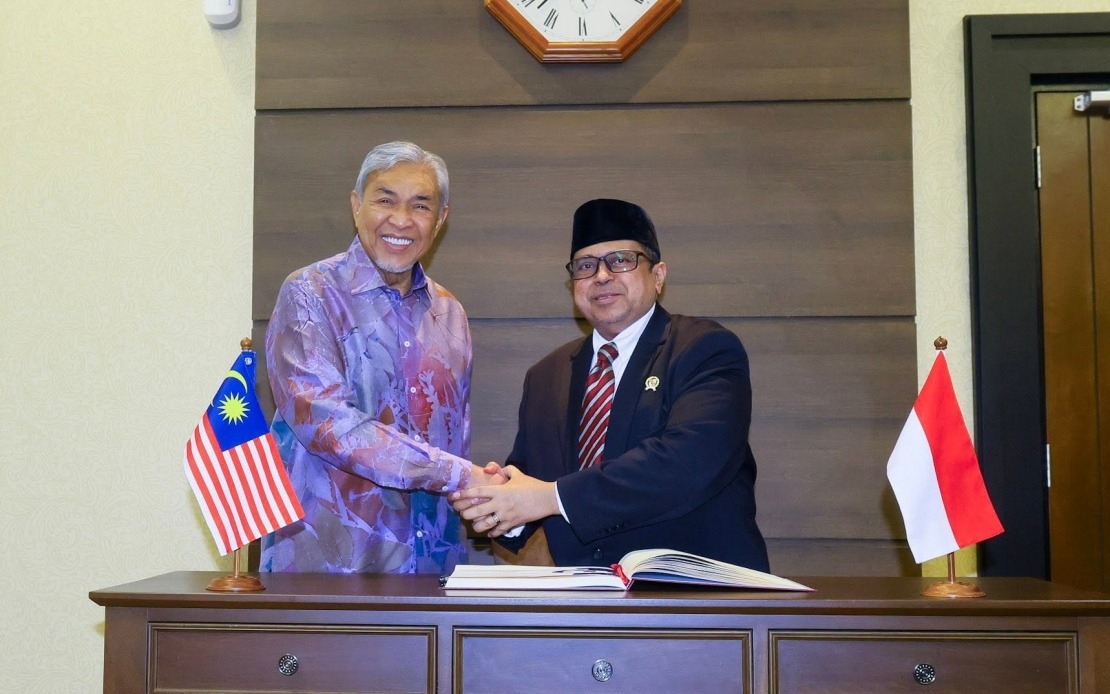
Malaysia and Indonesia are set to broaden their partnership across the halal industry, trade, rural development and human capital sectors, with discussions centring on establishing multilayered institutional frameworks to coordinate efforts across Southeast Asia and globally. Deputy Prime Minister Datuk Seri Dr Ahmad Zahid Hamidi outlined the expansion during a parliamentary meeting with Indonesia's Ambassador to Malaysia, Raden Datuk Mohammad Iman Hascarya Kusumo, and Dr Ahmad Haikal Hassan, who heads Indonesia's Halal Product Assurance Organising Body (BPJPH).
The proposed cooperation structure encompasses three tiers of governance designed to harmonise standards and facilitate trade across borders. At the bilateral level, Malaysia and Indonesia would establish the Malaysia-Indonesia Halal Council (MIHC) to serve as a direct platform for coordination between the two nations. Beyond this, the countries are exploring regional mechanisms through the ASEAN Halal Council, which would align halal practices and certification requirements across the ten-member bloc. At the apex sits the World Halal Development Council, aimed at elevating halal standards to international prominence and positioning Southeast Asian producers as premium global players.
For Malaysian stakeholders, this initiative represents a strategic opportunity to consolidate the region's dominance in halal certification and manufacturing. Malaysia has long positioned itself as the global halal hub, with its standards and certification framework widely recognised internationally. However, Indonesia's enormous Muslim population—representing roughly 87 per cent of its 275 million inhabitants—and its position as the world's largest Muslim-majority nation make it a crucial partner in scaling halal commerce across Asia and beyond. A coordinated approach between these two neighbouring economies could effectively establish Southeast Asian standards as the reference point for international halal trade.
The emphasis on harmonising halal standards addresses a longstanding challenge in regional trade. Currently, each country operates its own certification systems, creating duplication and increasing costs for producers seeking to export across borders. Businesses must navigate multiple regulatory frameworks, obtain separate certifications, and comply with varying compliance requirements—all of which create friction in supply chains. By establishing common standards through these proposed councils, Malaysia and Indonesia could significantly reduce these barriers, making it easier for small and medium enterprises from both countries to participate in halal commerce without bearing excessive compliance burdens.
Ahmad Zahid, who chairs the Malaysia Halal Industry Development Council, framed the cooperation as leveraging the historical strength of bilateral relations. The two nations share common Islamic values, extensive people-to-people ties, and complementary economic structures. Malaysia's advanced regulatory infrastructure and certification expertise could combine with Indonesia's vast production capacity and consumer base to create a compelling competitive advantage. This foundation positions the partnership to move beyond symbolic cooperation into tangible institutional mechanisms that reshape regional halal commerce.
The investment in human capital development forms another critical dimension of the proposed partnership. The halal industry increasingly requires skilled professionals across multiple domains—from certification and quality assurance to supply chain management and technology adoption. By collaborating on workforce development, Malaysia and Indonesia can ensure that both nations have sufficient trained personnel to manage expanded halal operations, while also facilitating knowledge transfer and professional mobility between countries. This could include joint training programmes, academic exchanges, and certifications recognised across both jurisdictions.
Rural development represents an often-overlooked but essential component of halal industry expansion. Much of the halal supply chain originates in agricultural regions where farmers and small producers operate. By incorporating rural development into the cooperation framework, Malaysia and Indonesia acknowledge that strengthening the halal ecosystem requires investing in the foundational productive capacity of farming communities. This could encompass improving agricultural practices, providing financing support, and establishing procurement networks that connect rural producers directly to halal processing facilities and export channels.
The timing of this initiative reflects broader regional economic realities. The global halal market is expanding rapidly, with projections suggesting continued double-digit growth across food, pharmaceuticals, cosmetics, and other sectors. Consumers worldwide are increasingly purchasing halal-certified products not solely for religious reasons but also based on perceptions of quality, safety, and ethical sourcing. Malaysia and Indonesia, by consolidating their market position through these frameworks, position themselves to capture a disproportionate share of this expanding opportunity. Nations like Turkey, the United Arab Emirates, and others have been investing heavily in halal infrastructure; this partnership ensures Southeast Asia remains competitive.
For Malaysian businesses, the establishment of these councils carries immediate practical implications. Manufacturers and traders will have clearer pathways to Indonesian markets and, conversely, Indonesian producers will gain better access to Malaysia's established halal supply chains and export networks. The reduction in certification complexity could particularly benefit small enterprises that currently lack resources to navigate multiple regulatory regimes. Additionally, joint standards could enhance the international credibility of Southeast Asian halal products, making them more attractive to buyers in Europe, the Middle East, and other markets that have shown growing interest in halal-certified goods.
The institutional architecture being proposed also signals a deeper strategic intent: positioning Malaysia and Indonesia as architects of global halal governance rather than merely participants in standards set by others. By establishing the World Halal Development Council, the two nations would effectively shape how halal is defined, certified, and enforced internationally. This is particularly significant given that halal certification has become a trade tool, with various countries seeking to establish their own standards as the international benchmark.
Implementation will require navigating bureaucratic, technical, and commercial complexities. The two governments must translate these broad cooperative intentions into specific agreements with clear enforcement mechanisms, dispute resolution procedures, and regular review processes. The private sector—farmers, manufacturers, traders, logistics providers—will need reassurance that these frameworks will genuinely reduce costs and expand market access rather than imposing additional layers of compliance. Civil society, including religious authorities and consumer organisations, must also be engaged to ensure that any harmonised standards reflect genuine halal principles rather than commercial shortcuts.
The success of this initiative will ultimately depend on whether Malaysia and Indonesia can move beyond symbolic cooperation to establish functioning institutional mechanisms that deliver tangible benefits to businesses and consumers. If executed effectively, the Malaysia-Indonesia Halal Council and associated frameworks could set a model for other Southeast Asian nations seeking to strengthen regional value chains. Given the scale of their economies, their Muslim populations, and their existing expertise in halal matters, the two countries are well-positioned to lead this transformation, provided they follow through on current commitments with substantive institutional development and binding commercial agreements.

