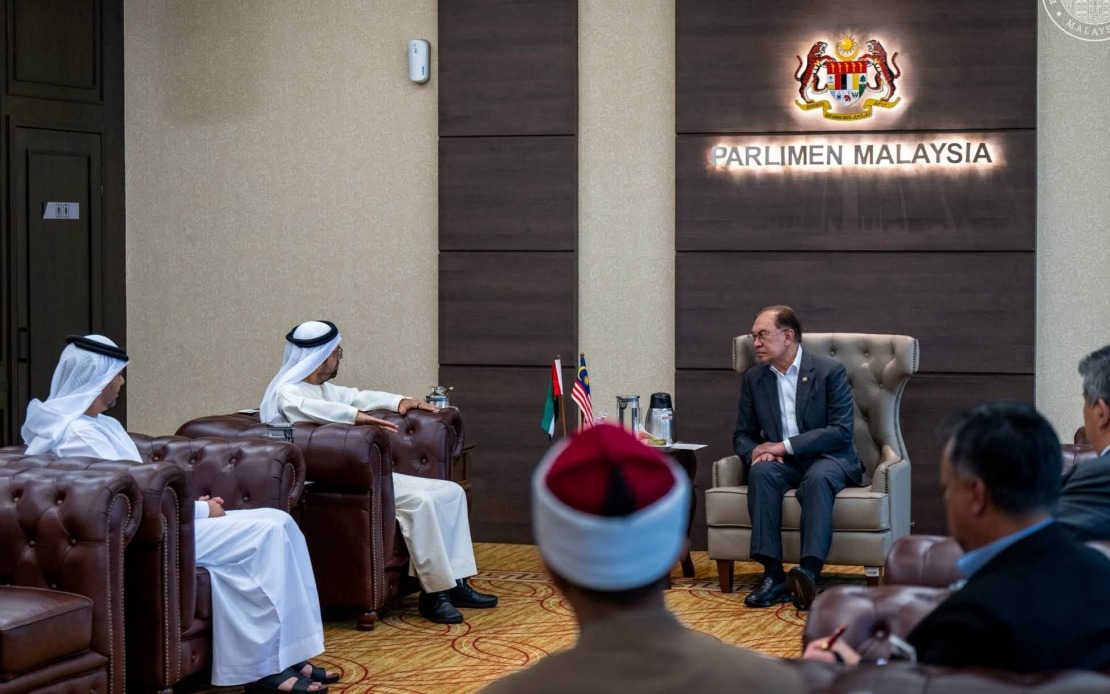
Prime Minister Datuk Seri Anwar Ibrahim has reaffirmed Malaysia's commitment to broadening its partnership with the United Arab Emirates, signalling the two nations' intention to move beyond traditional diplomatic channels and into more substantive areas of mutual interest. The declaration came during a meeting with Dr Ali Rashid Al Nuaimi, chairman of the Defence, Interior and Foreign Affairs Committee of the UAE's Federal National Council, at Parliament House in Kuala Lumpur on July 8.
The timing of this engagement reflects the growing strategic importance both nations place on their relationship within an increasingly complex geopolitical environment. Rather than limiting discussions to ceremonial exchanges, the two governments have identified concrete areas where collaboration can generate tangible benefits. This pragmatic approach suggests a maturation in how Malaysia and the UAE view their partnership, moving from bilateral goodwill gestures towards frameworks that address shared challenges and opportunities.
One of the most significant aspects to emerge from the discussions concerns the role of artificial intelligence in modernising government operations and defence capabilities. Anwar expressed particular interest in the UAE's institutional experience in making AI literacy mandatory for ministers and senior officials, viewing this as a model that could inform Malaysia's own approach to preparing its leadership for rapid technological advancement. This recognition reflects a broader regional trend where Southeast Asian nations are increasingly conscious of the need to equip their governance structures with digital-age competencies.
The UAE's proactive stance on AI governance represents a departure from traditional capacity-building approaches and demonstrates how smaller, technologically advanced nations can exercise soft power through institutional innovation. By sharing this experience with Malaysia, the UAE positions itself as a knowledge partner rather than merely a trade or investment counterpart. For Malaysia, adopting similar mandatory training frameworks could enhance the effectiveness of policy responses to emerging technological challenges while signalling to the private sector that government is serious about bridging digital capability gaps.
Beyond technological cooperation, both nations took the opportunity to discuss pressing geopolitical developments affecting the broader Middle East and Indo-Pacific regions. The conversation touched on the escalating tensions between the United States and Iran, a subject of considerable concern for maritime nations like Malaysia that depend on freedom of navigation through strategically vital waterways. The heightening of these tensions carries implications for regional security architectures and could necessitate closer coordination among countries committed to maintaining stability in shared strategic spaces.
For Malaysia, engagement with the UAE on such matters serves multiple purposes. It provides direct insights into how Gulf actors perceive emerging threats and opportunities, information that can inform Malaysia's own foreign policy positioning. Simultaneously, it demonstrates to regional and international actors that Malaysia maintains substantive relationships with key Middle Eastern players, enhancing its credibility as a nation capable of engaging across multiple geopolitical zones. The UAE, for its part, benefits from Malaysia's perspective as a major Southeast Asian economy with significant Muslim-majority credentials, lending weight to its regional diplomacy.
The emphasis on regional peace, stability and prosperity in the Prime Minister's closing remarks underscores a shared understanding that the two nations' interests are fundamentally aligned when it comes to maintaining an international environment conducive to trade, investment and development. Both Malaysia and the UAE have economies substantially dependent on global commerce and open sea lanes, making them natural partners in advocating for rules-based international order and de-escalation of regional conflicts.
Cooperation in the defence sector, while not explicitly detailed in the Prime Minister's remarks, forms an implicit strand of the broader partnership. The UAE's military modernisation programmes and technological advancement mean there are natural opportunities for equipment sales, training arrangements and intelligence sharing that could benefit Malaysia's armed forces. Such defence cooperation, when conducted transparently and within established international frameworks, strengthens both nations' security postures and creates additional channels for institutional-level dialogue.
The presence of the UAE Federal National Council delegation at this level of Malaysian governance also carries institutional significance. The Federal National Council, while primarily consultative, represents various constituencies and stakeholder groups within UAE society, suggesting that this engagement reflects broader societal and institutional interests rather than narrow governmental preferences. This gives the cooperation framework a more durable foundation, as it suggests buy-in from multiple levels within both polities.
Looking forward, the trajectory outlined by these discussions suggests Malaysia should expect more formal mechanisms for cooperation to emerge in coming months. Joint working groups on AI governance, defence technology partnerships, and regional security dialogues could all logically flow from this foundation. Such structured frameworks would transform the relationship from periodic high-level visits into ongoing institutional engagement with measurable outputs and sustained momentum.
For Malaysian stakeholders across government, business and academia, the deepening UAE partnership offers practical opportunities. Educational institutions can explore collaboration with UAE counterparts in technology and governance studies. Defence contractors and technology firms might identify partnership or supply chain opportunities. Most importantly, the relationship signals Malaysia's commitment to engaging pragmatically with capable partners regardless of geography, a posture increasingly necessary as regional complexity deepens.

