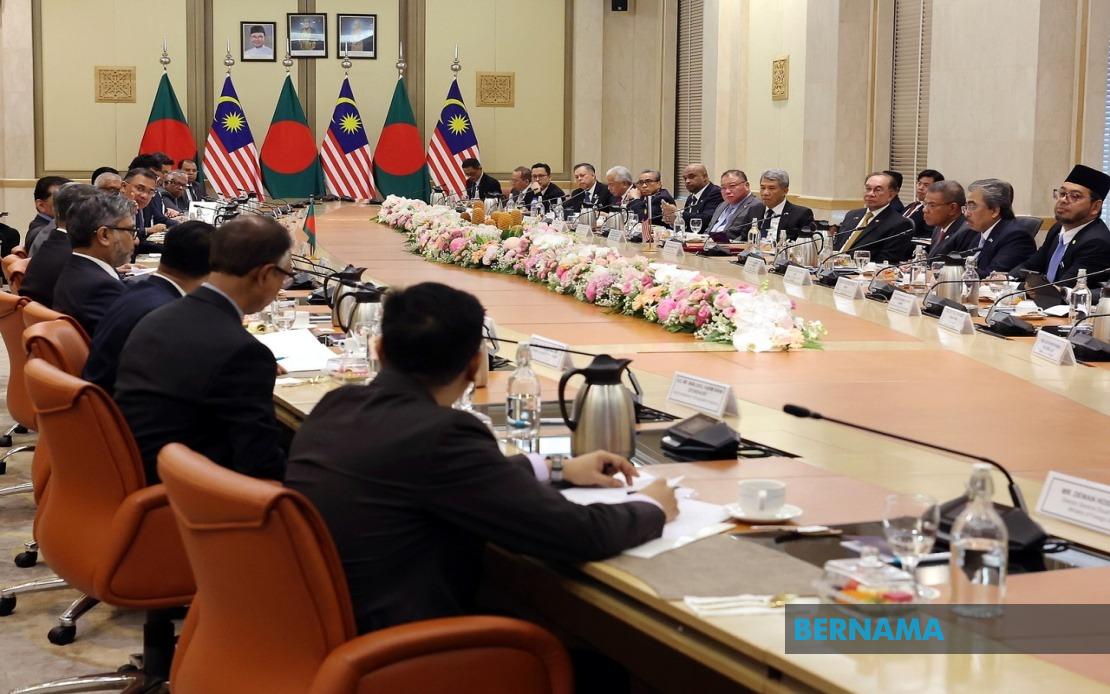
Prime Minister Datuk Seri Anwar Ibrahim has signalled a significant strategic shift in Malaysia's relationship with Bangladesh, moving bilateral engagement from conventional trade channels into cutting-edge technological domains. Speaking at a joint press conference in Putrajaya on June 22, Anwar outlined an ambitious partnership framework that positions both nations to compete in industries set to define the coming decades, particularly as regional economies race to harness transformative technologies.
The announcement came during an official two-day visit by Bangladesh Prime Minister Tarique Rahman, a high-level engagement that underscores strengthening ties between the two South and Southeast Asian economies. While both nations have maintained longstanding commercial relationships rooted primarily in agricultural trade and traditional manufacturing, the new direction reflects recognition that sustainable growth requires deeper integration in sectors where innovation drives competitive advantage.
Anwar emphasized that artificial intelligence represents a fundamental challenge and opportunity for both countries. Rather than treating AI as an abstract concept, Malaysia appears intent on building concrete collaborative mechanisms with Bangladesh to develop indigenous capability in this domain. The technology sector offers particular promise given Bangladesh's substantial pool of skilled IT professionals and Malaysia's position as a regional technology hub with established semiconductor and digital infrastructure.
The semiconductor industry emerged as a key focal point in discussions between the two leaders. This sector carries strategic importance for Malaysia, which has positioned itself as a global semiconductor hub with manufacturing capabilities and supply chain expertise. By extending cooperation to Bangladesh, Malaysia could help develop complementary capabilities across the region while simultaneously strengthening bilateral economic ties. Bangladesh's growing technical workforce and lower operational costs could make it an attractive location for semiconductor-related operations, creating opportunities for Malaysian companies to establish regional production networks.
Energy cooperation represents another dimension of expanding ties, reflecting broader regional patterns where nations increasingly recognize that energy security underpins economic stability. As both countries grapple with rising energy demands driven by industrial growth and urbanization, collaborative research and investment in renewable energy technologies and grid modernization could yield mutual benefits. Malaysia's experience in managing diverse energy portfolios, including natural gas and renewable initiatives, positions it well to share expertise with Bangladesh, which faces significant challenges in meeting growing power consumption.
The digital economy features prominently in the expanded cooperation framework, extending beyond semiconductor manufacturing into broader digital service sectors and fintech innovation. Bangladesh has emerged as a growing hub for software development and business process outsourcing, while Malaysia hosts sophisticated digital payment infrastructure and financial technology initiatives. Linking these capabilities through coordinated investment and research collaboration could create synergies that benefit both economies while positioning them more competitively against larger regional players.
During the visit, Malaysian and Bangladeshi officials formalized their commitment through several instruments. A Memorandum of Understanding on Cultural Cooperation acknowledges that deepening economic ties require complementary cultural and educational exchange. Simultaneously, two Exchanges of Notes addressing Counter-Terrorism Research and Investment Promotion and Facilitation demonstrate recognition that stable security environments and investor confidence form essential foundations for technological collaboration and business expansion.
The counter-terrorism research initiative carries particular relevance for both nations, as security challenges in the region have periodically disrupted business operations and investment flows. By formalizing research cooperation in this area, Malaysia and Bangladesh signal commitment to addressing shared vulnerabilities that could otherwise constrain the ambitious technology partnerships being developed. Investment promotion mechanisms similarly reflect practical acknowledgment that formal frameworks encouraging capital flows and technology transfer require legal clarity and institutional support.
For Malaysian policymakers, the Bangladesh engagement reflects a deliberate effort to build deeper South and Southeast Asian integration rather than concentrating exclusively on relationships with developed economies. Bangladesh's 170 million population represents a substantial market for Malaysian services and technology, while its growing manufacturing sector offers opportunities for Malaysian companies seeking regional diversification beyond traditional ASEAN partners. The country's strategic location linking South Asia to Southeast Asia adds geopolitical dimension to economic cooperation.
The timing of these announcements arrives as both nations navigate global economic uncertainty and technology competition intensifying between major powers. By positioning themselves as collaborative partners in emerging sectors rather than competitors, Malaysia and Bangladesh can pool resources and expertise to develop capabilities that neither could easily achieve independently. This approach aligns with broader regional trends emphasizing multilateral technology development and shared research infrastructure.
The semiconductor and AI domains hold particular strategic significance given global supply chain realignments and efforts by advanced economies to reduce dependence on single suppliers. Developing Bangladesh-Malaysia cooperation in these sectors could contribute to regional resilience while creating high-value employment opportunities in both nations. Advanced manufacturing capabilities supported by AI and semiconductor expertise would position the bilateral partnership to capture increasing shares of technology-intensive production as companies seek alternatives to current concentration points.
Moving forward, success in implementing these expanded cooperative frameworks will depend on effective institutional mechanisms, sustained political commitment, and tangible investment from both governments and private sectors. The formal agreements signed during Prime Minister Rahman's visit establish initial architecture, but translating diplomatic intent into operational programs requires coordinated planning, human capital development, and financial resource allocation. Both nations possess capability to execute such initiatives, given their experience managing complex regional partnerships and technology development programs.
The Malaysia-Bangladesh cooperation model may also offer insights for other developing nations seeking to build technological capacity through strategic partnership rather than pursuing isolated development strategies. By formalizing frameworks for AI research, semiconductor development, energy innovation, and digital economy advancement, both countries demonstrate that emerging economies can collaborate effectively in high-technology sectors without waiting for technology transfer from developed nations or competing wastefully for scarce expertise and investment resources.

