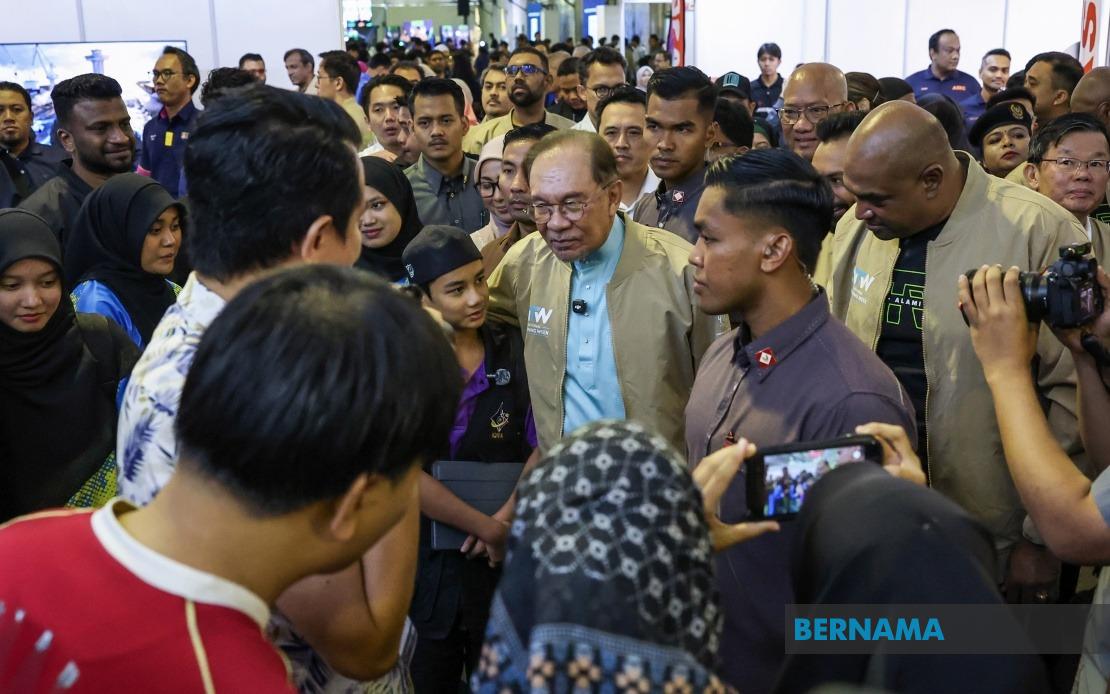
Prime Minister Datuk Seri Anwar Ibrahim has issued a stark warning that Malaysia will remain trapped in mediocrity unless its population, especially young people, abandon the polarising rhetoric and rigid thinking that has fractured national cohesion for decades. Addressing attendees at the closing ceremony of National Training Week 2026 at Universiti Teknologi MARA (UiTM) Permatang Pauh near Bukit Mertajam on July 25, Anwar articulated a vision of national progression contingent upon generational shift away from racial and divisive politics towards inclusive, forward-looking governance.
The Prime Minister's comments reflect growing concern within the MADANI Government about the persistence of polarising narratives in Malaysian political discourse. Rather than allowing such divisions to fester, Anwar emphasised that the government has deliberately chosen a path of conflict resolution through constructive dialogue and policies designed to serve all communities equitably. This approach stands in contrast to historical patterns of zero-sum political competition that have historically pitted ethnic and religious communities against one another, often at the expense of broader national interests and economic development.
Anwar specifically appealed to Malaysia's younger demographic to recognise their role as architects of the nation's future. Young people, he argued, possess both the numerical strength and intellectual capacity to catalyse meaningful transformation, but only if they consciously reject the divisive frameworks inherited from previous eras. The younger generation's potential, he suggested, lies not in reproducing old conflicts but in building bridges across traditional fault lines, thereby creating the social foundation necessary for Malaysia to compete effectively in an increasingly integrated global economy.
The timing of these remarks carries significance within Malaysia's broader political context. The MADANI Government has positioned itself as an alternative to the confrontational politics that characterised earlier administrations. By embedding calls for unity and skills development within the framework of the National Training Week—a programme ostensibly focused on workforce enhancement—Anwar sought to connect individual economic empowerment with collective national aspirations. The event's presence of Penang Chief Minister Chow Kon Yeow and Human Resources Minister Datuk Seri R. Ramanan underscored the multi-level commitment to this agenda.
Central to Anwar's address was the argument that Malaysia's competitive disadvantage globally stems partly from internal discord that diverts resources and attention away from productivity and innovation. Nations that have successfully achieved developed status, the implicit argument suggests, did so by channelling national energy into building human capital and institutional excellence rather than managing internal identity conflicts. Malaysia's trajectory, from this perspective, depends on whether its population can transcend the identity-based politics that have historically consumed political bandwidth.
The Prime Minister highlighted the government's commitment to expanding training and skills development programmes through the Ministry of Human Resources (KESUMA) and the Human Resource Development Corporation (HRD Corp). These initiatives, he indicated, represent not merely employment-focused interventions but investments in social cohesion. By equipping all Malaysians—regardless of background—with marketable skills and pathways to dignified employment, such programmes theoretically reduce the economic anxiety that often fuels divisive political mobilisation. Higher incomes and greater job security, the reasoning follows, create constituencies less susceptible to polarising messaging.
Anwar's dual role as Prime Minister and Finance Minister allowed him to anchor the unity message within Malaysia's macroeconomic achievements. He pointed to the ringgit's recent emergence as Asia's best-performing currency, record-high investment inflows, and sustained economic growth as evidence that the MADANI Government's approach—combining economic reform with inclusive policymaking—yields tangible results. These accomplishments, he suggested, would be impossible if Malaysia remained mired in the hateful politics and outdated ideologies he cautioned against.
The reference to government measures shielding citizens from rising living costs addresses a critical vulnerability in Malaysia's political economy. Real or perceived economic hardship frequently activates identity-based political mobilisation as populations seek scapegoats or in-group protection. By demonstrating that the government takes seriously citizens' material welfare, Anwar attempted to demonstrate that inclusive governance delivers concrete benefits beyond abstract appeals to unity. The framing thus transforms calls for social cohesion from moral imperatives into pragmatic economic strategy.
Anwar's invocation of the younger generation as agents of change reflects both demographic reality and political calculation. Malaysia's median age remains relatively young, and birth cohorts coming of age after 2010 have experienced less polarisation and possess greater exposure to globalised communication than their predecessors. However, these demographic advantages only translate into political outcomes if institutions and leaders actively nurture inclusive orientations. The National Training Week served as a platform for attempting precisely this cultivation, positioning skills development and national service as patriotic acts transcending narrow identity interests.
The structural challenge Anwar's remarks implicitly acknowledge is that divisive politics persist partly because they serve specific political actors and entrenched interests. Overcoming such resistance requires not only rhetorical appeals but sustained institutional reform, equitable resource distribution, and genuine devolution of power towards inclusive decision-making. Whether training programmes and economic messaging suffice to overcome these deeper structural incentives remains a consequential question for Malaysia's governance trajectory.
Looking forward, the tension between Anwar's aspirational vision and Malaysia's political reality will likely intensify as the next electoral cycle approaches. The capacity of the MADANI Government to deliver measurable improvements in living standards, employment quality, and inter-communal relations will largely determine whether the younger generation embraces the unity framework he articulated at UiTM. For Malaysia to progress as he envisions, both elite political behaviour and ordinary citizens' choices must fundamentally reorient towards prioritising collective advancement over competitive identity mobilisation—a transformation far more challenging than any single speech can catalyse.

