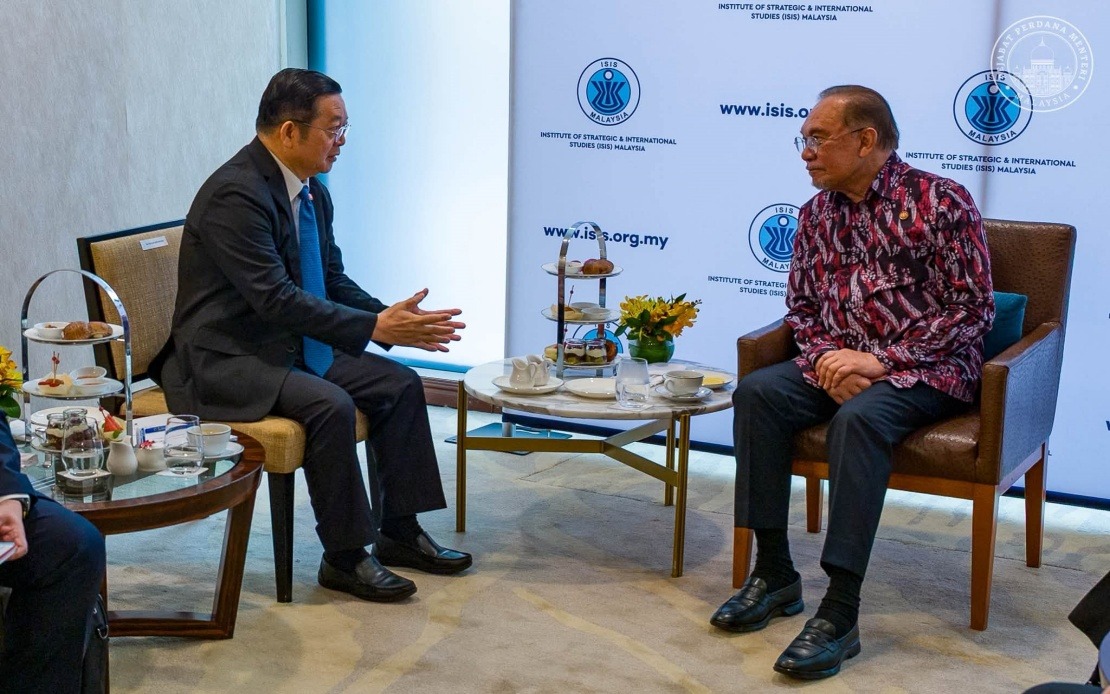
Prime Minister Datuk Seri Anwar Ibrahim has reiterated Malaysia's unwavering commitment to advancing ASEAN as a robust and inclusive regional community capable of delivering meaningful outcomes for its citizens. The affirmation came during a formal engagement with ASEAN Secretary-General Dr Kao Kim Hourn on the sidelines of the 39th Asia-Pacific Roundtable in Kuala Lumpur, where Anwar had delivered the keynote address and participated in substantive discussions on pressing regional matters.
The bilateral meeting between Malaysia's premier and the bloc's chief administrator underscored the importance both parties place on sustained dialogue amid a rapidly shifting international order. Anwar, who concurrently holds the portfolio of Finance Minister, viewed the encounter as a valuable platform for candid exchanges on matters of collective concern to the ten-member association and its broader strategic interests in maintaining regional equilibrium.
Among the substantive topics examined during the discussion were the deteriorating humanitarian and political crisis in Myanmar, which continues to strain ASEAN's consensus-building mechanisms and internal cohesion. The conversation also touched upon maritime tensions in the South China Sea, an area of persistent friction involving multiple claimants and drawing competing great-power interests that threaten regional stability and freedom of navigation.
The emergence of artificial intelligence as a transformative technology featured prominently in their exchange, reflecting growing recognition across Southeast Asia that technological advancement demands coordinated regional approaches to governance, ethical deployment, and ensuring equitable distribution of benefits. The digital revolution presents both opportunities for development and risks that transcend national borders, making multilateral coordination essential for the bloc's collective prosperity.
Anwar highlighted the significance of managing Timor-Leste's full integration following its accession to ASEAN, a milestone that expanded the bloc's membership to ten nations but also introduced new dynamics requiring careful institutional navigation. The post-accession phase demands coordinated efforts to ensure the newest member can effectively participate in regional mechanisms while maintaining ASEAN's operational efficiency and decision-making processes.
The implementation trajectory of ASEAN Community Vision 2045 represented another focal point of their dialogue. This ambitious blueprint, which guides the bloc's long-term development, encompasses economic integration, social progress, environmental sustainability, and political-security cooperation. Assessing progress and identifying obstacles to achieving these interconnected objectives remains critical for determining whether ASEAN can realise its aspirations for shared prosperity and enhanced competitiveness in an increasingly multipolar world.
The ramifications of the ongoing conflict in West Asia occupied significant space in their deliberations, reflecting awareness that geopolitical turbulence far beyond Southeast Asia's borders inevitably influences regional stability, security perceptions, and economic dynamics. Supply chain disruptions, maritime route vulnerabilities, and potential shifts in power alignments stemming from Middle Eastern developments all carry consequences for ASEAN members' development trajectories and strategic calculations.
Anwar underscored that ASEAN must remain steadfastly committed to foundational principles of unity, centrality, and deepened cooperation to sustain the region's trajectory toward peace, stability, and shared prosperity. The principle of ASEAN centrality—positioning the bloc as the driving force in regional architecture and decision-making—faces mounting pressures from extra-regional powers seeking influence and from internal disparities in development levels and strategic interests among member states.
Malaysia's emphasis on these principles reflects its consistent advocacy for preserving ASEAN's agency and relevance amid great-power competition. As a middle-power player with significant economic and diplomatic influence within the bloc, Malaysia has historically championed inclusive frameworks that prevent any single nation or external actor from dominating regional outcomes. The country's geographic position, historical ties to multiple ASEAN partners, and role in regional economic corridors afford it considerable leverage in shaping collective stances on contentious issues.
The timing of this reaffirmation carries particular weight given the mounting complexities confronting the association. ASEAN grapples simultaneously with internal cohesion challenges, external pressure from major powers, economic headwinds, climate vulnerabilities, and the imperative to integrate new members while maintaining institutional coherence. Anwar's emphasis on constructive engagement signals Malaysia's readiness to contribute actively to resolving these multifaceted challenges through dialogue and consensus-building, ASEAN's hallmark operational approach.
Looking ahead, Malaysia's sustained commitment to ASEAN strengthening remains crucial for the bloc's capacity to navigate an increasingly contested regional environment. As an economy deeply integrated into regional supply chains and a nation whose security is fundamentally linked to Southeast Asian stability, Malaysia has tangible interests in ensuring ASEAN remains effective, legitimate, and capable of serving member states' collective aspirations. The convergence of Malaysia's demonstrated commitment with its material capacity to support regional initiatives positions the country as a reliable partner in advancing ASEAN's institutional development and strategic resilience during a historically consequential period for the association's future trajectory.

