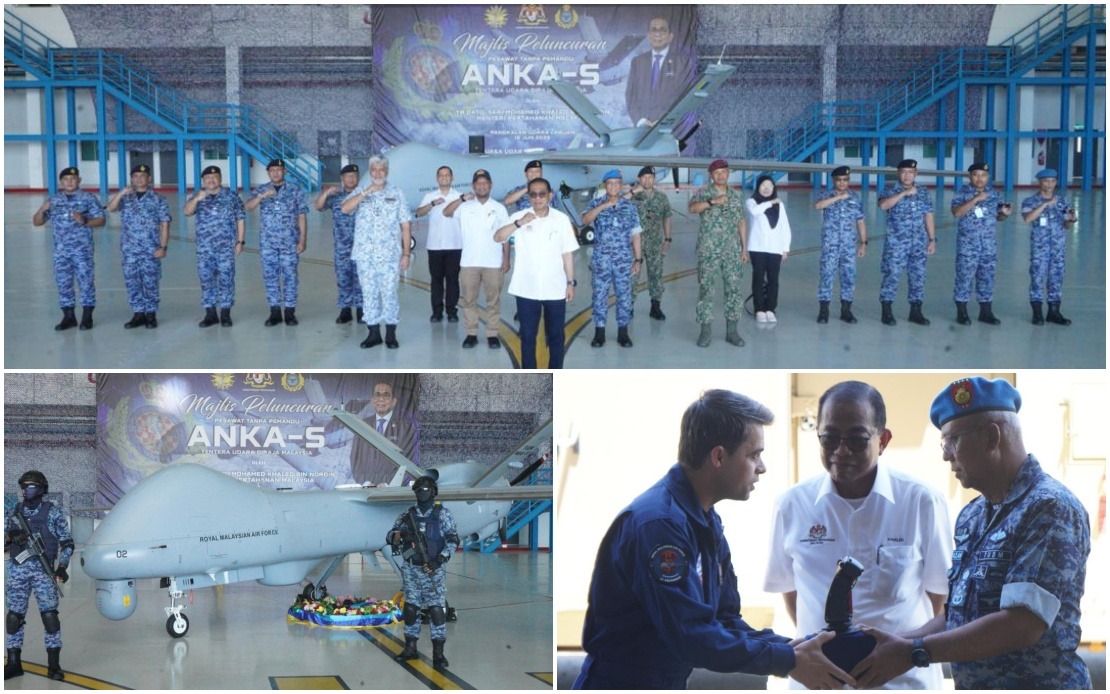
The Royal Malaysian Air Force has officially activated its ANKA-S Unmanned Aircraft System, marking a significant advancement in the nation's capacity to monitor one of the world's most strategically important and contested maritime zones. Defence Minister Datuk Seri Mohamed Khaled Nordin unveiled the system at the RMAF Labuan Air Base, describing it as a transformative development that addresses longstanding gaps in surveillance coverage across Malaysia's vast maritime territories, particularly in the South China Sea where territorial disputes and shipping activities demand constant vigilance.
The acquisition represents a substantial investment of RM423.8 million for three aircraft, inclusive of ground control infrastructure and comprehensive two-year personnel training programmes. This financial commitment reflects the defence establishment's determination to modernise its surveillance apparatus and reduce reliance on more resource-intensive platforms such as crewed fighter jets or large naval vessels for patrol duties. The medium-altitude, long-endurance configuration of the ANKA-S platform enables continuous operations that would be prohibitively expensive if conducted through conventional manned aviation assets.
Operationally, the ANKA-S demonstrates impressive technical specifications that directly address Malaysia's surveillance requirements. The system can maintain flight operations exceeding 24 hours at altitudes reaching 30,000 feet, providing persistent observation capabilities across expansive geographic areas. This extended endurance translates to more efficient use of defence resources, eliminating the need for unfocused patrols that consume fuel and personnel time without generating actionable intelligence. The aircraft functions effectively across diverse weather conditions, a critical advantage in Southeast Asia's tropical climate where monsoon patterns and sudden meteorological changes frequently disrupt conventional air operations.
The intelligence-gathering capacity of the platform extends beyond mere visual detection. The ANKA-S incorporates sophisticated sensor systems capable of identifying and tracking vessel characteristics with sufficient precision to enable targeted responses to maritime intrusions or suspicious activities. This advancement permits the Royal Malaysian Air Force and allied maritime agencies to allocate limited assets strategically toward genuine security concerns rather than conducting speculative sweeps across open water. The data exploitation capabilities demonstrated at the launch indicate integration with modern command and control infrastructure designed to process intelligence in near-real time.
Significantly, Malaysian defence planners have consciously maintained the ANKA-S in an unarmed configuration despite the aircraft's technical capacity to carry weaponry. This deliberate choice carries diplomatic weight in a region where military buildups and capabilities are closely scrutinised. Mohamed Khaled explicitly framed this restraint as a signal that Malaysia's defence posture remains fundamentally protective and non-threatening, designed solely to preserve national sovereignty rather than project offensive capability. This positioning proves particularly relevant given historical sensitivities surrounding defence acquisitions in the South China Sea, where neighbouring nations and external powers monitor military developments with considerable interest.
The deployment to Labuan Air Base reflects strategic geographic positioning that extends Malaysia's effective surveillance reach northward across contentious waters. Labuan's location enables the ANKA-S to conduct operations across maritime zones critical to national interests whilst maintaining operational flexibility. The base selection suggests coordination with broader maritime security strategies, potentially linking unmanned surveillance assets with naval operations and coast guard activities to create integrated monitoring systems across Malaysia's exclusive economic zone and continental shelf claims.
Cost efficiency considerations form another compelling dimension of this capability acquisition. Compared to alternatives such as continuous rotations of fighter aircraft conducting surveillance sorties or deploying dedicated maritime patrol vessels, the ANKA-S offers substantial operational economy. The extended endurance characteristics mean fewer aircraft are required to maintain continuous coverage, whilst ground-based control reduces pilot fatigue limitations that constrain manned platform effectiveness. Over extended operational periods, these efficiency gains accumulate into significant budgetary benefits that permit reallocation of defence resources toward other priorities.
The government has already initiated planning for a second acquisition phase encompassing three additional aircraft, with formal proposals under preparation within Malaysia's national development planning framework. This expansion trajectory indicates confidence in the platform's operational value and suggests recognition that current commitments may prove insufficient for comprehensive coverage of all strategically significant maritime zones. The sequential acquisition approach permits operational learning from initial deployments to inform subsequent purchases and infrastructure development.
Regionally, Malaysia's adoption of sophisticated unmanned surveillance systems reflects broader Southeast Asian trends toward modernising defence capabilities within fiscal constraints. The ANKA-S deployment demonstrates how nations can enhance situational awareness in contested areas without necessarily escalating military tensions through weapons acquisitions. This model potentially offers instructive lessons for neighbouring countries facing similar surveillance challenges and budgetary limitations across the South China Sea and broader Indo-Pacific region.
The launch ceremony included senior defence officials spanning the navy, air force, and joint command structures, reflecting institutional coordination around this capability. This attendance pattern underscores recognition that maritime surveillance serves multiple operational constituencies beyond the air force alone, with naval and interagency applications informing operational doctrine and tasking protocols. The presence of the Defence Ministry secretary-general and Joint Forces Commander particularly indicates integration at strategic planning levels rather than purely tactical deployment.
Looking forward, the ANKA-S system establishes foundational infrastructure for increasingly sophisticated intelligence operations across Malaysia's maritime domain. Future enhancements might incorporate artificial intelligence applications for autonomous target detection, expanded sensor suites, or enhanced data integration with other surveillance platforms operating across Malaysian waters. The initial deployment provides operational experience that will inform technological roadmaps and capability development in coming years.
For Malaysian policymakers, this capability addresses documented surveillance gaps that have constrained responses to maritime incidents ranging from illegal fishing and smuggling to more serious security concerns. The improved situational awareness enables more informed decision-making regarding deployment of limited maritime enforcement assets and contributes to evidence-based national security policy formulation. Ultimately, the ANKA-S represents not merely an equipment acquisition but a strategic shift toward technologically sophisticated maritime domain awareness that supports Malaysia's interests in one of Asia's most contested waters.