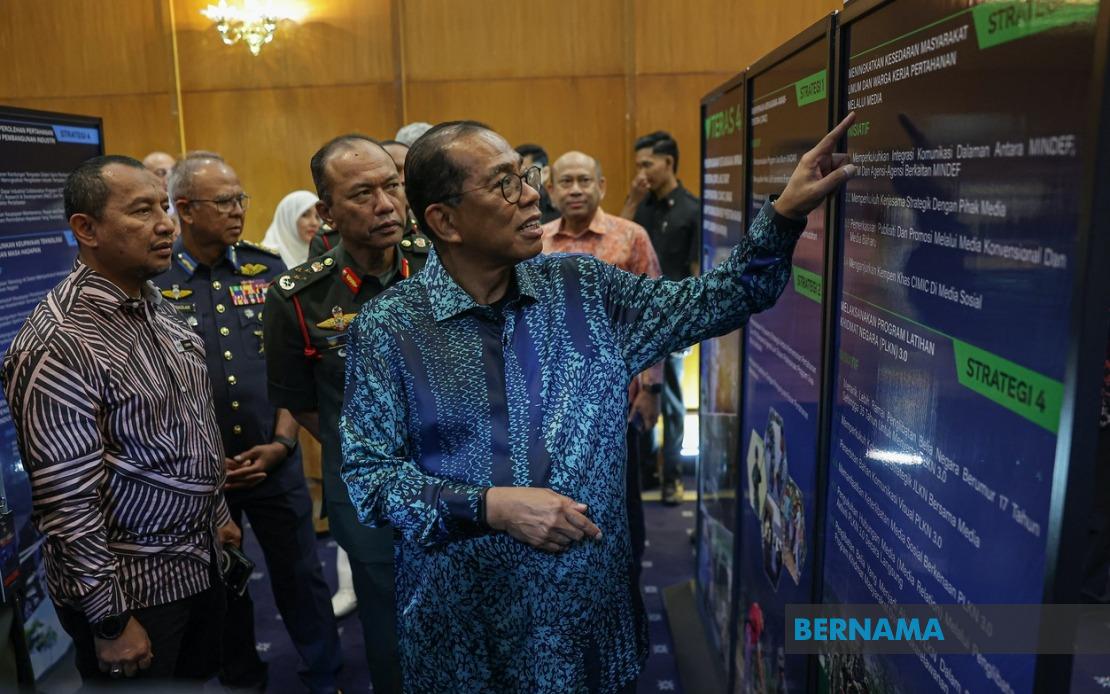
Malaysia's Defence Ministry has introduced a comprehensive strategic framework aimed at reinforcing the country's defence capabilities over the next five years, responding to an increasingly complex and unpredictable global security environment. The National Defence Strategic Plan (PSPN) and Defence Capacity Blueprint (RTKP) for 2026-2030, unveiled on June 25 by Defence Minister Datuk Seri Mohamed Khaled Nordin, represent a coordinated effort to ensure the nation's armed forces remain capable of addressing both traditional military threats and emerging security challenges.
The dual framework builds upon the existing Defence White Paper, serving as a mechanism to translate long-term strategic objectives into concrete operational capabilities and resource allocation. Rather than establishing entirely new principles, the PSPN consolidates the Defence Ministry's vision through seven strategic pillars that span operational readiness of the Malaysian Armed Forces, upgrading defence technology and systems, personnel welfare and veteran support, and cultivating innovation within the defence sector. This structured approach acknowledges that strategic planning without corresponding capacity development remains merely aspirational, necessitating the complementary RTKP to bridge the gap between ambition and implementation.
The global strategic environment has shifted markedly in recent years, presenting Malaysia with multifaceted security considerations that extend far beyond conventional military threats. Growing geopolitical instability, particularly in the Indo-Pacific region where competing great power interests intersect, has elevated regional tensions and created unpredictability for smaller nations. Simultaneously, rapid technological advancement—especially artificial intelligence, autonomous systems, and cyber capabilities—has fundamentally altered the character of potential conflicts. The Defence Ministry's acknowledgment of these dynamics reflects a realistic assessment that Malaysia cannot operate in isolation from broader regional and international developments, requiring defence planning that remains sufficiently flexible to accommodate unforeseen contingencies.
Beyond technological and geopolitical dimensions, the ministry has identified non-traditional security threats as increasingly demanding attention and resources. These encompass transnational organised crime, maritime piracy, human trafficking, environmental degradation, and pandemic-related disruptions—challenges that conventional military force alone cannot address effectively. The strategic framework's emphasis on inter-agency coordination and a whole-of-society approach implicitly recognises that national security transcends the Defence Ministry's purview, requiring coordinated responses from law enforcement, intelligence services, maritime authorities, and civilian government agencies. This represents a maturation of Malaysia's security thinking, moving beyond siloed institutional responses toward integrated national strategies.
The PSPN's seven strategic pillars provide structure to defence planning across multiple dimensions. Operational readiness remains paramount, ensuring the Malaysian Armed Forces can respond effectively to immediate threats. Simultaneously, capacity enhancement recognises that aging equipment and legacy systems must be progressively modernised to maintain comparative regional capability. Personnel welfare and veteran support address a critical but sometimes overlooked aspect of military effectiveness—experienced, motivated service personnel remain the foundation of any credible defence force, and inadequate support undermines both recruitment and retention. Defence technology and innovation focus on developing indigenous capabilities and reducing dependency on foreign equipment and expertise, a strategic imperative for any nation seeking long-term autonomy in security matters.
The Defence Capacity Blueprint acknowledges that strategy without resources remains hollow aspiration. Financial constraints have historically limited Malaysia's defence spending, and the RTKP implicitly emphasises optimising available resources through improved coordination and strategic allocation. Beyond funding, the blueprint identifies human capital as a critical capacity dimension—attracting, developing, and retaining highly skilled personnel in advanced defence technologies requires competitive compensation and meaningful career progression. Technological expertise represents another capacity pillar, reflecting recognition that modern defence increasingly depends on specialised knowledge in areas ranging from cyber security to artificial intelligence to advanced materials science. Institutional coordination across government agencies recognises that siloed operations waste resources and create gaps in national defence.
Recent equipment acquisitions illustrate the framework's practical application. The Malaysian Armed Forces received three ANKA Medium Altitude Long Endurance Unmanned Aircraft Systems in March, with these platforms now operational at Labuan Air Base. These surveillance and reconnaissance systems represent significant capability enhancement, providing extended airborne observation across Malaysia's extensive maritime exclusive economic zone. The concurrent scheduled acquisition of FA-50M light combat aircraft addresses air defence gaps, while maritime patrol aircraft and additional Littoral Mission Ships strengthen coastal security capabilities. These procurement decisions, coordinated through the strategic planning framework, demonstrate how the PSPN and RTKP translate into tangible military capabilities.
The emphasis on a whole-of-government and whole-of-society approach represents important conceptual evolution in Malaysia's defence strategy. This recognises that security challenges originating from terrorism, organised crime, environmental destruction, or humanitarian crises cannot be effectively addressed through military means alone. Whole-of-society approaches implicitly engage the private sector, civil society organisations, academic institutions, and ordinary citizens in collective security thinking. For Malaysia, a multicultural nation with significant maritime interests, this integrated approach acknowledges the interconnection between economic security, social stability, environmental protection, and military capability. Disruptions in any of these domains can cascade into broader security challenges.
The Mid-Term Review process underlying these new frameworks reveals an important institutional practice—regular assessment and adjustment of strategic documents rather than treating them as static blueprints. This adaptive approach proves essential given the rapid pace of technological change and geopolitical evolution. Strategic plans that remain frozen in time quickly become irrelevant as circumstances shift. Malaysia's Defence Ministry's willingness to revise and supplement its foundational Defence White Paper through interim strategic plans and capacity blueprints demonstrates institutional responsiveness to changing conditions.
For Malaysia specifically, these frameworks arrive at a moment when regional security dynamics demand heightened attention. Tensions in the South China Sea, evolving great power competition, transnational threats, and technological disruption all demand sophisticated responses calibrated to Malaysia's particular strategic position and capabilities. The country possesses significant maritime interests, considerable international trade dependencies, and a geographic position that makes regional stability essential to national prosperity. The PSPN and RTKP must therefore balance multiple imperatives—maintaining credible deterrence capabilities, preserving regional stability, protecting maritime commerce routes, and managing non-traditional security threats—within necessarily constrained budgets.
Implementation will ultimately determine whether these frameworks translate strategic vision into operational reality. The Defence Ministry faces the ongoing challenge of securing adequate budget allocations in competitive fiscal environments, recruiting and retaining highly skilled personnel in competitive labour markets, and fostering inter-agency cooperation across institutional interests and bureaucratic divisions. Success requires sustained political commitment, consistent funding, and genuine institutional coordination. The frameworks themselves represent necessary but insufficient conditions for strengthened defence preparedness—their value depends entirely on rigorous implementation and continuous monitoring against measurable objectives.
The broader implication for Malaysia and the Southeast Asian region suggests recognition that security challenges have grown too complex and interconnected for isolated responses. Nations across the region face similar pressures—technological disruption, geopolitical uncertainty, non-traditional threats, and constrained defence budgets. Malaysia's integrated strategic approach, emphasising both military and non-military dimensions of security while stressing whole-of-government coordination, offers a model potentially relevant for regional partners navigating comparable challenges. Whether Malaysia successfully executes these frameworks will provide valuable lessons for defence planning throughout Southeast Asia.

