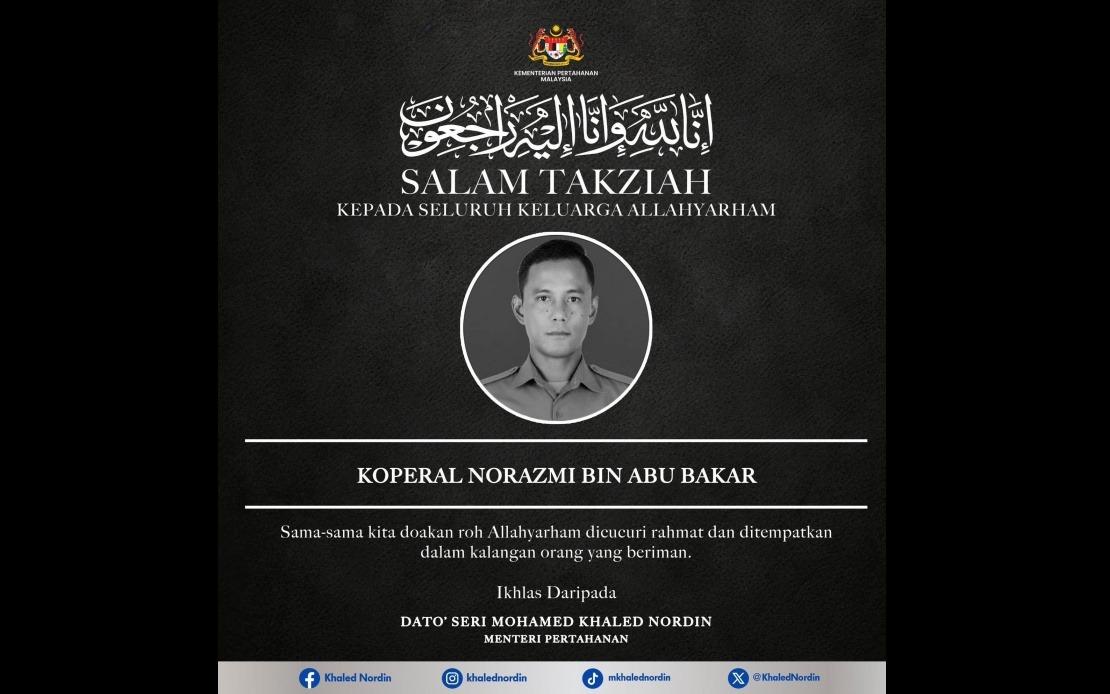
The Malaysian Defence Ministry and government have extended their condolences to the families of two service members who lost their lives in a training accident on June 16. Corporal Norazmi Abu Bakar of the 6th Battalion, Royal Malay Regiment, and Private Siti Khadijah Sungip of the 1st Squadron, Royal Army Engineers Regiment, were fatally injured during a grenade-throwing exercise at Hobart Camp firing range in Gurun, Kedah.
Defence Minister Datuk Seri Mohamed Khaled Nordin released a statement expressing profound sorrow over the incident and calling for prayers on behalf of the bereaved families. The minister conveyed the government's support during this difficult period, praying that the families would find the strength and inner fortitude needed to endure their loss. In his social media post, he invoked religious sentiment, requesting that Allah SWT grant mercy to the souls of the deceased service members, forgive their transgressions, and welcome them among His righteous servants.
According to the Malaysian Army, both personnel sustained severe injuries when an explosion occurred at approximately 10:57 am during the training activity. Despite immediate assistance, they succumbed to their injuries while being transported to Sultan Abdul Halim Hospital in Sungai Petani. The incident marks a sobering reminder of the inherent dangers military personnel face even during routine training operations, where equipment handling and procedural adherence are critical safeguards.
The tragic event has prompted swift action from military leadership. Army Chief General Tan Sri Azhan Md Othman has mandated a comprehensive investigation to establish the circumstances and underlying causes of the blast. Such inquiries are standard protocol following fatal accidents at training facilities, seeking to identify whether the incident resulted from equipment malfunction, human error, procedural lapses, or other contributing factors.
Training accidents, though statistically uncommon given rigorous safety protocols, underscore the operational risks inherent in military service. Grenade-throwing exercises, while essential for combat readiness, demand precise execution and strict adherence to established safety procedures. The incident will likely prompt a review of training protocols at Hobart Camp and potentially across other Malaysian Army facilities, ensuring all safeguards remain adequate and consistently enforced.
For Malaysia's defence establishment, such losses carry particular significance given the relatively small standing military and the close-knit nature of unit communities. Service members and their families frequently maintain deep bonds formed through shared training experiences and operational duties. The death of two personnel, regardless of rank, reverberates through their units and broader military circles, affecting morale and reinforcing awareness of occupational hazards.
The involvement of the Royal Army Engineers Regiment and the Royal Malay Regiment highlights how training activities cut across multiple specialist branches. Both units maintain critical roles within Malaysia's defence architecture, with engineers providing essential support for infrastructure and operations while infantry battalions form the backbone of ground forces. The loss of trained personnel, particularly those with operational experience, represents a loss to overall military capability.
From a broader Southeast Asian perspective, military training accidents remain a persistent concern across regional defence forces. Nations throughout ASEAN regularly conduct similar exercises to maintain combat effectiveness, and any incident serves as a cautionary reminder for neighbouring militaries to reinforce their own safety measures. International military cooperation often includes sharing best practices regarding training safety and accident prevention, and Malaysia's investigation findings may inform regional discussions on maintaining operational readiness while minimising personnel risk.
The government's swift public response and commitment to investigation reflect institutional responsibility and transparency. Such openness can help restore public confidence in military leadership and demonstrate that service member safety receives serious institutional attention. Families of the deceased will likely expect thorough findings and potential implementation of corrective measures to prevent similar tragedies.
Moving forward, the Malaysian military will balance the imperative for realistic, challenging training with enhanced protective measures. Equipment inspection protocols, procedural refresher training, and environmental assessments at firing ranges may be intensified to prevent future incidents. Additionally, counselling and support services for affected units will become essential, addressing the psychological impact on service members who witnessed or knew the victims.