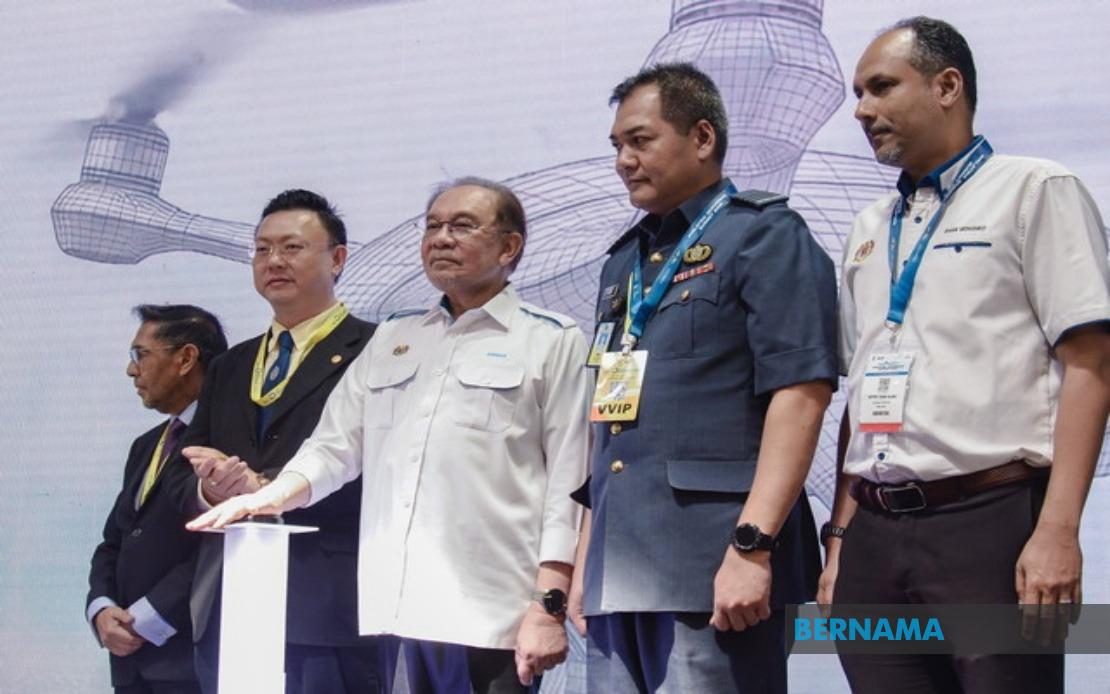
Malaysia must move decisively to capture opportunities in the unmanned aerial vehicle sector, Prime Minister Datuk Seri Anwar Ibrahim declared at the closing of MyDrone Expo 2026 in Sepang on June 27, emphasising that technological advancement in drones represents a critical pathway to economic prosperity. Speaking to thousands of industry delegates and exhibitors from 46 countries gathered for the three-day exposition, Anwar framed drone technology not as an isolated industrial pursuit but as a fundamental lever for transforming Malaysia's competitive standing on the global stage.
The drone industry's significance extends far beyond the aviation sector itself. Anwar highlighted that unmanned systems intersect with artificial intelligence and digital transformation—two fields where Malaysia has already begun establishing expertise. This convergence creates multiple points of innovation and deployment, ranging from defence applications to agricultural productivity, manufacturing optimisation and infrastructure monitoring. By positioning drones as part of a broader technological ecosystem rather than a standalone industry, Anwar signalled the government's understanding that success requires integrated investment across complementary fields.
The scale of opportunity is substantial and increasingly difficult to ignore. The global UAV market is anticipated to exceed USD55 billion by 2030, representing a sevenfold expansion from current valuations. Concurrently, the low-altitude economy—the emerging commercial space where drones operate—is attracting significant capital investment globally. For Malaysia, a nation seeking to diversify beyond traditional economic pillars and compete with more technologically advanced neighbours, this represents a window of opportunity that narrows with each passing year as other countries consolidate their positions.
Recognising these dynamics, Anwar has tasked Cabinet ministers, policymakers, research institutions and regulatory agencies with providing comprehensive support to the sector. The directive reflects a whole-of-government approach essential for building competitive advantage in advanced technology fields. Regulatory support carries particular weight, as countries with clear, predictable and innovation-friendly drone frameworks have consistently attracted more investment and talent than those with restrictive or ambiguous rules.
The government's commitment extends beyond general statements to specific interventions. Anwar identified several concrete action areas: improving the regulatory framework to enable rather than obstruct innovation; enhancing research funding to support local technological development; and establishing testing and certification infrastructure that allows Malaysian companies and researchers to validate solutions without depending on foreign facilities. These measures address fundamental bottlenecks that can either accelerate or stall technological development.
Significantly, Anwar stressed that government support encompasses both defence-oriented and civil applications. While military and aerospace applications often receive priority in technology development discussions, the premier highlighted agricultural drones, plantation management systems and productivity-enhancing commercial uses. This inclusive framing expands the addressable market beyond defence procurement to encompassing civilian enterprises that collectively represent larger economic value and employment potential.
The MyDrone Expo 2026 itself provided tangible evidence of sector momentum. Surpassing organiser expectations, the event featured more than 100 exhibition booths and drew participants spanning 46 countries. This international participation underscores Malaysia's potential emergence as a regional hub for drone technology—a position that requires not merely technological capability but also market credibility and institutional capacity to attract global players. The exposition was co-organised by the World UAV Federation Malaysia Chapter and the Malaysia UAV Development Association, highlighting the institutional infrastructure already developing around this sector.
Building a sustainable competitive advantage in drones demands cultivation of talent alongside infrastructure and regulation. Anwar called for strengthened collaboration between private industry, government research institutions and universities to establish a comprehensive talent pipeline. He explicitly referenced existing Malaysian expertise in artificial intelligence and quantum computing faculties as models for replication in drone and related technologies. This approach acknowledges that technological sectors require not one-time innovation but continuous human capital development—the supply chain of skilled engineers, researchers and entrepreneurs essential for sustained progress.
For Malaysian manufacturers and service providers, government backing opens possibilities across multiple value-chain segments. Rather than competing at the frontier of drone design—where entrenched international players possess advantages—Malaysian firms could specialise in components, subsystems, applications software, data analytics, regulatory compliance services or regional distribution. The expo's international attendance suggests demand for regional capabilities tailored to Southeast Asian geography, climate and regulatory environments.
The timing of Anwar's emphasis on drone technology reflects broader patterns in global economic competition. Nations from Israel to China to Singapore have recognised that emerging technology sectors offer pathways to economic transformation for countries willing to invest strategically. Malaysia's advantages—geographic location, existing manufacturing capabilities, developing digital infrastructure and technical education capacity—position it to move faster than many developing nations, provided policy implementation matches policy rhetoric.
The challenge ahead involves translating announced support into consistent investment and regulatory clarity. Technology sector development requires patience, as commercial maturity typically requires five to ten years from initial government backing. Equally important is ensuring that regulatory frameworks enable rather than constrain experimentation, a balance that demands sophisticated policymaking and ongoing dialogue between government, industry and academic institutions.

