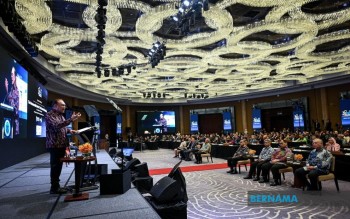
Prime Minister Datuk Seri Anwar Ibrahim has outlined a strategic imperative for Malaysia to establish dedicated sovereign cloud infrastructure capable of protecting sensitive national security data and personal information as Southeast Asia's reliance on digital technologies intensifies. Speaking at the 39th Asia-Pacific Roundtable in Kuala Lumpur, Anwar framed this initiative not as isolationism but as a pragmatic balancing act—one that allows Malaysia to remain attractive to foreign investment while defending its citizens against potential exploitation by foreign corporate interests.
The catalyst for Anwar's position stems directly from the United States Cloud Act, a legislative framework that grants American technology companies legal authority to access data stored on their servers regardless of where that data originates. Anwar was candid about the implications, noting that President Trump's administration has asserted the right for US-established companies to penetrate networks and retrieve data from countries where they operate. Rather than express futility over this arrangement, Anwar acknowledged the reality of American sovereignty while insisting Malaysia must take countermeasures appropriate to its own interests.
The sovereign cloud concept represents a middle path between two extremes that many developing nations struggle to navigate. Rather than attempting to completely sever digital ties with major technological powers or passively accepting foreign oversight of national data, Malaysia would operate firewalled systems designed specifically to house sensitive government information and personal citizen data beyond the reach of foreign corporate access orders. This architecture would theoretically allow Malaysian authorities to maintain control over how sensitive information is stored, processed, and potentially shared with foreign partners on Malaysia's own terms rather than those dictated by foreign legal frameworks.
Anwar's framing of this initiative reveals sophisticated political thinking about Malaysia's position in a multipolar digital world. He did not present the sovereign cloud as confrontational toward any particular power, nor did he suggest Malaysia would retreat from digital globalisation. Instead, he positioned it as an "ingenious" response that acknowledges fundamental constraints inherent to operating within an interconnected world while carving out protected spaces for the most sensitive assets. This language suggests Malaysia views the issue not as ideological but as pragmatic governance—akin to how nations maintain confidential defence systems even while engaging in broader international technology partnerships.
The Prime Minister acknowledged, with evident realism, that absolute protection remains impossible in a globalised, digitally interconnected world. Malaysia's commitment to democratic values and freedom of information necessarily creates openness that cannot be completely sealed. However, Anwar argued that creating rings of protection around the most critical infrastructure and personal data represents responsible stewardship. He distinguished between data that can reasonably circulate globally and data whose exposure would genuinely compromise national security or individual privacy rights.
Beyond data security, Anwar raised the parallel challenge of digital platform misuse, which he characterised as taking political, economic, personal, and sexual forms. This acknowledgment reflects growing Southeast Asian concern that digital freedom, while valuable, has created vectors for harassment, disinformation, and exploitation that disproportionately affect young people and vulnerable populations. Anwar's suggestion that "legitimate safeguards" are necessary indicates Malaysia is considering regulatory frameworks to address these harms without reverting to authoritarian censorship—a delicate distinction that many nations have struggled to maintain credibly.
Crucially, Anwar emphasised that Malaysia's push for data sovereignty does not reflect antipathy toward any major power. He explicitly noted Malaysia's attractiveness to investors from the United States, China, and Germany, signalling that the sovereign cloud initiative should not be interpreted as a signal to multinationals that their investment faces new obstacles. Rather, it represents the establishment of certain protected boundaries within which foreign corporate interests must respect Malaysian authority, while broader economic engagement continues unimpeded. This framing attempts to reassure international capital that Malaysia remains a reliable, business-friendly destination.
Anwar's positioning on Malaysia's regional role reinforced this balanced approach. He resisted characterising Malaysia as a "great power" and instead emphasised that Malaysia's strength derives not from independent might but from ASEAN's collective agency. This rhetorical move serves multiple purposes: it distances Malaysia from great-power competition while elevating the importance of regional solidarity, positions Malaysia as a voice for smaller nations' concerns, and suggests that solutions to digital governance challenges should emerge from ASEAN consensus rather than individual countries racing to align with distant powers.
The sovereignty cloud initiative also reflects deeper anxieties across Southeast Asia about technological dependency. As regional economies digitise rapidly, they have largely relied on cloud infrastructure controlled by American, Chinese, or European companies. This dependency creates vulnerabilities: during geopolitical tensions, a foreign power could theoretically restrict a country's access to its own data, leverage data access for political coercion, or extract commercial intelligence from national businesses operating through foreign cloud systems. Malaysia's proposal addresses these fears by establishing alternative pathways for the most sensitive operations.
For Malaysia specifically, implementing a sovereign cloud would require substantial technical investment, regulatory infrastructure, and expertise development. The initiative touches on broader questions about whether Southeast Asian nations should collectively develop shared cloud infrastructure—a possibility that could reduce costs and build regional technological autonomy. ASEAN has previously discussed digital cooperation, and a sovereign cloud framework could accelerate discussions about whether regional technological self-sufficiency should become a formal priority.
Anwar's statements also implicitly critique the assumption that digital globalisation must proceed on terms set by the world's largest technology companies and most powerful states. His insistence that Malaysia can simultaneously embrace global openness while protecting specific domains challenges a false binary that has often constrained policy discussions in developing countries. By proposing concrete mechanisms for this balance, Anwar offered a template that other Southeast Asian nations grappling with similar digital sovereignty questions might study closely.
The broader significance extends beyond Malaysia to how Southeast Asia positions itself in an era of intensifying great-power competition over digital infrastructure and data control. Anwar's measured tone—neither deferential to foreign powers nor aggressively nationalistic—suggested a path toward digital resilience that respects both national autonomy and global cooperation. Whether Malaysia can successfully implement this vision will test whether smaller nations can meaningfully govern their digital futures or whether structural inequalities in technological capacity will ultimately constrain their agency regardless of policy intentions.

