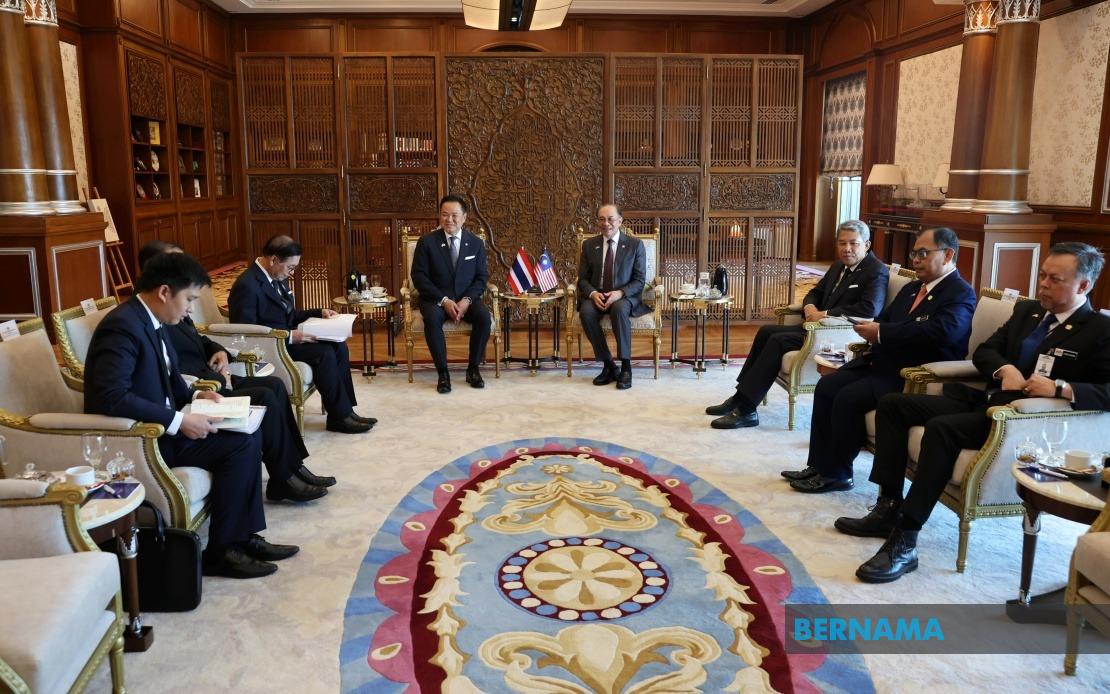
Malaysia has doubled down on its position that dialogue and constructive engagement represent the most viable path toward resolving Myanmar's ongoing political turmoil, with Prime Minister Datuk Seri Anwar Ibrahim explicitly identifying Thailand as a crucial partner in these efforts. Speaking during bilateral discussions with Thai Prime Minister Anutin Charnvirakul in Putrajaya on Thursday, Anwar underscored the importance of allowing Myanmar's population to chart their own political course rather than imposing external solutions.
The Malaysian leader's comments reflect a broader regional consensus within ASEAN that military intervention or coercive measures have limited utility in resolving Myanmar's complex internal divisions. Instead, Anwar argued that Thailand, by virtue of its geographical proximity and established relationships with stakeholders across Myanmar's political spectrum, occupies a uniquely advantageous position to facilitate the kind of sustained dialogue that might eventually produce a negotiated settlement. This framing acknowledges the reality that Myanmar's military leadership remains largely impervious to international pressure, making regional persuasion through trusted neighbours considerably more plausible than external demands for democratic restoration.
Anwar's emphasis on Myanmar's self-determination carries particular weight given Malaysia's own experiences with political instability and democratic transitions. The Prime Minister's assertion that Myanmarese citizens should independently determine their nation's future direction represents a philosophical commitment to sovereignty that resonates across Southeast Asia, where post-colonial sensitivities regarding foreign interference remain pronounced. This language also implicitly rejects external powers' unilateral approaches to Myanmar, positioning Malaysia and Thailand as advocates for an authentically regional resolution mechanism.
The Myanmar crisis has consumed considerable diplomatic bandwidth within ASEAN since the February 2021 military coup displaced the democratically elected government led by Aung San Suu Kyi. The regional organization's Five-Point Consensus, adopted in April 2021, has proven largely ineffective in producing measurable progress toward restoring civilian governance or meaningful dialogue between competing factions. Malaysia's renewed emphasis on engagement, articulated through Anwar's remarks, suggests growing recognition that ASEAN's existing frameworks require either substantive reformulation or complementary bilateral initiatives to generate tangible movement.
Thailand's particular relevance to Myanmar peace efforts extends beyond mere neighbourliness. Bangkok hosts substantial populations of Myanmar migrants and refugees, manages significant cross-border trade relationships, and maintains historical ties to various ethnic armed organizations operating within Myanmar's territories. These multifaceted connections position Thailand as a potential bridge between the military junta in Naypyidaw and opposition elements, though Bangkok's own domestic political constraints sometimes limit its freedom to pursue assertive mediation strategies. Anutin's apparent alignment with Malaysia's engagement-focused approach, as evidenced by his receptiveness to Anwar's framing, suggests potential for coordinated Thai-Malaysian diplomatic initiatives.
Beyond Myanmar, Anwar and Anutin's bilateral talks also addressed the longstanding Thailand-Cambodia border dispute, an issue that periodically threatens regional stability despite years of negotiation. Anwar's acknowledgment of Thailand's commitment to peaceful resolution, combined with his expression of confidence in the wisdom of leaders directly involved, reflects Malaysia's broader investment in maintaining Southeast Asian tranquility. These complementary concerns—Myanmar's internal conflict and Thailand-Cambodia tensions—illustrate how interconnected security challenges across the region require sustained multilateral attention and bilateral cooperation.
Anwar's diplomatic overture toward Thailand assumes particular significance given the nation's pivotal geographic location and its capacity to influence events across mainland Southeast Asia. By explicitly validating Anutin's leadership on Myanmar matters and expressing appreciation for Thailand's approach to border controversies, Malaysia signals its willingness to support Bangkok as a stabilizing force within the region. This positioning strengthens Malaysia's own diplomatic standing while potentially creating space for coordinated Malaysian-Thai initiatives that might gain greater traction with Myanmar's military leadership than purely ASEAN-level pronouncements.
The timing of Anutin's first bilateral visit to Malaysia since his reappointment in March provides an opportune moment for both governments to realign their strategic priorities and coordinate messaging on regional challenges. The scheduled joint visit to Bukit Kayu Hitam on Friday to inaugurate the newly completed road linking Malaysia's Immigration, Customs, Quarantine and Security Complex with Thailand's Customs, Immigration and Quarantine Complex represents more than ceremonial significance. Such infrastructure projects facilitate the people-to-people and commercial interactions that undergird stable bilateral relationships and demonstrate tangible progress in regional integration.
For Malaysian readers and policymakers, Anwar's statements carry implications regarding Malaysia's broader regional strategy under his leadership. The emphasis on dialogue, regional ownership of solutions, and respect for sovereignty reflects a diplomatic philosophy that prioritizes consensus-building and long-term stability over confrontational posturing. This approach aligns with Malaysia's historical role as a moderating voice within ASEAN and its commitment to conflict prevention mechanisms that privilege negotiation.
The Myanmar crisis, now approaching its fourth year without resolution, illustrates the limitations of traditional diplomatic tools when dealing with entrenched military governments resistant to external pressure. Malaysia's strategy of working through trusted regional partners like Thailand suggests recognition that incremental progress through sustained engagement may represent the only realistic pathway forward, at least in the near to medium term. Such patience, while frustrating to Myanmar's democracy advocates, reflects mature acknowledgment that premature declarations of victory or intensified external pressure often prove counterproductive in regional contexts where honour, face, and indigenous ownership of solutions carry substantial weight.
Looking forward, Malaysia's investment in supporting Thailand's mediatory role could yield dividends if Bangkok succeeds in establishing communication channels with Myanmar's military leadership while simultaneously maintaining dialogue with opposition elements. The Malaysian government's public backing of this approach provides diplomatic cover for Thailand's efforts while positioning Kuala Lumpur as a constructive regional actor committed to pragmatic problem-solving rather than ideological rigidity. Whether such engagement ultimately produces meaningful movement toward Myanmar's political resolution remains uncertain, but the coordinated Malaysian-Thai stance at minimum signals continued regional commitment to addressing one of Southeast Asia's most consequential ongoing challenges.

