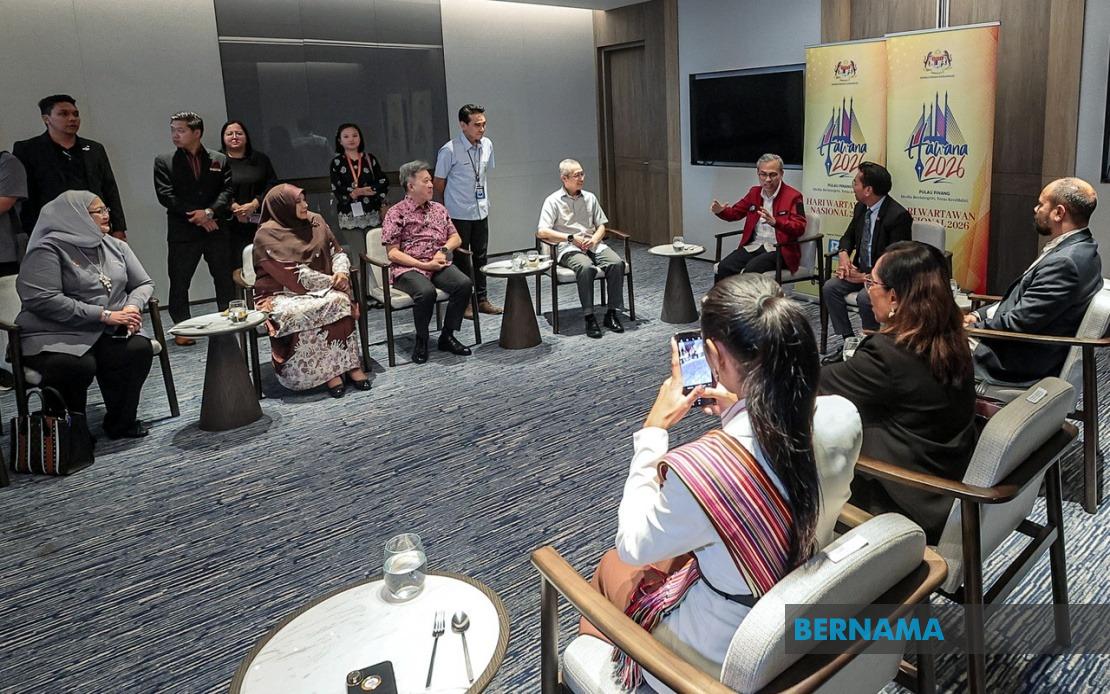
Communications Minister Datuk Fahmi Fadzil is pursuing a strategic deepening of media ties between Malaysia and Timor-Leste, envisioning expanded collaboration between the region's key broadcasting and news agencies. The initiative emerged from discussions held at the PICCA Convention Centre @ Butterworth Arena, where Fahmi met with a high-level Timor-Leste delegation comprising Secretary of State for Social Communication Expedito Loro Dias Ximenes, TATOLI (Agencia Noticiosa de Timor-Leste) president Noemio Mateus Soares Falcao, and deputy president Madalena DE JCP Carlos.
The proposed framework focuses on expanding existing partnerships between Malaysia's Bernama news agency and Radio Televisyen Malaysia with their Timor-Leste counterparts, positioning both nations as key media hubs within Southeast Asia. Fahmi articulated the ambition to move beyond routine information exchange toward substantive institutional collaboration, signalling Malaysia's intent to position itself as a regional leader in media development and innovation. This approach reflects a broader regional strategy to strengthen multilateral ties in an era where information credibility and media infrastructure have become central to national soft power and diplomatic influence.
A notable component of the cooperation framework involves capacity-building initiatives. Fahmi proposed that the Tun Abdul Razak Broadcasting and Information Institute, commonly known as IPPTAR, conduct specialised training programmes for Timor-Leste journalists. Such educational exchanges would address technical skills, editorial standards, and professional practices, creating pathways for sustained knowledge transfer across the border. This mirrors broader Southeast Asian trends where developed media systems mentor emerging ones, fostering regional expertise networks that reduce reliance on external training providers from outside the region.
The bilateral discussion touched upon a critical dimension of contemporary media policy: international press freedom rankings. Timor-Leste has achieved remarkable progress in the World Press Freedom Index compiled by Reporters Without Borders, currently ranking highest across Southeast Asia and 30th globally among 180 countries. Malaysia, meanwhile, occupies second place in the regional standings. Fahmi's acknowledgement of Timor-Leste's superior performance indicates Malaysia's willingness to learn from peer nations and suggests that press freedom improvement has become a measurable diplomatic priority rather than merely a governance footnote.
The Malaysian government's stated commitment to climbing higher in international press freedom indices represents a significant rhetorical shift from earlier administrations. Under the MADANI Government, Malaysia has reportedly registered improvements in its ranking position over the preceding three to four years. However, Fahmi's candid admission that "room for enhancement" remains suggests the administration recognises that Malaysia's trajectory, while improving, still lags behind regional peers in independent assessment frameworks. This transparency indicates a government willing to benchmark itself against comparable democracies and acknowledge competitive disadvantages.
The underlying strategy appears multifaceted. By elevating press freedom as a bilateral discussion point with Timor-Leste—rather than treating it as an isolated domestic concern—Malaysia signals that media credibility serves national interests beyond ideological considerations. Stronger regional standing in press freedom indices attracts international investment, talent, and media market participation. For Malaysia specifically, such improvements could enhance its competitiveness as a media production hub and regional journalism centre, offsetting its current second-place ranking within Southeast Asia.
Timor-Leste's elevated position in global press freedom metrics is particularly instructive for the region. Despite its younger statehood and smaller economy, the nation has apparently established institutional frameworks and political commitments that international observers recognise as protective of editorial independence. This suggests that press freedom advancement is achievable across diverse political contexts and development levels, potentially providing a developmental roadmap for regional peers. The fact that Fahmi explicitly highlighted this achievement indicates Malaysia views Timor-Leste not merely as a development partner but as a model for certain governance metrics.
The broader context involves the sixth edition of the HAWANA conference, held concurrently at the same venue. With approximately 1,000 media professionals attending from across the region and internationally, the event demonstrates Southeast Asia's growing commitment to convening on media sector challenges. The conference theme, "Media Integrity Strengthens Credibility," directly addresses concerns about misinformation, polarisation, and audience trust—issues affecting all regional democracies regardless of development stage. Malaysia's positioning as host and coordinator underscores its aspiration to lead regional discourse on these challenges.
Prime Minister Datuk Seri Anwar Ibrahim's scheduled official launch of HAWANA further elevates the political significance of media cooperation initiatives. Prime ministerial involvement signals that media governance and press freedom fall within the highest tiers of government priority. This elevation reflects global trends where democratic governments increasingly recognise media sector development as central to competitive statecraft, social cohesion, and institutional legitimacy. The Malaysian government appears to be repositioning media cooperation from a communications ministry issue to a matter of prime ministerial concern.
The delegation hosting arrangements reveal institutional depth in Malaysia's media sector. The Communications Ministry secretary-general, deputy secretary-general, Bernama leadership spanning chair and chief executive positions, the Broadcasting director-general, and Bernama's editor-in-chief all attended. This comprehensive institutional presence suggests the Malaysian government views media sector partnerships not as symbolic courtesy but as substantive professional engagement requiring senior technical expertise and policy authority.
Looking forward, the proposed initiatives carry implications for regional media industry development. Journalist training programmes could establish Malaysia as a regional capacity-building hub, attracting participants from across Southeast Asia and creating networks of professional relationships. Expanded news agency cooperation might improve information flows within ASEAN, supporting more sophisticated regional journalism. These developments, while incremental, contribute toward a more integrated Southeast Asian media ecosystem where professional standards, institutional practices, and quality benchmarks become increasingly harmonised.
The Malaysian government's pursuit of closer media cooperation with Timor-Leste simultaneously addresses two distinct but complementary objectives: it advances bilateral relations with an important ASEAN neighbour while signalling commitment to press freedom improvement. By linking media cooperation to international ranking performance rather than framing it primarily through domestic political lenses, Malaysia presents press freedom as a professional and competitive matter rather than an ideological battleground. This positioning could influence how regional governments subsequently approach media governance debates, potentially depoliticising conversations about editorial independence and institutional credibility.

