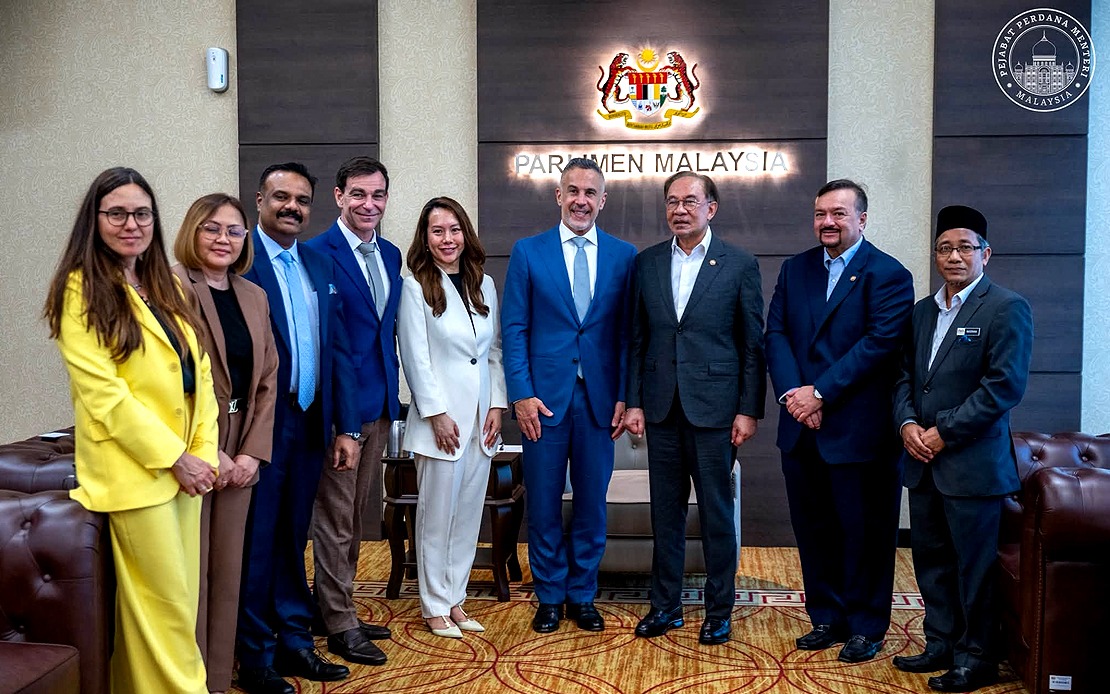
Prime Minister Datuk Seri Anwar Ibrahim has reaffirmed Malaysia's commitment to deepening collaboration with multinational enterprise software giant SAP, positioning strategic partnerships with technology leaders as essential to the nation's digital modernisation journey. During a parliamentary courtesy visit from Emanuele (Manos) Raptopoulos, SAP's President of Global Customer Success covering Europe, Asia-Pacific, the Middle East and Africa, Anwar outlined three interconnected priorities shaping Malaysia's technological strategy: accelerating digital adoption across the economy, lifting operational performance in both government and commercial sectors, and cultivating a robust pipeline of technically proficient professionals among the country's youth and emerging workforce.
The encounter underscores a broader Malaysian policy orientation toward leveraging foreign technological expertise and investment to close capability gaps and establish competitive advantages in a rapidly digitalising regional landscape. SAP's standing as a world-leading provider of enterprise applications and artificial intelligence solutions positions it as a potentially valuable institutional partner for Malaysia's transformation ambitions. The discussions held at Parliament reflect the seriousness with which the government views technology sector engagement, with high-level political visibility lending weight to the initiative and signalling investor confidence in Malaysia's commitment to digital-first governance and economic models.
Anwar's emphasis on collaboration rather than isolation reflects pragmatic recognition that Malaysia cannot independently develop the technological infrastructure and human capital required for comprehensive digital transformation. By partnering with established global players, the nation can accelerate implementation timelines, access cutting-edge applications without reinventing systems domestically, and benefit from international best practices proven in comparable markets. This approach aligns with Malaysia's historical positioning as a technology-adjacent economy, one that adopts and adapts foreign innovations rather than originating them, though recent policy discussions have increasingly highlighted aspirations toward greater innovation autonomy.
The focus on talent development particularly resonates within Malaysia's current policy environment, where skills mismatches persistently constrain both foreign direct investment attraction and domestic economic productivity. Graduate employment surveys consistently reveal gaps between academic preparation and industry requirements, particularly in advanced technical domains. Through structured partnership with SAP, Malaysia can establish training frameworks, apprenticeship schemes, and curriculum alignment initiatives that bridge this divide, potentially creating pathways for youth employment while simultaneously building organisational capacity within government and private enterprises.
Public sector digitalisation represents a significant modernisation opportunity for Malaysia, where administrative processes in many agencies remain partially manual or rely on fragmented legacy systems. Enhanced efficiency through enterprise software integration can reduce processing times, lower administrative costs, improve service delivery consistency, and strengthen data integrity across government operations. These improvements carry tangible consequences for citizen experiences, from business registration timelines to social benefit distribution and regulatory compliance processes, making digital public administration reform substantively important beyond mere technological novelty.
The private sector component of this agenda addresses Malaysia's competitive positioning against regional rivals increasingly outpacing the country in technological sophistication and operational efficiency. Singapore and South Korea have achieved deeper digital integration across their economies, generating productivity advantages that translate into export competitiveness and foreign investor preference. Malaysian companies, particularly small and medium enterprises, often lack resources and technical expertise for digital transformation initiatives, creating an opportunity for government-facilitated partnerships with technology majors to democratise access to sophisticated enterprise systems and implementation support previously available mainly to large corporations.
SAP's artificial intelligence capabilities merit particular attention within Malaysia's strategic calculus, as AI applications increasingly determine competitive outcomes across manufacturing, financial services, logistics, and customer-facing sectors. Malaysian industries adopting AI-enhanced analytics, predictive maintenance, supply chain optimisation, and personalised customer engagement can improve margins and responsiveness compared to regional competitors still operating on traditional management systems. Government endorsement of SAP collaboration effectively legitimises AI adoption among Malaysian businesses by demonstrating that technology leadership recognises artificial intelligence as essential rather than optional.
Regional competition for technology partnership presently intensifies as Indonesia, Thailand, and Vietnam simultaneously pursue digital transformation initiatives, often in direct competition for the same international vendor partnerships and investment commitments. Malaysia's articulation of clear, high-level commitment to SAP collaboration potentially strengthens its competitive position within SAP's regional strategy, potentially securing preferential resource allocation, faster product innovation deployment in Malaysian markets, and priority consideration for pilot programs and capability centres. This positioning advantage could matter significantly as technology firms make geographic investment and expansion decisions across Southeast Asia.
The sustainability dimension embedded within Anwar's framing deserves recognition, as the Prime Minister explicitly linked digital transformation to generating "sustainable and competitive economic growth." This phrasing aligns with Malaysia's stated environmental commitments and international obligations, suggesting that digital transformation discussions encompass not merely efficiency metrics but broader considerations of resource consumption, emissions reduction, and circular economy principles. Enterprise software systems increasingly incorporate environmental monitoring and sustainability reporting capabilities, enabling organisations to measure and minimise their ecological footprints while maintaining or improving operational performance.
Implementation challenges should temper optimism regarding rapid transformation delivery, as partnership announcements frequently exceed subsequent execution pace. SAP engagement requires substantial organisational change management, staff training commitments, and potentially contentious legacy system replacements. Malaysian institutions, whether government agencies or corporate entities, often demonstrate considerable inertia regarding operational transformation, reflecting institutional cultures, risk-averse procurement processes, and competing budgetary priorities. Successful delivery depends not merely on vendor commitment but on Malaysian institutional readiness to embrace the organisational disruptions accompanying genuine digital transformation.
The timing of this collaboration initiative reflects Malaysia's positioning within global technology cycles and geopolitical realignment. As technology supply chain dependencies receive heightened scrutiny and countries reconsider over-reliance on single-source providers, Malaysia's engagement with major Western technology firms like SAP represents deliberate diversification of technological partnerships. This approach maintains Malaysia's traditional alignment with Western-origin technology standards and platforms while implicitly balancing against potential concentration risks from other major technology-producing nations.
Longer-term implications extend beyond immediate efficiency gains or skill development outcomes. Successful SAP partnership could establish template models for subsequent technology collaborations, creating institutional mechanisms and expertise foundations supporting ongoing digital evolution. Malaysian experience gained through SAP implementation becomes exportable knowledge, potentially positioning the nation as a credible digital transformation mentor within Southeast Asia, attracting consulting opportunities and professional services exports. This dynamic mirrors how Singapore leveraged early technology adoption into regional thought leadership and professional services dominance.

