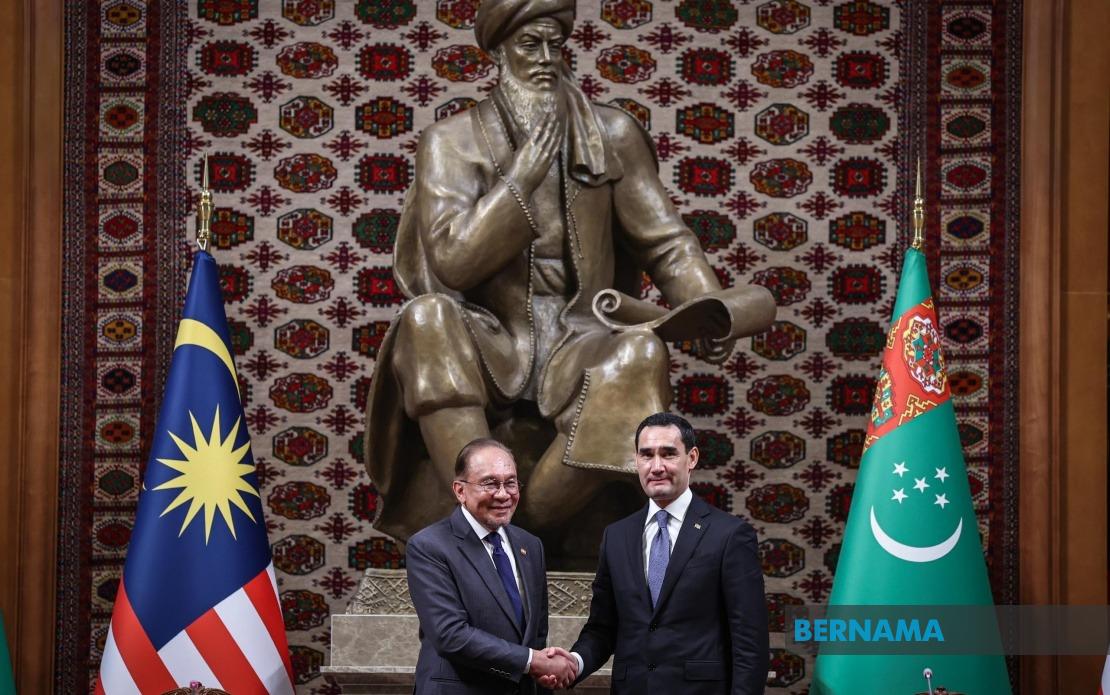
Prime Minister Datuk Seri Anwar Ibrahim and Turkmenistan President Serdar Berdimuhamedov have committed to building a more structured and forward-looking bilateral relationship that prioritises the long-term interests of both nations. The pledge came during formal discussions at the Presidential Palace in Ashgabat on Friday, where the two leaders and their delegations engaged in comprehensive talks spanning multiple economic and social dimensions. This marks a significant diplomatic engagement for Kuala Lumpur in Central Asia, signalling Malaysia's intent to expand its partnerships beyond traditional trading partners in Southeast Asia.
The substantive nature of the commitment was underscored through the exchange of multiple binding documents that lay the groundwork for expanded cooperation. Four instruments were formally signed, including an Air Services Agreement that will facilitate direct connectivity between the two nations—a critical factor for deepening people-to-people exchanges and business ties. Beyond aviation, the delegations exchanged memoranda of understanding covering institutional cooperation between Malaysia's Institute of Diplomacy and Foreign Relations and Turkmenistan's Institute of International Relations, creating formal channels for diplomatic coordination and policy dialogue that will extend far beyond individual ministerial visits.
The scope of cooperation discussed during the bilateral talks reflects both nations' recognition of complementary strengths and mutual opportunities. Energy emerged as a priority area, which carries particular significance given Turkmenistan's substantial natural gas reserves and Malaysia's regional expertise in petrochemical processing and energy trading. The inclusion of the halal industry in discussions highlights Malaysia's positioning as a global halal standards-setter and Turkmenistan's potential as a growing market for certified halal products and services. This sector represents a distinctive Malaysian competitive advantage that few regional players can replicate at scale.
Trade and investment featured prominently in the conversations, acknowledging that economic engagement typically anchors diplomatic relationships. Malaysian companies, particularly those in plantation agriculture, manufacturing, and financial services, could find opportunities in Turkmenistan's economy, which has historically relied heavily on energy exports but seeks diversification. Conversely, Turkmenistan's energy resources and strategic location along historic Silk Road corridors could open pathways for Malaysian firms to establish regional trading hubs serving Central Asian markets.
The institutional cooperation frameworks reflected in the signed memoranda deserve particular attention for their long-term implications. The agreement between Malaysia's Institute of Diplomacy and Foreign Relations and Turkmenistan's counterpart institution creates a mechanism for sustained intellectual exchange, training programmes, and collaborative research on shared regional challenges. Similarly, the cooperation between the Academy of Sciences Malaysia and the Academy of Sciences of Turkmenistan opens doors for joint research initiatives in fields where both nations possess complementary expertise, potentially in renewable energy, agricultural technology, or mineral resource management.
Education and research cooperation signals commitment to building human capital linkages that will outlast individual trade cycles. Malaysian universities have increasingly positioned themselves as destinations for Central Asian students, and formalised cooperation agreements can accelerate this trend. Turkmenistan, seeking to modernise its education systems, may benefit from Malaysian institutional expertise, whilst Malaysian researchers gain access to Central Asian academic networks and resource bases. Science and technology collaboration, as articulated in the discussions, could facilitate knowledge transfer in areas ranging from industrial processes to digital innovation.
Tourism cooperation represents another dimension with untapped potential for both economies. Malaysia's well-developed tourism infrastructure, hospitality expertise, and regional connectivity could help Turkmenistan develop its tourism sector, whilst Central Asia's cultural heritage and historical significance could attract Malaysian and Southeast Asian tourists seeking alternative destinations. The formalisation of cooperation in this area suggests both governments recognise tourism as a vehicle for economic diversification and cultural understanding.
Anwar's status as both Prime Minister and Finance Minister during this visit carries symbolic weight, suggesting Malaysia's serious economic engagement with Turkmenistan. The accompanying delegation—including Minister of Investment, Trade and Industry Datuk Seri Johari Abdul Ghani and Minister of Economy Akmal Nasrullah Mohd Nasir—reinforced the business-oriented nature of the visit. This composition indicates that Malaysia intends to translate diplomatic goodwill into concrete commercial outcomes, with government ministers present to facilitate Malaysian private sector participation in emerging opportunities.
The timing of this inaugural official visit since Anwar's appointment as Malaysia's 10th Prime Minister in November 2022 reflects deliberate diplomatic prioritisation. Rather than limiting engagement to well-established trading partners, the administration has chosen to expand Malaysia's diplomatic footprint into Central Asia, a region increasingly recognised as strategically important for future regional stability and economic development. Turkmenistan's geographical position between the Caspian Sea and Afghanistan, coupled with its energy reserves, makes it a logical anchor for Malaysian engagement in the broader Central Asian region.
Beyond bilateral dimensions, this partnership carries implications for Southeast Asia's broader relationships with Central Asian states. As ASEAN seeks to deepen engagement with external partners through mechanisms like the ASEAN Regional Forum and East Asia Summit frameworks, Malaysia's proactive bilateral diplomacy with Turkmenistan establishes pathways for potential multilateral cooperation. Energy security discussions at the regional level could benefit from stronger Malaysia-Turkmenistan ties, given Turkmenistan's hydrocarbon resources and Southeast Asia's substantial energy import requirements.
The emphasis on transparency and disciplined implementation in the agreed cooperation areas reflects lessons learned from earlier bilateral relationships where ambitious agreements failed to translate into tangible results. By explicitly committing to transparent and effective execution, both governments acknowledge that sustained partnership requires not just signed documents but operational momentum and accountability mechanisms that track progress against agreed timelines.
Looking forward, the success of this partnership will be measured not by the agreements themselves but by their implementation. Malaysian investors will need assurance regarding Turkmenistan's business environment, regulatory frameworks, and dispute resolution mechanisms. Similarly, Turkmenistan will seek evidence of Malaysian follow-through on promised trade and investment flows. The newly formalised institutional channels—particularly the diplomatic and scientific academies cooperation—will serve as important platforms for troubleshooting implementation challenges and identifying emerging opportunities for deepened engagement across sectors not yet fully explored.

