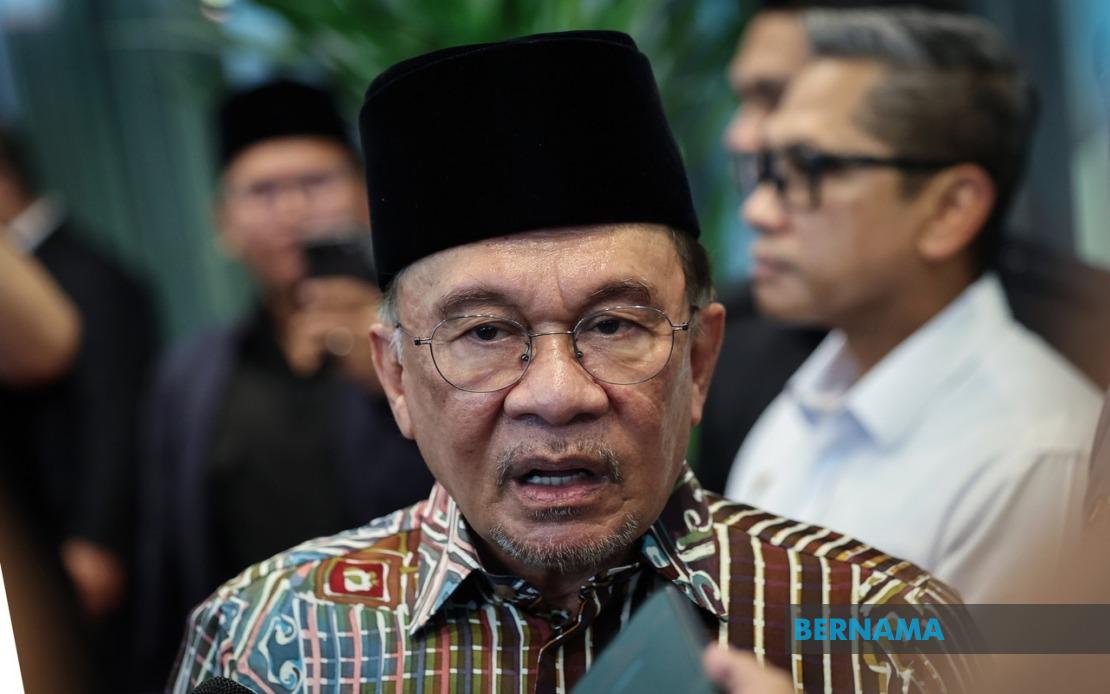
Prime Minister Datuk Seri Anwar Ibrahim has made clear that the Malaysian government maintains a zero-tolerance stance towards refugees who breach local laws, disrupt traffic, or attempt to occupy public spaces without authorisation. Speaking to reporters at the closing ceremony of the International Wakaf Dakwah Convention 2026 in Kuala Lumpur, Anwar responded to a gathering of hundreds of Rohingya refugees who had congregated outside the United Nations High Commissioner for Refugees office on Jalan Bukit Petaling earlier that day.
The demonstration, which reportedly involved refugees who had travelled to the capital on three buses from Penang that morning, prompted swift clarification from the Prime Minister's office regarding the government's approach to refugee management. Anwar emphasised that while the administration recognises the vulnerable circumstances facing those seeking international protection, such recognition does not extend to permitting behaviour that compromises urban tranquillity or public safety. His remarks underscored a fundamental principle: Malaysia's legal framework applies uniformly across all resident populations, regardless of immigration status.
In outlining the enforcement strategy, Anwar detailed specific instructions issued to multiple agencies operating under the government's purview. The Royal Malaysia Police, the Immigration Department, and municipal authorities have all been directed to adopt rigorous measures against non-compliance. This multi-agency approach reflects the government's determination to address the matter comprehensively rather than through fragmented responses. The coordinated directive signals that refugee management is now viewed as a whole-of-government concern requiring integration across border control, law enforcement, and local administration.
The Prime Minister's differentiated approach to enforcement acknowledges varying circumstances within the refugee population. Those lacking proper documentation face referral to immigration authorities, the standard pathway for processing undocumented arrivals. Conversely, individuals holding valid permits receive formal warnings before escalation to legal proceedings. This tiered response demonstrates an effort to distinguish between administrative violations and deliberate defiance, though the ultimate consequence—formal legal action—remains available for persistent offenders.
Anwar's comments reveal a tension inherent in Malaysia's refugee policy. The nation has historically hosted one of Southeast Asia's largest refugee populations, with over 180,000 registered Rohingya alone, predominantly concentrated in camps and urban settlements. Yet successive administrations have struggled to balance humanitarian obligations with public order concerns, particularly as urban refugee populations expand into residential and commercial districts. The UNHCR gathering illustrates how advocacy, protest, and direct action by refugee communities occasionally strain the delicate equilibrium policymakers attempt to maintain.
The emphasis on disrupted traffic in Anwar's remarks is significant, suggesting that the demonstration's impact on urban mobility triggered the firm governmental response. Malaysia's major cities already contend with substantial congestion and infrastructure pressures; refugee gatherings that exacerbate traffic flow issues directly affect the commuting public and business operations. By framing refugee activities through the lens of public inconvenience rather than humanitarian need alone, government messaging appeals to the concerns of ordinary residents who may not perceive refugees primarily as vulnerable populations meriting protection.
This positioning carries implications for broader social cohesion. As refugee populations become more visible through demonstrations and gatherings, local communities often respond with growing scepticism about integration and coexistence. The government's enforcement-focused messaging, while addressing immediate order concerns, may inadvertently reinforce perceptions of refugees as problems to be managed rather than individuals requiring assistance. Balancing security and social order with protection responsibilities remains an ongoing challenge for Malaysian policymakers.
Anwar's clarification that refugees must seek UNHCR protection while adhering to Malaysian law frames the government's position as one of conditional tolerance. The acknowledgment that some refugees legitimately approach the UNHCR office for asylum processing concedes the legal basis for their presence and activities, yet simultaneously insists such legitimate refugee status does not exempt them from national regulations. This interpretation positions refugee rights within strict subordination to sovereign law enforcement, a principle that, while legally sound, potentially limits the scope for refugees to exercise agency or voice grievances through collective action.
The broader Southeast Asian context illuminates Malaysia's refugee policy challenges. Thailand hosts approximately 900,000 refugees, while Indonesia accommodates significant populations; none of these regional nations have signed the 1951 Refugee Convention, placing them in similar legal positions to Malaysia. However, Malaysia's role as a transit point for refugee movements, combined with its economic standing relative to poorer neighbours, generates unique pressures. The visibility of refugee communities in developed urban areas heightens salience among voters and policymakers alike, generating political incentives for demonstrative enforcement.
Moving forward, Anwar's directive establishes clearer operational parameters for enforcement agencies, reducing discretion and standardising responses to refugee law violations. Whether this approach achieves the intended deterrent effect while maintaining humanitarian standards will depend significantly on implementation. Enforcement that appears disproportionate or discriminatory could invite international scrutiny and reputational costs, while insufficient implementation may fail to address public order concerns and erode government credibility.
The intersection of refugee protection and public order management will continue demanding sophisticated policymaking. Malaysia's government appears committed to asserting state authority while nominally respecting international refugee principles, yet this balancing act remains fragile. Future refugee gatherings and demonstrations will test whether the framework Anwar has articulated can be applied consistently and fairly, or whether enforcement patterns reveal underlying inconsistencies in how the government weighs competing priorities.

