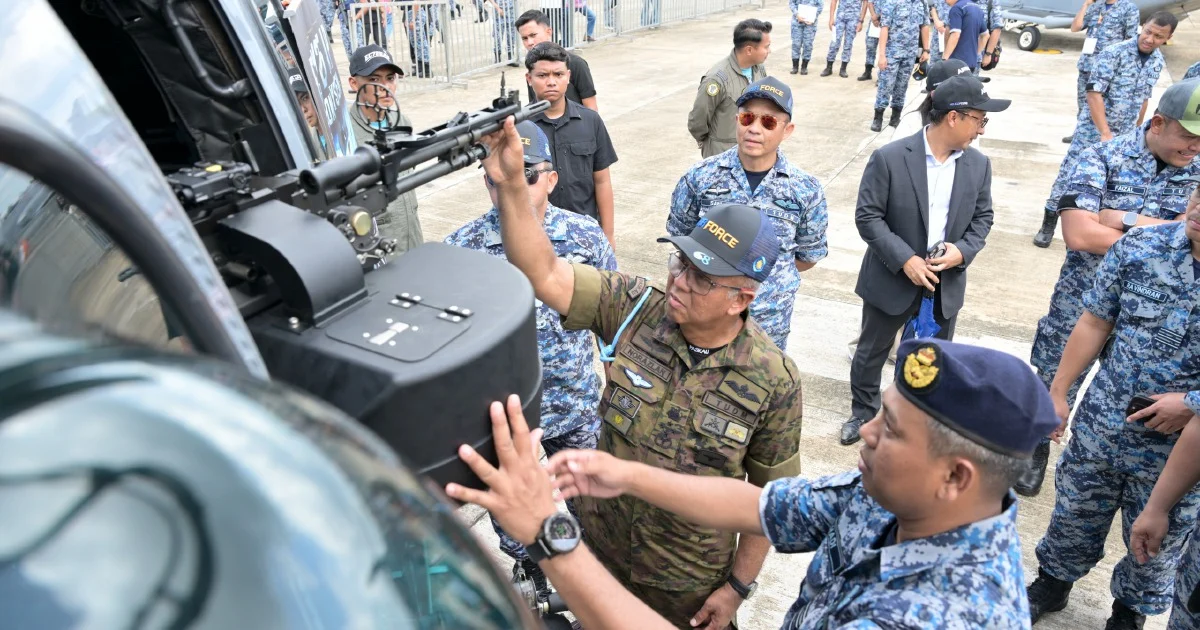
The Royal Malaysian Air Force has moved to strengthen its operational capacity by equipping its EC725 helicopter fleet with enhanced firepower systems designed to support combat search and rescue operations in demanding environments. This modernisation initiative represents a strategic investment in the service branch's ability to execute critical missions where ground conditions present elevated security risks and personnel recovery operations demand both speed and defensive capability.
Combat search and rescue, commonly abbreviated as CSAR, remains one of the most dangerous mission profiles in modern military aviation. When aircrews or ground personnel find themselves in hostile territory, the window for successful recovery narrows rapidly as adversary forces mobilise to prevent extraction. The upgraded EC725 helicopters now carry armament systems that enable them to suppress enemy fire and create protective environments for rescue teams operating on the ground. This dual capability—the helicopter's inherent mobility combined with offensive capacity—substantially improves survival odds for personnel in distress.
The EC725, manufactured by Airbus Helicopters, has established itself as a dependable medium-lift platform across numerous air forces in Asia-Pacific and beyond. Its relatively spacious cabin, robust twin-engine configuration, and proven reliability in challenging climates make it well-suited to the Malaysian operational environment. The addition of weaponry systems transforms the airframe from a primarily transport and utility platform into a more versatile asset capable of simultaneously projecting force and conducting rescue operations.
For the Royal Malaysian Air Force specifically, this enhancement addresses operational gaps that may have emerged during previous deployments or training exercises. The service branch operates across a geographically dispersed archipelago with complex terrain, including mountainous regions and maritime zones where conventional rescue approaches may prove inadequate. The upgraded helicopters can now provide crew defence during extraction manoeuvres, enabling pilots and rescue personnel to concentrate on the primary objective—retrieving personnel—rather than managing external threats.
The timing of this capability upgrade aligns with evolving security challenges in Southeast Asia. Regional air forces increasingly recognise that future contingencies will require integrated air-ground operations where rescue helicopters function not merely as transport assets but as capable combat platforms. The Royal Malaysian Air Force's decision to arm its EC725 fleet reflects this strategic evolution and demonstrates commitment to maintaining operational relevance in an era of advancing military technologies and shifting geopolitical dynamics.
The firepower upgrade carries particular significance given Malaysia's role in regional security architectures and its participation in various multinational defence initiatives. Armed EC725 helicopters can support broader operations by providing suppressive fire during personnel recovery missions, reducing exposure time for ground teams and augmenting the overall effectiveness of search and rescue coordination. This capability proves especially valuable in operations extending into territory controlled by hostile forces or non-state actors where conventional defences prove insufficient.
Implementing such upgrades requires comprehensive training protocols ensuring flight crews can operate the new weapons systems safely and effectively while maintaining focus on the fundamental rescue mission. The Royal Malaysian Air Force has presumably invested in professional development programmes preparing personnel to employ these systems in complex scenarios ranging from high-altitude mountainous terrain to dense jungle environments characteristic of Malaysia's geography. Effective integration of weaponry with existing rescue procedures demands extensive preparation and realistic training exercises.
The enhancement also signals confidence in the EC725 platform's longevity within the RMAF inventory. Rather than pursuing replacement aircraft, the service branch has chosen to invest in upgrades extending the operational utility of existing assets. This approach balances fiscal considerations with operational requirements—newer helicopter platforms carry substantially higher acquisition costs, while upgrading existing airframes offers improved capabilities at more manageable expense levels. For a regional air force managing budget constraints alongside modernisation priorities, this represents a pragmatic solution.
Operationally, the armed EC725s strengthen Malaysia's capacity to respond to various contingencies across the South China Sea and surrounding regions. Whether supporting counterinsurgency operations, disaster response, or conventional defence missions, the helicopters' enhanced defensive capabilities provide commanders with flexible options for personnel recovery and force projection. This versatility enhances the overall combat effectiveness of Malaysian air operations while demonstrating technological sophistication to both regional partners and potential adversaries.
The upgrade programme underscores the Royal Malaysian Air Force's broader commitment to capability development despite resource limitations characteristic of defence spending in the region. By methodically enhancing existing platforms rather than attempting wholesale fleet replacement, the service maintains operational continuity while gradually modernising its inventory. This incremental approach allows the RMAF to spread capital expenditures across multiple fiscal cycles while ensuring current squadrons retain cutting-edge capabilities.
Peers within ASEAN and broader Asia-Pacific air forces may view Malaysia's EC725 upgrade programme with particular interest, as decisions made by one regional air arm frequently influence strategic thinking among others. The success or operational effectiveness of the firepower upgrade could inform future equipment decisions by neighbouring nations facing similar operational requirements and budgetary constraints. Malaysian experience with armed medium-lift helicopters contributes to emerging regional doctrine and best practices for contemporary air operations.

