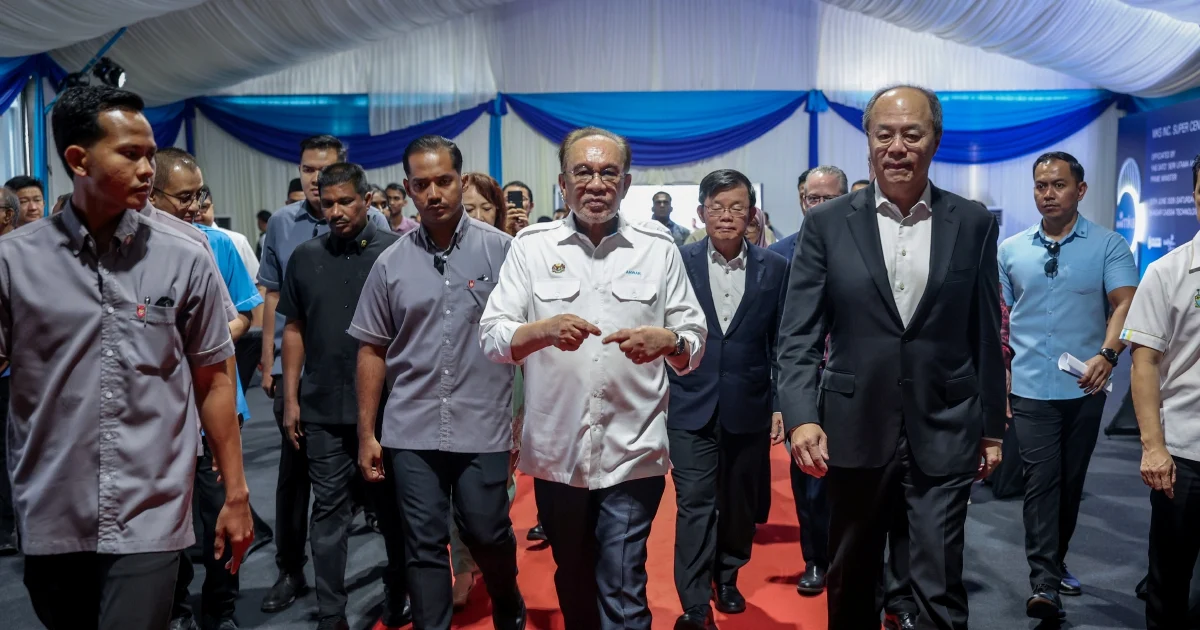
Prime Minister Datuk Seri Anwar Ibrahim has outlined Malaysia's strategic advantage in maintaining a position of diplomatic independence while simultaneously cultivating relationships across the global political spectrum, framing this balanced approach as a critical factor in attracting foreign capital and sustaining economic momentum.
Declaring his remarks in Batu Kawan, Anwar emphasised that Malaysia's refusal to align exclusively with any single bloc or power has created a distinctly favourable operating environment for multinational corporations and international investors. This positioning stands in contrast to the increasing polarisation observed across the Indo-Pacific region, where many nations have faced mounting pressure to choose between competing geopolitical interests. By contrast, Malaysia's principled neutrality serves as a reassuring signal that the country remains a stable, predictable, and commercially attractive destination regardless of shifts in global power dynamics.
The Prime Minister's comments reflect a broader strategic philosophy underpinning Malaysia's economic policy in an era marked by intensifying US-China rivalry, regional supply chain fragmentation, and competing infrastructure initiatives. Investors historically value jurisdictions that provide clear regulatory frameworks, political stability, and freedom from destabilising geopolitical entanglements. Malaysia's declared equidistance from major powers addresses this calculus directly, suggesting to corporations that operations within the country will not be jeopardised by the foreign policy disputes of others.
This approach has particular resonance for manufacturing and technology sectors seeking to diversify production networks away from concentration in single jurisdictions. Companies concerned about sanctions, export restrictions, or supply chain vulnerabilities increasingly examine nations perceived as geopolitically flexible and unlikely to be drawn into confrontational alignments. Malaysia's historical role as an economically pragmatic state—one willing to engage productively with Washington, Beijing, Tokyo, and New Delhi simultaneously—makes it an obvious candidate for such portfolio diversification strategies.
The neutrality doctrine carries explicit economic implications beyond abstract investor psychology. By maintaining functional diplomatic and trade relationships across ideological and geopolitical divides, Malaysia preserves multiple access routes to markets, capital, and technology. Rather than depending on a single patron or alliance structure, Malaysian policymakers can negotiate from a position of genuine optionality, potentially yielding more favourable terms in trade agreements, investment frameworks, and technology transfer arrangements. This negotiating flexibility becomes increasingly valuable as global supply chains fragment and access to critical materials or advanced manufacturing capacity becomes more contested.
Anwar's emphasis on independence also addresses a specific Malaysian vulnerability: the country's size and economic footprint mean it cannot afford to be perceived as a client state of any major power. Southeast Asian investors and international observers scrutinise Malaysian decision-making for signs of external domination. A reputation for independent analysis and autonomous policymaking strengthens the legitimacy of government decisions domestically while reassuring foreign firms that Malaysian authorities operate according to rational economic logic rather than external dictation.
The timing of these remarks carries significance within Malaysia's own regional diplomacy. ASEAN members have collectively emphasised centrality and non-alignment as principles, though adherence varies considerably in practice. By articulating this philosophy clearly, Anwar positions Malaysia as an exemplary practitioner of ASEAN's founding principles at a moment when regional cohesion faces pressure from great power competition. This consistency strengthens Malaysia's diplomatic standing within ASEAN while reinforcing its claims to openness and reliability in the eyes of external actors.
Investor confidence operates through multiple channels, and geopolitical positioning represents only one component. However, as multinational corporations increasingly factor political risk and geopolitical exposure into investment decisions, Malaysia's explicit commitment to balanced engagement becomes a concrete asset rather than merely rhetorical positioning. This is particularly true for sectors where supply chains span multiple jurisdictions or where final markets encompass ideologically diverse consuming regions.
The practical implications extend to specific sectors where Malaysia maintains competitive advantage. Semiconductor manufacturing, electrical and electronics assembly, petrochemical processing, and advanced manufacturing all benefit from investor perception of stable, accessible operating environments. Companies in these industries face particular scrutiny regarding geopolitical exposure; Malaysia's positioning as neutral territory facilitates their ability to operate regional hubs without triggering sanctions or export control complications that affect competitors located in clearly aligned jurisdictions.
Anwar's articulation of this strategy also subtly addresses international criticism regarding Malaysia's approach to various geopolitical flashpoints. By emphasising engagement rather than isolation, and independence rather than alignment, the Prime Minister signals that Malaysia's positions on contentious issues reflect autonomous assessment rather than subservience to external pressure. This rhetorical framing strengthens Malaysia's credibility when navigating sensitive issues involving competing interests of major powers.
Looking forward, the sustainability of this strategy depends on Malaysia's ability to remain genuinely attractive to investors across ideological divides. Should Malaysia be perceived as covertly favouring any particular power or adopting positions inconsistent with its neutrality claims, the strategic advantage erodes rapidly. The government's challenge therefore lies in ensuring that concrete policies align with diplomatic rhetoric—a balance requiring constant calibration as regional competition intensifies.

