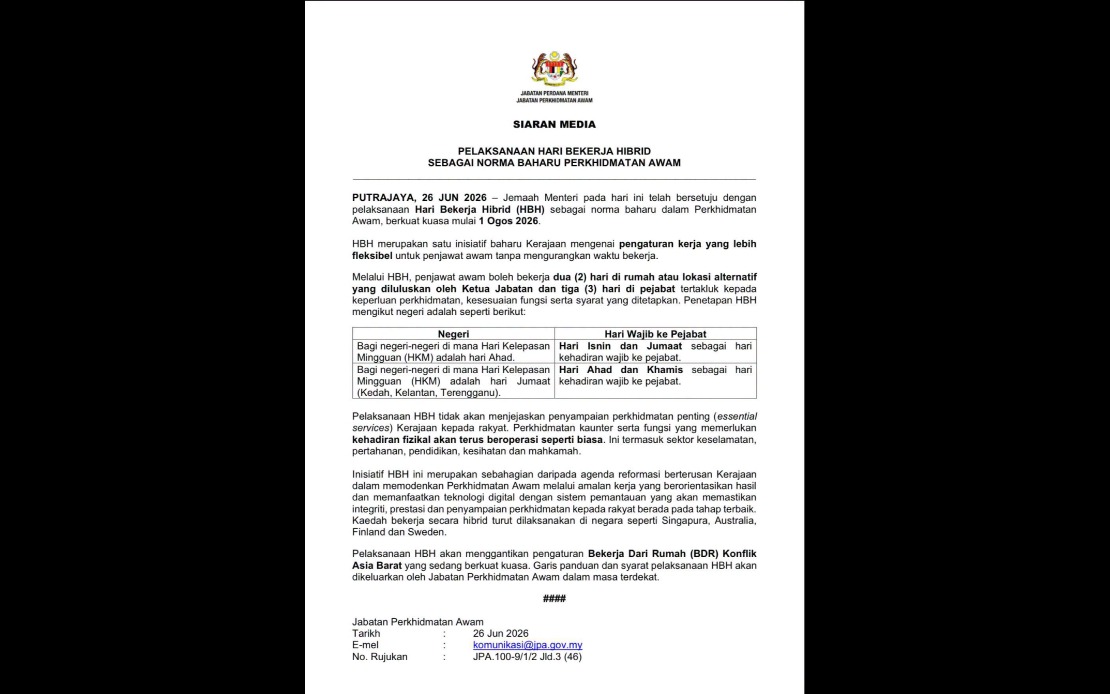
Malaysia's Cabinet has formally endorsed a Hybrid Work Day arrangement that will become the standard operating model for the nation's civil service beginning August 1. The Public Service Department announced the decision on Wednesday, marking a significant departure from pandemic-era work-from-home practices that have dominated government offices since 2020. The new framework represents an attempt to balance workforce flexibility with operational efficiency, establishing a structured approach to remote work that applies uniformly across federal and state administrations.
Under the hybrid model, civil servants will have the discretion to work remotely for two days per week from their homes or at alternative locations sanctioned by their departmental heads, while maintaining a mandatory three-day physical presence in offices. The arrangement remains subject to operational requirements, the nature of individual job functions, and departmental protocols established by each ministry. This middle-ground approach reflects global trends where organisations seek to retain flexibility gains from remote work while preserving the collaborative and supervisory advantages of in-office environments. The Public Service Department has stressed that this initiative does not reduce weekly working hours but rather redistributes how and where those hours are completed.
The decision to implement the Hybrid Work Day framework reflects the government's broader ambition to modernise the public sector through performance-based work methodologies and expanded digital infrastructure adoption. Officials position the change as part of a comprehensive public service reform agenda intended to enhance productivity whilst maintaining workforce morale. This strategic shift acknowledges that technological advancement has fundamentally altered how government operations function, with digital tools now enabling routine administrative tasks to occur outside traditional office settings. The Public Service Department has emphasised that this modernisation effort places particular emphasis on results-driven metrics rather than presenteeism, potentially signalling a cultural shift in how the Malaysian civil service evaluates employee performance and contribution.
To prevent service disruptions, the government has established carefully calibrated protocols that account for Malaysia's diverse religious and cultural observances across different states. States observing Sunday as their weekly rest day, which comprises the majority of Malaysian jurisdictions, will designate Mondays and Fridays as mandatory office attendance days, ensuring continuous service capacity. Meanwhile, Kedah, Kelantan and Terengganu, which observe Friday as their weekly holiday, will require civil servants to attend offices on Sundays and Thursdays instead. This nuanced approach demonstrates governmental sensitivity to religious diversity whilst maintaining administrative consistency, a particularly important consideration given Malaysia's federal structure and the varying public holiday arrangements across states.
Critical services facing no operational changes under the new arrangement include counter services that require direct citizen interaction, security and defence operations, educational institutions, healthcare facilities and the judicial system. These sectors will continue operating under existing protocols where physical presence remains non-negotiable. The government's assurance that essential service delivery will not deteriorate aims to address public concerns that flexible work arrangements might compromise access to government services. This categorical exemption acknowledges that whilst administrative functions can often migrate to remote settings, frontline services and sensitive operations demand in-person oversight and compliance capabilities that technology cannot fully replicate.
The Public Service Department intends to introduce comprehensive monitoring mechanisms designed to track integrity, work performance and service quality throughout the hybrid work transition. These oversight systems represent a critical component of the framework, as government leaders recognise that flexible work arrangements require robust accountability structures to maintain public confidence and operational standards. The department has committed to developing detailed implementation guidelines and specific conditions governing the hybrid arrangement, which officials will disseminate through official channels in the coming weeks. This phased communication approach allows different government departments time to prepare infrastructure, revise internal policies and train management on enforcing the new work standards.
Malaysia joins an international cohort of developed and developing nations that have adopted hybrid work models for their public sectors and private enterprises. Singapore, Australia, Finland and Sweden are cited as examples of jurisdictions that have successfully integrated flexible work arrangements, suggesting that the Malaysian government has studied comparative international practices before endorsing this policy direction. These reference nations represent diverse geographical regions and governance systems, indicating that hybrid work proves viable across different administrative cultures and technological infrastructure environments. For Malaysian observers and civil servants, this international validation provides reassurance that the model is neither experimental nor unique to Malaysia's circumstances, whilst demonstrating that governments globally view workplace flexibility as compatible with maintaining public sector excellence.
The transition from the existing Work From Home arrangement to the more structured Hybrid Work Day framework signals a deliberate move toward formalising flexible work as permanent policy rather than treating it as a temporary pandemic adaptation. This represents a significant policy evolution in Malaysia's public sector management philosophy, acknowledging that workforce expectations and technological capabilities have fundamentally shifted. The government appears to recognise that rigid return-to-office mandates risk talent attrition and reduced morale, whilst completely unrestricted remote work may compromise organisational cohesion and institutional knowledge transfer. The carefully balanced three-two split attempts to capture maximum benefits from both working modalities whilst minimising drawbacks associated with either extreme.
For Malaysian businesses and citizens relying on government services, the hybrid work transition carries both operational implications and broader significance. Whilst most administrative processes have digitised substantially, citizens requiring in-person services at government offices should adjust expectations around office availability on specific days. The government's commitment to maintaining service standards suggests that department-wide hybrid schedules will be staggered to ensure continuous coverage, though individual departments may face temporary bottlenecks during transition periods. This policy change also signals government confidence in digital infrastructure maturity, suggesting that Malaysia's public sector technology systems now support remote operations sufficiently to enable flexible arrangements without compromising security, data integrity or service quality.
The Hybrid Work Day initiative ultimately reflects Malaysia's positioning as a modern Southeast Asian economy adapting institutional practices to contemporary workforce realities. Rather than rigidly adhering to traditional office-centric culture, the government demonstrates flexibility in embracing operational models that appeal to contemporary workers whilst maintaining public service standards. As detailed guidelines emerge and implementation proceeds from August 1, different government departments will face varying challenges translating policy into practice. The success of this framework will likely depend not merely on government directives but on how effectively individual departments balance flexibility requirements with operational needs, how managers adapt supervisory practices to hybrid contexts, and whether monitoring mechanisms prove sufficiently robust to maintain accountability without becoming oppressively restrictive.

