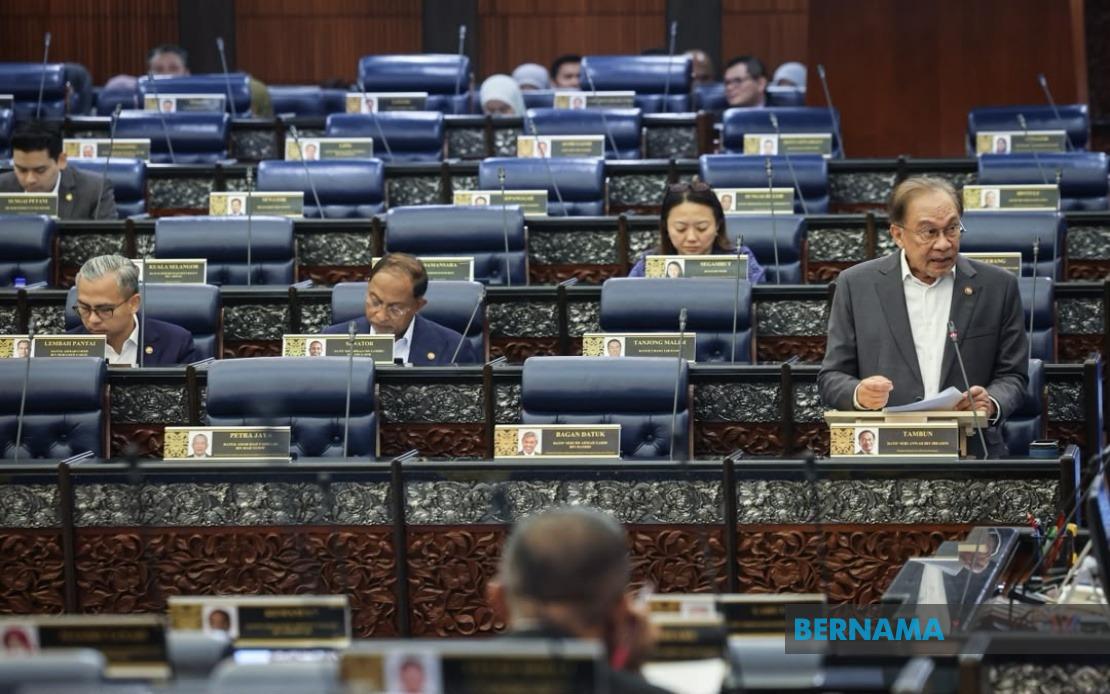
In parliament today, Prime Minister Datuk Seri Anwar Ibrahim moved to counter criticism of Malaysia's fuel pricing strategy by presenting comparative cost data that positions the country favourably against major petroleum-exporting neighbours. The premier's remarks were delivered during parliamentary proceedings in response to a supplementary question regarding fuel price differentials across different administrations, specifically comparing the tenure of former Prime Minister Datuk Seri Najib Razak with his current government's approach.
The centrepiece of the Prime Minister's defence focuses on the BUDI MADANI subsidy scheme, which maintains RON95 petrol at RM1.99 per litre. Anwar highlighted that this controlled retail price undercuts the current market rates in neighbouring oil-producing economies by a meaningful margin. Saudi Arabia, one of the world's largest crude oil exporters, now sees retail prices exceeding RM2.40 per litre, representing a price differential of more than 20 percent above Malaysia's capped rate. This comparison carries particular weight given Saudi Arabia's vast hydrocarbon reserves and the expectation that such abundance would translate into lower domestic consumer prices.
The Prime Minister further extended his comparison to include other significant regional oil producers. Qatar, despite possessing substantial natural gas and petroleum reserves, operates at higher retail fuel prices than Malaysia currently maintains. Similarly, the United Arab Emirates, another wealthy Gulf state with substantial oil wealth, has recently implemented price increases rather than reductions. Anwar specifically noted that the UAE raised fuel prices approximately two months prior to his parliamentary statement, a move that underscores the pressures facing even resource-rich nations in managing domestic energy costs.
Anwar's reference to historical pricing positions his government's achievements within a longer arc of political messaging. During his time in opposition, he had campaigned on reducing fuel prices to RM1.50 per litre, a pledge that resonated with cost-conscious Malaysian consumers. At that historical juncture, Saudi Arabian fuel prices stood at approximately 50 sen per litre, creating a dramatic price advantage. The comparison between that earlier promise and current realities illustrates how global energy market dynamics have shifted substantially, with crude prices experiencing significant volatility and inflationary pressures affecting economies worldwide since those opposition pledges were made.
The backdrop to these parliamentary exchanges involves ongoing political scrutiny regarding energy policy. Datuk Rosol Wahid, the Member of Parliament for Hulu Terengganu representing the Perikatan Nasional bloc, had raised the original question that prompted the Prime Minister's response. The query specifically invited comparison between fuel pricing under the previous Najib administration and current arrangements, framing the issue within a political narrative about which government has delivered better economic outcomes for ordinary Malaysians managing household energy expenses.
Anwar's rebuttal carries implications extending beyond mere statistical comparison. The assertions challenge a prevailing narrative that Malaysia has lost competitive advantage in fuel pricing relative to its regional peers. This perception has occasionally surfaced in public discourse and social media discussions, where citizens contemplating travel to neighbouring countries sometimes note apparent price differences at petrol pumps. By marshalling specific comparative figures from multiple countries, the Prime Minister seeks to firmly establish that Malaysian fuel prices remain advantageous within the broader regional context.
The BUDI MADANI scheme represents a deliberate government intervention maintaining price controls despite market pressures. This subsidy mechanism reflects a policy commitment to managing inflationary impacts on Malaysian households, particularly affecting lower-income and middle-income groups for whom fuel expenditures constitute a significant household budget component. The scheme's maintenance at a fixed price point requires government resources and represents a trade-off against other potential fiscal allocations, making the political economy of fuel pricing a recurring point of parliamentary attention and public debate.
The comparative analysis also implicitly addresses claims circulating within Malaysian political discourse that subsidies represent wasteful spending or that market-driven pricing would be preferable. By demonstrating that Malaysia's subsidised price remains competitive with non-subsidised rates in neighbouring jurisdictions, Anwar positions the intervention as pragmatic rather than indulgent. This framing suggests that removing price controls would likely push Malaysian consumers toward rates comparable to or exceeding those observed across the Gulf region, potentially creating household budget pressures without delivering the claimed efficiency benefits of deregulation.
For Malaysian consumers and policymakers alike, these comparative metrics matter because they ground fuel pricing discussions in concrete empirical reality rather than abstract principle. When citizens perceive their fuel costs as disadvantageous relative to neighbour countries, political grievances crystallise around energy policy. Conversely, evidence that Malaysia maintains lower prices than wealthy oil-producing states can moderate such discontent and provide rhetorical ammunition for defending subsidy policies. The Prime Minister's parliamentary intervention thus serves both communicative and political functions, framing government energy policy as delivering tangible material benefits to Malaysian households relative to international benchmarks.
Looking forward, the sustainability of Malaysia's pricing advantage depends on global crude oil market trajectories and the government's continued capacity to finance subsidy mechanisms. Should international crude prices surge significantly or should fiscal constraints intensify, the maintenance of subsidised fuel prices could become increasingly challenging. Conversely, should global energy markets soften, Malaysia's current price positioning would become even more advantageous. The parliamentary exchange therefore encapsulates an ongoing tension in Malaysian economic policy between commitments to maintaining domestic cost controls and the external market forces that ultimately determine petroleum economics across the region.

