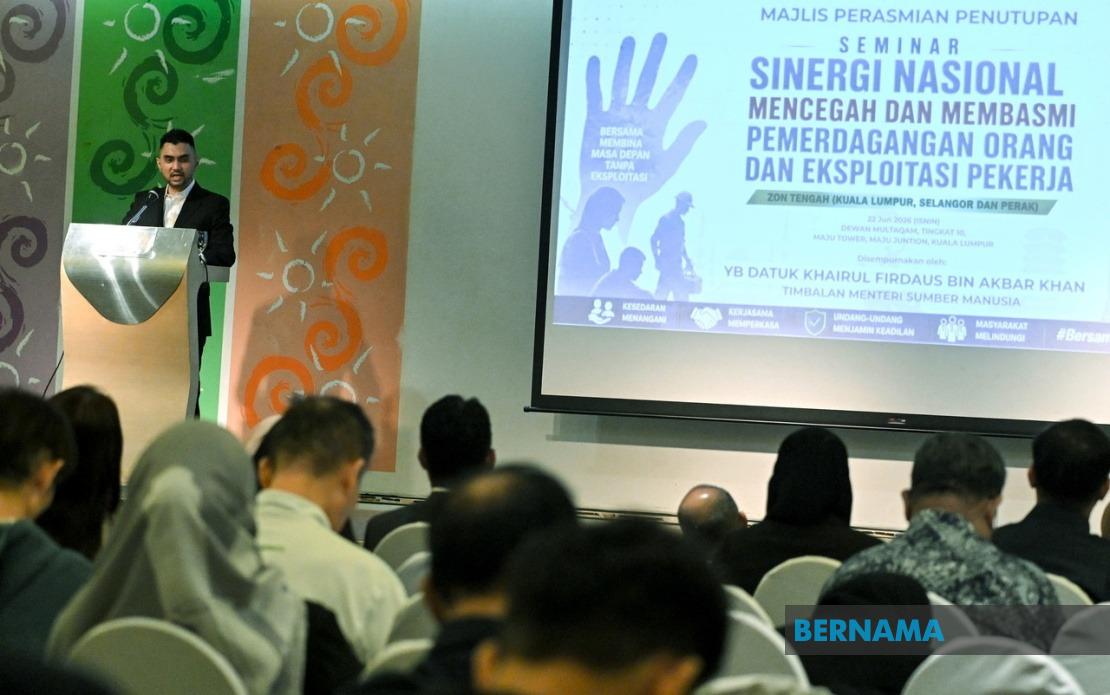
The Malaysian government reported a significant downturn in the number of human trafficking and labour exploitation victims rescued over the past three years, with figures dropping dramatically from 70 cases in 2023 to four in the first five months of 2026. Deputy Human Resources Minister Datuk Khairul Firdaus Akbar Khan attributed the decline to intensified enforcement and prevention strategies rolled out nationwide, pointing to the statistics from the Peninsular Malaysia Manpower Department (JTKSM) as evidence that government interventions are yielding measurable results in combating this serious crime.
However, Khairul Firdaus tempered optimism with a crucial caveat during remarks at the closing ceremony of the National Synergy Seminar on Preventing and Eradicating Human Trafficking and Labour Exploitation in the Central Zone. He cautioned that while the declining reported figures appear encouraging, they may mask a darker reality: cases that go unreported remain invisible to authorities, making it premature to declare victory against human trafficking networks that operate covertly across the region. This acknowledgment reflects the sophisticated nature of trafficking operations, which often prey on vulnerable migrant workers and individuals with limited access to authorities or protection mechanisms.
The trajectory of reported cases tells an interesting story when examined more closely. After reaching 70 rescues in 2023, the figure plummeted to 10 in 2024, then rose moderately to 17 in 2025 before dropping sharply again to just four cases in the first five months of 2026. This volatility suggests that enforcement operations may be concentrated during specific periods or that trafficking patterns themselves fluctuate seasonally and geographically. The uptick in 2025 followed by a significant decline raises questions about whether the lowest figures indicate genuine progress or simply reflect operational challenges in detecting crimes that deliberately avoid detection.
Parallel to the rescue statistics, Malaysia's enforcement machinery has demonstrated considerable activity across multiple fronts. Between January and May 2026 alone, authorities conducted 386 labour-related enforcement operations spanning the country, resulting in the opening of 311 investigation papers. This operational intensity underscores the government's commitment to proactive investigation and prosecution, moving beyond merely responding to reported incidents toward systematic searches for violations. The scale of these operations indicates that authorities are casting a wide net across industries and geographic zones where labour exploitation is most prevalent.
Malaysia's efforts align with broader international commitments to combat forced labour, particularly through ratified International Labour Organisation protocols that establish binding standards for worker protection. The government's adoption of these frameworks signals recognition that human trafficking and labour exploitation represent not merely domestic law enforcement challenges but violations of international human rights conventions. This positioning matters for Malaysia's standing in the global community and for ensuring that enforcement efforts meet internationally recognised standards that protect vulnerable populations regardless of their nationality or immigration status.
The National Synergy Seminar series itself represents a strategic pivot toward preventive awareness rather than solely reactive policing. The initiative involves nationwide awareness tours conducted by JTKSM designed to educate stakeholders about trafficking risks and labour exploitation tactics. The Central Zone programme, held in Kuala Lumpur, followed similar seminars conducted in the North Zone in Sungai Petani, Kedah on May 18 and the South Zone in Kluang, Johor on June 8. This systematic geographic distribution ensures that both urban centres and secondary cities receive educational resources and support.
The seminar series attracted nearly 1,000 participants across multiple zones, creating platforms for sharing insights, proposing solutions, and building collective responses to trafficking challenges. These forums bring together government officials, enforcement agencies, civil society organisations, labour unions, employer representatives, and community leaders—stakeholder groups whose coordinated action is essential for disrupting trafficking networks. The emphasis on dialogue and shared problem-solving reflects understanding that trafficking operates through complex supply chains and often involves cooperation across sectors, requiring similarly complex institutional responses.
For Malaysian businesses and employers, the enforcement drive carries significant implications. Workplaces remain common locations where labour exploitation occurs, whether through wage theft, excessive working hours, unsafe conditions, or debt bondage systems that trap workers in exploitative arrangements. The 386 enforcement operations conducted in just five months suggest heightened scrutiny of labour practices across manufacturing, construction, hospitality, domestic work, and agricultural sectors. Companies operating in these industries face elevated compliance requirements and reputational risks if trafficking or exploitation is discovered within their operations or supply chains.
The regional dimension of Malaysia's trafficking challenge cannot be overlooked. As a major destination country for migrant workers from across Southeast Asia and South Asia, Malaysia attracts substantial population flows that create vulnerabilities exploited by trafficking networks. Workers from Bangladesh, Myanmar, Indonesia, Nepal, and other countries frequently encounter illegal recruitment practices, fraudulent employment contracts, and conditions that constitute labour trafficking once they arrive. Addressing this requires cooperation with origin countries through bilateral agreements, joint enforcement operations, and capacity-building for regional law enforcement agencies.
The declining rescue figures, while potentially reflecting genuine enforcement success, demand cautious interpretation given the hidden nature of trafficking crimes. Criminal networks deliberately obscure their operations, exploitation often goes unreported by victims who fear deportation or retaliation, and many cases never come to government attention. The government's recognition of this reporting gap, evident in Khairul Firdaus's statement that some cases remain unseen, suggests awareness that official statistics represent only the visible portion of a larger problem. Future policy should focus on mechanisms that encourage victim reporting, protect whistleblowers, and develop intelligence-gathering capabilities that penetrate trafficking networks rather than waiting for complaints to surface.
Moving forward, Malaysia's approach requires sustained investment in both enforcement infrastructure and prevention mechanisms that address root causes of trafficking vulnerability. Economic desperation, limited educational opportunities, and information gaps in origin communities drive individuals toward trafficking networks. Complementing police operations with economic development initiatives, improved labour market information systems, and education programmes targeting at-risk populations offers longer-term solutions. The emphasis on the National Synergy Seminar series demonstrates recognition of this multilayered challenge, though scaling these awareness efforts to reach the millions of vulnerable workers across the region remains an ongoing challenge for policymakers.

