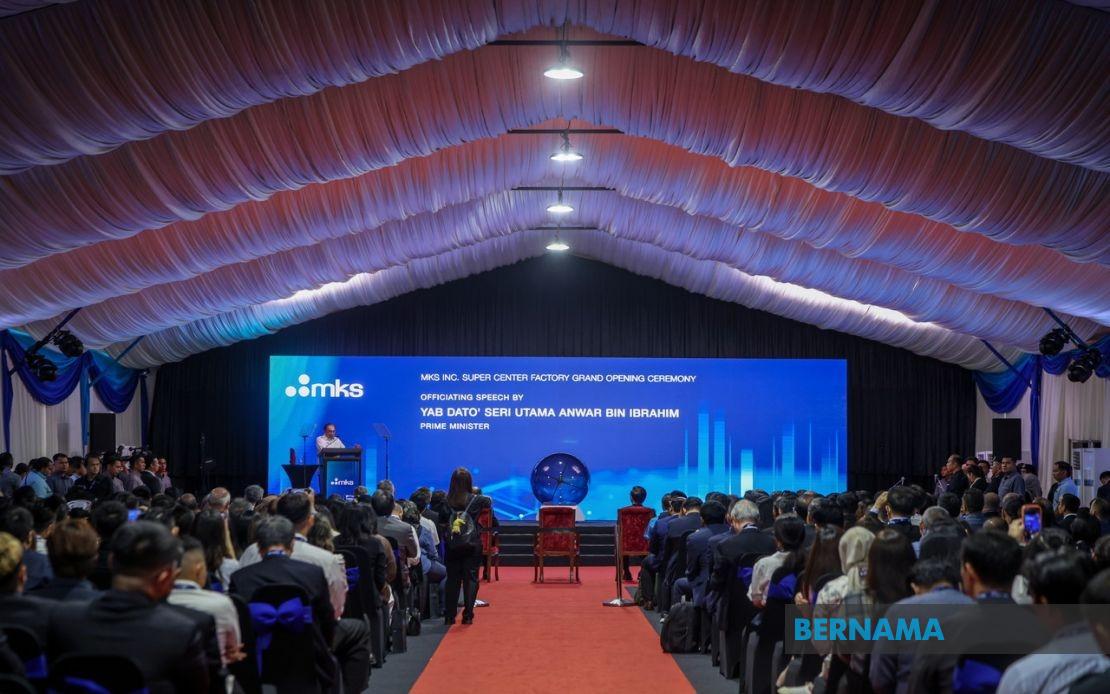
Prime Minister Datuk Seri Anwar Ibrahim has underscored how Malaysia's foundational commitment to maintaining independence and neutrality while engaging with nations across competing geopolitical spheres has translated into tangible economic gains and reinforced the country's standing on the international stage. Speaking at an industrial facility opening in Penang, Anwar framed Malaysia's diplomatic posture not merely as a foreign policy principle but as a strategic economic asset that positions the nation as a reliable and principled partner for investors and trading partners alike.
The Prime Minister's remarks come as Malaysia pursues a delicate diplomatic balancing act in a region increasingly characterised by great-power competition. By refusing to align exclusively with any single bloc, Anwar suggested, Malaysia preserves its ability to forge mutually beneficial relationships across ideological and economic divides. This approach has historically underpinned Malaysia's development trajectory, allowing successive governments to access investment, technology, and market access from diverse sources rather than remaining dependent on a single patron or alliance.
Anwar specifically cited recent high-level engagements with the United States, China, India, and Russia as evidence that Malaysia's non-aligned stance enhances rather than diminishes its diplomatic relevance. The visits from these major powers, he indicated, validate Malaysia's central position within regional and global affairs. Rather than being sidelined for refusing to choose sides, Malaysia is increasingly sought after as a partner precisely because of its independence and principled neutrality. This dynamic reflects a broader recognition that non-aligned nations can offer unique value in an era of fractured geopolitical consensus.
A concrete example of how this diplomatic positioning translates into economic advantage emerged through Petronas's recent commercial arrangements in Turkmenistan. The state-owned energy company's ability to negotiate agreements in Central Asia demonstrates how Malaysia's reputation for independence and fair dealing opens doors that might otherwise remain closed to nations perceived as satellites of larger powers. Turkmenistan, similarly positioned between competing spheres of influence, likely finds Malaysia a more palatable partner than nations closely aligned with particular superpowers.
The energy sector exemplifies why Malaysia's non-aligned approach holds particular relevance for economic development. Global energy markets are increasingly shaped by geopolitical considerations, with sanctions, alliances, and strategic competition affecting access to resources and markets. Malaysia's ability to maintain working relationships across these divides provides Petronas with flexibility in pursuing supply contracts and investment opportunities that might prove inaccessible to companies based in nations locked into rigid alliance structures. This independence has been instrumental in sustaining Malaysia's energy sector competitiveness over decades.
Beyond energy, Malaysia's diplomatic independence creates advantages across multiple economic sectors. Foreign direct investment flows more readily when investors perceive political stability and an absence of ideological constraints that might disrupt business operations. By explicitly welcoming participation from all quarters while maintaining its own independent positions on contentious global issues, Malaysia signals that commercial relations will not be held hostage to geopolitical disputes. This reassurance has particular appeal to multinational corporations seeking to maintain operations across multiple countries without fear of secondary sanctions or political retaliation.
The industrial facility opening in Bandar Cassia Technology Park, where Anwar delivered these remarks, itself reflects this principle. Technology parks and manufacturing hubs attract investment from companies seeking to establish production bases outside primary geopolitical fault lines. Malaysia's positioning as a stable, non-aligned jurisdiction with rule of law, modern infrastructure, and skilled labour creates competitive advantages in attracting such investment relative to nations facing greater geopolitical uncertainty or pressure to adopt restrictive policies toward particular trading partners.
Anwar's emphasis on Malaysia's willingness to engage all nations while maintaining independence also addresses concerns among some constituencies about potential economic vulnerabilities. By articulating a clear commitment to non-alignment, the Prime Minister reassures different audiences—whether Western investors concerned about Chinese dominance or Chinese partners worried about Western encroachment—that Malaysia will not subordinate economic interests to ideological conformity. This balanced positioning becomes increasingly valuable as global trade becomes more fragmented and companies must navigate competing regulatory and political frameworks.
The participation of Penang Chief Minister Chow Kon Yeow and other officials at the facility opening underscores how this diplomatic philosophy extends to subnational economic development. Penang, as a major industrial and technology hub, benefits directly from Malaysia's international reputation as a stable, neutral investment destination. The state's continued attractiveness to multinational manufacturers and technology companies depends partly on the stability and predictability that Malaysia's non-aligned approach provides at the national level.
For Southeast Asia broadly, Malaysia's articulation of non-alignment carries particular resonance. The region faces intensifying pressure to choose sides as US-China competition deepens, yet most Southeast Asian nations, like Malaysia, derive economic benefits from maintaining relationships across these divides. Malaysia's willingness to actively champion this position offers a model and diplomatic cover for other regional nations pursuing similar strategies. Through vocal commitment to engagement with all parties, Malaysia helps sustain the possibility of a multipolar economic order within Asia rather than one fractured into competing blocs.
The timing of Anwar's remarks also reflects Malaysia's broader economic strategy as it seeks to attract investment in higher-value manufacturing and technology sectors. These industries increasingly operate globally, requiring access to diverse supply chains, technology sources, and markets. Companies in these sectors are particularly attracted to operating bases in nations that can promise unfettered access across geopolitical divides. Malaysia's non-aligned reputation thus becomes a competitive asset in attracting precisely the types of investment that the government prioritises for upgrading the economy.
Looking forward, Malaysia's continued emphasis on neutrality and independence will likely remain central to its economic strategy, particularly as geopolitical competition continues to reshape global investment patterns and trade flows. By maintaining this principled stance while actively engaging investors and partners from all backgrounds, Malaysia positions itself to benefit from economic opportunities regardless of how broader geopolitical contests unfold. This flexibility, grounded in genuine commitment to independence rather than mere opportunism, provides Malaysia with resilience that more ideologically committed partners may lack in an increasingly uncertain global environment.

