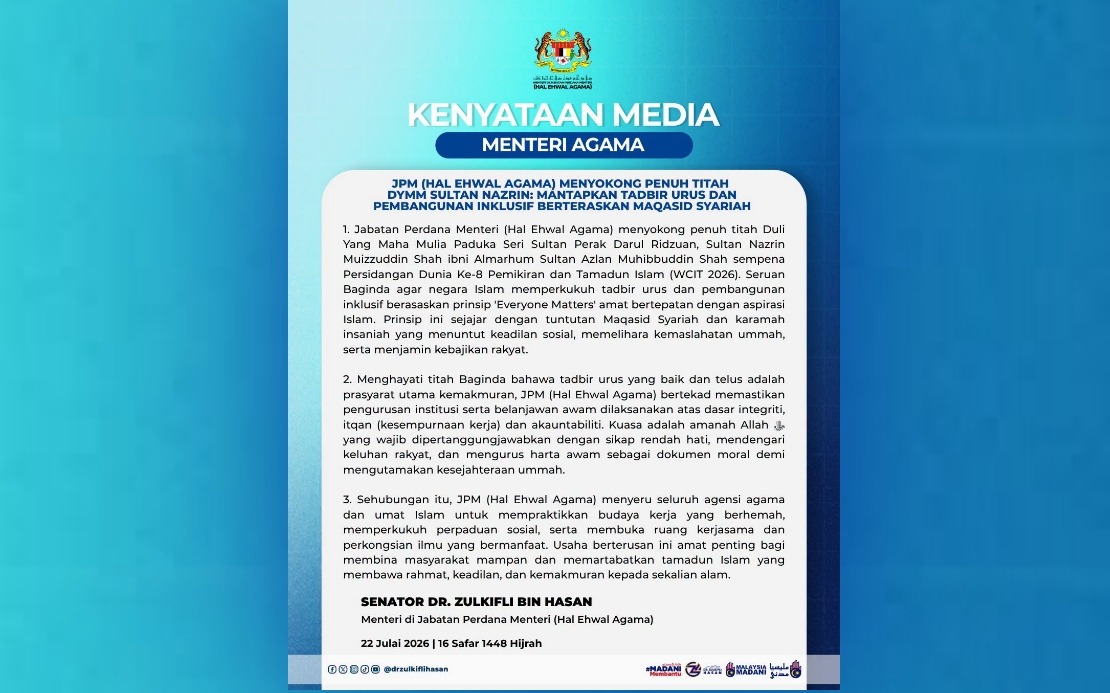
The Prime Minister's Department (Religious Affairs) has committed itself to advancing the governance of religious institutions through frameworks centred on integrity, accountability and collective well-being, embracing principles articulated by Sultan Nazrin Shah during his address at the 8th World Conference on Islamic Thought and Civilisation. Minister in the Prime Minister's Department (Religious Affairs) Dr Zulkifli Hasan outlined this direction in a formal statement, signalling a deliberate realignment of institutional priorities towards what the Sultan characterised as inclusive development guided by the foundational concept of "Everyone Matters".
Sultan Nazrin Shah's intervention into matters of governance carries particular significance within Malaysian political discourse, given the symbolic and constitutional weight vested in the institution of the Malay Rulers. His articulation of governance principles at the international conference represents more than ceremonial rhetoric; it signals expectations for how federal departments managing religious affairs should operationalise their mandate. The Sultan's emphasis on serving every citizen irrespective of ethnicity, faith affiliation or political allegiance frames national unity not as an aspirational slogan but as a measurable outcome of institutional practice.
The theological and conceptual foundations underpinning this governance framework warrant close examination for Malaysian observers. Dr Zulkifli Hasan situated the Sultan's principles within established Islamic jurisprudential traditions, specifically invoking Maqasid Syariah—the objectives of Islamic law—and the concept of karamah insaniah, or human dignity. This intellectual positioning serves a crucial function: it demonstrates that contemporary governance reforms need not conflict with Islamic foundations but rather emerge organically from them. The integration of social justice, community welfare preservation and protection of the ummah's interests becomes framed as fundamentally Islamic rather than externally imposed or culturally alien.
The Sultan's observations regarding public service delivery and inclusive administration carry direct implications for how the Religious Affairs Ministry must recalibrate its operations and institutional culture. A public service genuinely functioning across communal divides requires deliberate structural changes, from recruitment and promotion practices to the language and framing of policy communications. The principle that listening precedes lawmaking inverts conventional bureaucratic hierarchies and suggests that religious institutions should be responsive entities shaped by public input rather than top-down impositions of interpretation or practice.
Dr Zulkifli Hasan's characterisation of authority as divine trust requiring exercise through humility represents a rhetorical pivot toward servant leadership within Malaysia's religious bureaucracy. This framing explicitly rejects models of authority rooted in coercion, exclusivity or narrow sectarian interpretation. The emphasis on managing public funds as moral responsibility to prioritise the ummah's welfare extends governance concerns beyond ceremonial matters into the material realm of budgetary allocation, institutional spending and resource distribution—areas where principle translates into tangible impact on citizens' lives.
The Sultan's observation that development cannot occur in isolation within increasingly interconnected global systems addresses a persistent challenge in Malaysian policymaking. Religious institutions, like all government agencies, operate within contexts of international trade, technological innovation and cross-border knowledge flows. The temptation toward isolationist or protectionist approaches may feel consonant with certain theological perspectives, yet the Sultan positions openness to global engagement as compatible with Islamic principles. This framing becomes particularly relevant as Malaysia seeks to maintain its position within regional and international Muslim networks while navigating technological and economic transformation.
The Ministry's stated commitment to ensuring that institutional management adheres to principles of itqan—excellence in work—signals expectations for operational rigour and professional competence. This concept, rooted in Islamic traditions emphasising that excellence in execution honours divine trust, transforms governance reform from abstract principle into concrete practice standards. Religious agencies must demonstrate not merely good intentions but measurable competence, transparent processes and verifiable outcomes in how they administer their mandates.
Dr Zulkifli Hasan's invocation of courteous work culture and collaborative knowledge-sharing points toward cultural transformation within Malaysia's religious administration. The cultivation of politeness and respect in institutional interactions, particularly across religious and communal boundaries, requires sustained attention to personnel training, institutional communication protocols and the enforcement of professional standards. This emphasis on courtesy becomes politically significant when religious institutions have sometimes been characterised as confrontational or dismissive toward non-Muslim communities' concerns.
The alignment between the Sultan's governance vision and the Ministry's stated direction gains importance within Malaysia's current political landscape, where questions of institutional legitimacy and public confidence in government agencies remain contested terrain. Religious institutions occupy particularly sensitive positions given their jurisdiction over matters touching personal identity, family law and communal belonging for Muslim citizens. Demonstrating commitment to transparency, accountability and inclusive listening practices becomes essential for maintaining public trust and mitigating perceptions of institutional bias or sectarian capture.
For Southeast Asian observers more broadly, Sultan Nazrin's intervention signals how regional Muslim-majority states are grappling with governance challenges at the intersection of traditional authority structures, modern administrative imperatives and pluralistic societies. Malaysia's approach—positioning good governance not as externally imposed requirement but as Islamic imperative—offers instructive lessons for how religious and secular governance frameworks might be integrated rather than perpetually positioned in opposition. The Religious Affairs Ministry's adoption of these principles will ultimately be measured not through rhetorical commitment but through observable changes in institutional behaviour, decision-making transparency and demonstrable protection of citizen welfare across communal divides.

