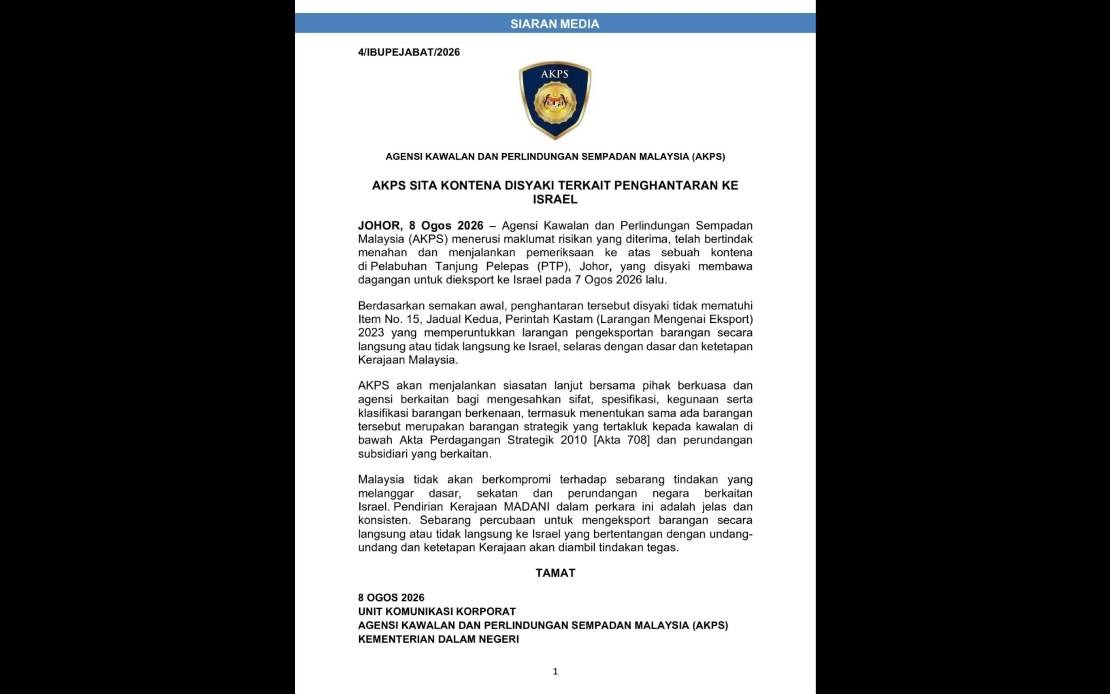
Malaysia's border control authorities have intercepted a shipment at Port Tanjung Pelepas in Johor suspected of containing strategic materials intended for export to Israel, prompting Prime Minister Datuk Seri Anwar Ibrahim to publicly acknowledge the enforcement action as evidence of the country's resolute diplomatic position on the Israeli-Palestinian conflict. The seizure, announced through an official statement from the Malaysian Border Control and Protection Agency (AKPS), represents a tangible demonstration of how Malaysia translates its rhetorical support for Palestinian rights into concrete trade restrictions that carry real economic consequences.
The Prime Minister's public endorsement of AKPS's interception, communicated via Facebook, carries significance beyond routine customs enforcement. By specifically highlighting the action as a reflection of Malaysia's "firmness," Anwar positioned the seizure within a broader strategic narrative about national sovereignty and moral principle. His framing suggests that allowing such shipments to pass through Malaysian ports would represent not merely a commercial transaction but a potential compromise of the nation's stated values and international commitments regarding the Palestinian cause, a position that resonates deeply within Malaysian domestic politics where support for Palestinian rights enjoys broad popular backing.
The detained container violated Item No. 15 of the Second Schedule under the Customs (Prohibition of Exports) Order 2023, which explicitly prohibits Malaysia from directly or indirectly exporting goods to Israel. This legal framework, established through government policy directive, creates enforcement mechanisms that reach beyond simple port-of-origin restrictions to capture transshipment scenarios where goods might be routed through Malaysia to circumvent direct sanctions. The 2023 order thus addresses a practical vulnerability in trade enforcement that previous frameworks may not have fully covered, reflecting accumulated experience in monitoring complex international supply chains.
Anwar explicitly connected Malaysia's action to the nation's participation in The Hague Group, an international coalition focused on advancing Palestinian causes through diplomatic and legal channels. This contextualisation transforms what might otherwise appear as unilateral national policy into an expression of collective international commitment. By embedding Malaysia's enforcement action within this broader multilateral framework, the Prime Minister signals that the country operates as part of an organized diplomatic front rather than acting in isolation, which carries strategic importance for maintaining credibility with other members of the coalition and among non-aligned nations that observe Malaysia's foreign policy conduct.
The Prime Minister further referenced a comprehensive ban implemented since December 2023 that prohibits Israeli-flagged vessels and ships carrying cargo destined for Israel from utilizing any Malaysian port facilities. This blanket prohibition on Israeli maritime traffic represents a significant escalation from selective goods restrictions, effectively closing Malaysia's entire port infrastructure to direct Israeli commerce. The scope of this measure underscores how Malaysia has progressively hardened its trade stance against Israel, moving from targeted restrictions on specific commodities toward comprehensive port access denial that encompasses all Israeli-associated maritime activity.
Malaysia's enforcement actions must be understood within the context of the nation's carefully calibrated approach to international law and humanitarian principles. The Prime Minister articulated the philosophical foundation underlying these trade restrictions as rooted in commitments to humanity, justice, and international legal frameworks. This rhetorical positioning presents Malaysia as upholding universal principles rather than pursuing narrowly nationalist economic objectives, a framing that provides diplomatic cover for measures that other nations might characterize as discriminatory or protectionist.
The interception of the container at Tanjung Pelepas assumes added importance given that port's status as one of Malaysia's major maritime facilities handling significant container traffic. The fact that enforcement occurred at this high-volume location demonstrates that authorities maintain active monitoring capabilities at critical chokepoints rather than relying solely on intelligence-driven operations. This suggests sustained resource commitment to detecting and interdicting Israel-bound shipments, implying that Malaysian customs enforcement has institutionalized procedures specifically designed to identify goods destined for Israel, whether through direct labeling, shipping documentation analysis, or intelligence coordination.
For Malaysian importers and exporters, the seizure carries practical implications regarding supply chain compliance and due diligence requirements. Companies must now implement screening procedures to ensure their outbound shipments do not inadvertently route through intermediaries that could direct goods toward Israel. The enforcement action thus functions as a public reminder that Malaysia actively prosecutes violations, creating incentive structures that encourage voluntary compliance even among firms not specifically targeted by investigation.
Regionally, Malaysia's enforcement posture influences perceptions across Southeast Asia regarding trade relationships with Israel. As a major regional economy and transportation hub, Malaysia's decision to maintain comprehensive restrictions sends signals about the costs and complications of Israeli commercial engagement within Southeast Asian infrastructure networks. Other nations in the region must factor Malaysian enforcement into their own calculations regarding Israel-related trade policy, whether they ultimately adopt comparable restrictions or maintain more permissive approaches.
The AKPS statement accompanying the Prime Minister's remarks provides the technical foundation for the seizure, establishing that Malaysian authorities conducted inspection procedures and determined that goods in the container violated explicit prohibitions contained within the 2023 customs order. The agency's coordination with port authorities to execute the interception suggests well-established protocols for identifying suspect shipments and implementing detention procedures, indicating that Malaysia has developed institutional capacity for translating policy directives into operational reality at the port level.
Looking forward, the seizure establishes precedent that Malaysian authorities view enforcement of Israel-related trade prohibitions as a priority matter worthy of public acknowledgment and ministerial attention. When Prime Ministers publicly commend enforcement actions, subordinate agencies receive clear signals about institutional expectations and priorities. This dynamic likely encourages AKPS and customs personnel to maintain vigilance regarding potential Israel-bound shipments, knowing that successful interdictions receive political validation from the highest levels of government.
The broader strategic context involves Malaysia's positioning as a nation that translates diplomatic rhetoric into concrete policy implementation, distinguishing it from countries that issue statements opposing Israeli actions without corresponding trade restrictions or enforcement mechanisms. For Palestinian advocacy organizations and sympathetic governments, Malaysia's enforcement record demonstrates the feasibility of maintaining functional trade relationships with Israel while simultaneously implementing targeted restrictions on specific commerce categories, suggesting that opposition to Israeli policies need not entail comprehensive economic decoupling.

