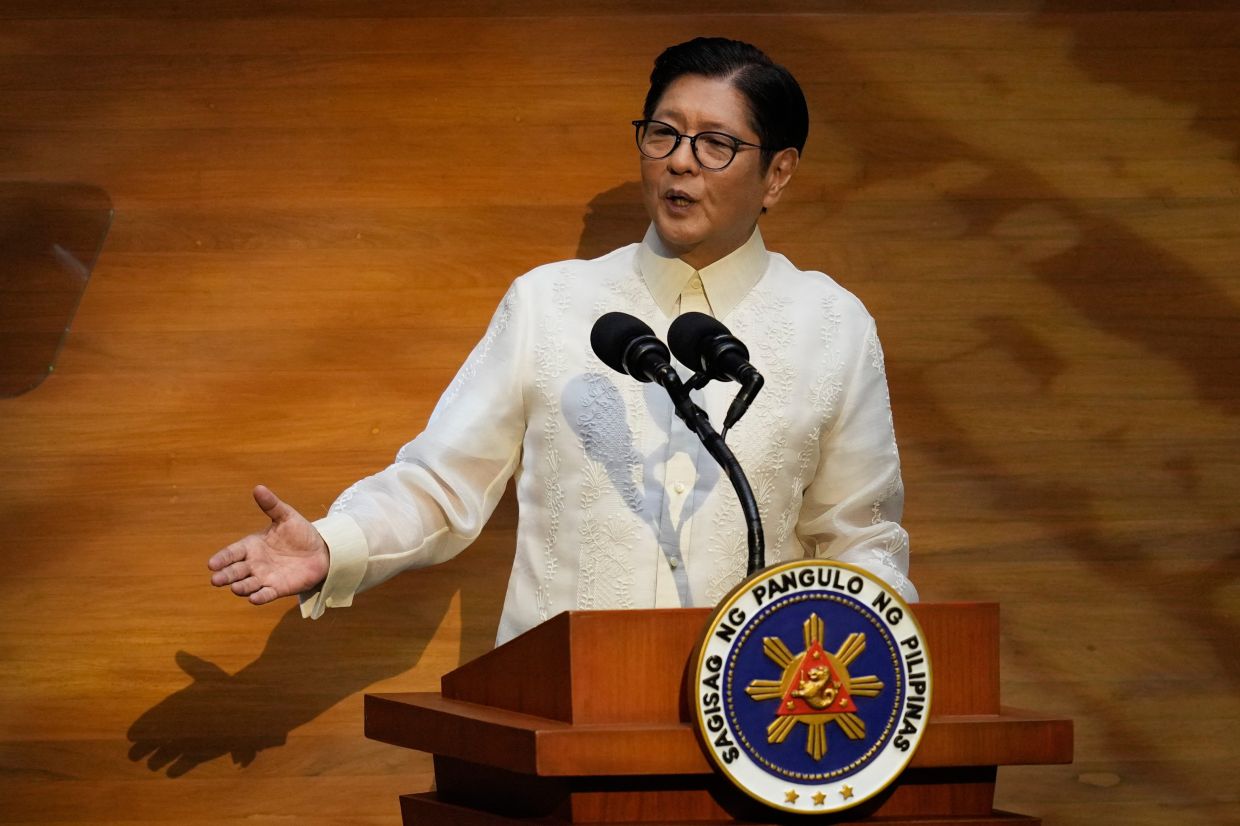
Philippine President Ferdinand Marcos Jr. mounted a vigorous defence of his country's legal victory in the South China Sea during his state of the nation address on Monday, pledging that Manila will uphold a landmark 2016 arbitration ruling that dismantled Beijing's sweeping territorial claims. Though the president refrained from naming China directly, his pointed remarks—asserting that Filipinos "do not yield" to conquerors and rejecting suggestions that his nation's character or honour could be questioned—amounted to a transparent challenge to Beijing's intransigence on the disputed waters. The speech struck a carefully calibrated diplomatic tone, deploying rhetoric that resonated with domestic audiences without escalating tensions that already simmer across Southeast Asia's most contested maritime zone.
Marcos's comments arrived barely a week after Manila lodged a formal complaint against China following the circulation of AI-generated racist imagery by China Daily, a state-controlled outlet, that depicted Filipinos as primates in animated cartoons and videos. The inflammatory content centred on Beijing's rejection of the 2016 arbitration award, a decision that invalidated China's expansive nine-dash-line territorial claims across the South China Sea. The incident prompted Marcos to summon Chinese Ambassador Jing Quan to his office to lodge the diplomatic protest. While Manila characterised the images as "racist and dehumanizing" and demanded their removal, Beijing's response proved characteristically dismissive—Foreign Ministry spokesperson Lin Jian refused to acknowledge the propaganda effort as representing official Chinese policy, attributing it to an unnamed third party whilst simultaneously reasserting China's categorical rejection of the arbitration as "a political farce disguised as a legal proceeding."
The 2016 arbitration ruling, initiated by the Philippines in 2013 following a tense naval confrontation between Chinese and Philippine vessels at a contested shoal, constitutes a watershed moment for international maritime law in Asia. An international arbitral tribunal determined that China's historical claims to the disputed waters lacked legal standing under the 1982 United Nations Convention on the Law of the Sea, effectively validating the Philippines' own jurisdictional claims while establishing a framework that benefits other claimants throughout Southeast Asia. Marcos characterised the ruling as a "definitive benchmark" for interpreting the international law convention and emphasised that his government would deploy "every peaceful and legal means available" to defend this achievement against external pressure or domestic erosion.
For Malaysian policymakers and regional observers, Marcos's rhetorical commitment carries significant weight. The South China Sea remains a flashpoint where the interests of Malaysia, Vietnam, Brunei, Taiwan, and the Philippines converge over overlapping territorial and maritime claims. Chinese vessels have increasingly challenged fishing operations and official patrols by Philippine, Vietnamese, and Malaysian authorities, creating friction that threatens to destabilise the entire region. By positioning the 2016 arbitration verdict as non-negotiable legal authority rather than a political bargaining chip, Marcos signals that claimant states possess common ground upon which to mount collective diplomatic or legal resistance against Chinese revisionism. His insistence that the ruling represents binding international law carries implications that extend well beyond Manila's bilateral relationship with Beijing.
The second major announcement in Marcos's address concerned the imminent prosecution of former House Speaker Martin Romualdez, his own cousin and a key political lieutenant. The president revealed that a special anti-graft prosecutor would soon file charges against Romualdez, who became ensnared in a corruption scandal that Marcos had publicly identified during last year's state of the nation speech. The charges relate to allegations that Romualdez and other House members diverted substantial kickbacks from flood control infrastructure projects, a scheme exposed through government and congressional investigations. The announcement represents a striking departure from typical Philippine political behaviour, where family connections and factional loyalty customarily shield prominent figures from prosecution, regardless of criminal suspicion.
Marcos stressed that his commitment to accountability transcends personal relationships, declaring that "I'm not a president for my family. I'm not a president for my friend." The sentiment carries particular weight given that Romualdez resigned from his House speaker position last year but retained his congressional seat, suggesting that institutional pressure and legal jeopardy eventually convinced the president to act. Romualdez responded to the announcement by maintaining his innocence and vowing to defend himself through the legal process, characterising the forthcoming charges as manageable rather than existential threats to his political standing.
The corruption scandal that engulfed Romualdez appears as part of a larger pattern of graft within Philippine infrastructure procurement, particularly involving flood mitigation projects that should have strengthened communities' resilience but instead enriched politically connected contractors and officials. Authorities have already charged several lawmakers alongside a former senator, a former public works secretary who served under Marcos himself, government engineers, and construction company executives. The combined recovery and freezing of assets belonging to corruption suspects has reached nearly 25 billion pesos (US$410 million), with substantial portions already returned to the national treasury. This financial recovery demonstrates both the scale of the theft and the government's determination to dismantle networks that have historically diverted development resources.
The convergence of Marcos's uncompromising stance on the South China Sea with his apparent willingness to prosecute a family member suggests a calculated effort to establish presidential credibility on governance and national interest. By addressing both external sovereignty and internal accountability within a single address, Marcos attempts to project an image of a leader whose principles supersede factional considerations or personal convenience. Whether sustained prosecution of Romualdez and other officials occurs remains uncertain, given the Philippines' historical record of stalled corruption cases and politically motivated prosecutions, but the presidential rhetoric establishes a benchmark against which Filipino citizens and international observers can measure administrative performance.
Southeast Asian governments, particularly those managing their own complex relationships with Beijing whilst navigating internal corruption challenges, will monitor how thoroughly the Philippines pursues these dual commitments. The region increasingly recognises that sustainable development and security stability require transparent governance, predictable legal systems, and respect for international law—principles that underpin both maritime stability and investor confidence. Marcos's articulation of these principles within a single policy statement suggests potential alignment with regional efforts to establish institutional safeguards that extend beyond individual administrations. The credibility of such commitments, however, depends entirely on whether rhetoric translates into consistent administrative action over months and years of political pressure and competing interests.
The practical implications for Malaysia and other ASEAN members remain considerable. A Philippines government that enforces rule of law domestically whilst defending international maritime legal frameworks internationally strengthens the entire region's capacity to resist coercive pressure from larger powers attempting to redraw the regional order through force or intimidation. Conversely, any backsliding on either commitment—whether through abandonment of the anti-corruption campaign or acquiescence to Chinese territorial revisionism—would weaken the collective diplomatic and legal position that claimant states have painstakingly constructed. The coming months will determine whether Marcos's Monday pronouncements reflect genuine policy direction or represent temporary rhetorical flourishes designed to manage immediate political pressures.

