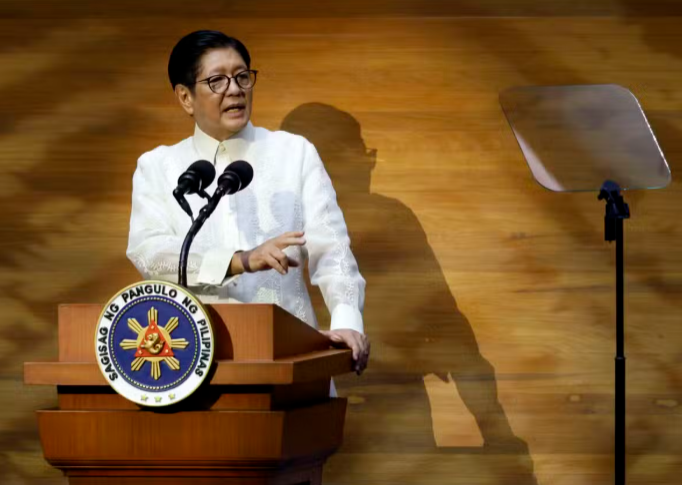
Philippine President Marcos has drawn a clear line between his personal relationships and his administrative duty, declaring during his State of the Nation Address that even relatives will not escape the government's intensifying anticorruption campaign. The pronouncement carries particular weight given that the Office of the Ombudsman has already begun investigating his cousin, former House Speaker and Leyte Representative Martin Romualdez, in connection with a massive flood control scandal spanning years of questionable public works expenditure.
Speaking before Congress on July 27, Marcos framed the message as both a commitment and a sacrifice, acknowledging the personal cost of pursuing accountability within his own family circle. His statement, "I am not the President of my family. I am not the President of my friends. I am the President of the Philippines," has become the defining statement of his administration's stance on graft, emphasising that institutional duty supersedes familial bonds. The comments during his fifth State of the Nation Address underscored how the anticorruption drive has consumed much of his political messaging, occupying a substantial portion of what became his longest address since taking office in 2022.
Romualdez, responding to the President's public criticism, struck a tone of resignation rather than defiance. In a statement released after the address, the Leyte representative acknowledged the pain inflicted on their family while expressing respect for Marcos' position. Rather than contesting the investigation, he reiterated his innocence and declared readiness to confront the charges through legal processes. His measured response reflects the political reality that opposing the President's anticorruption agenda publicly could damage his position further, even as he maintains that evidence will ultimately vindicate him.
The flood control investigation represents the centrepiece of Marcos' anticorruption efforts, originating from his public rebuke during last year's State of the Nation Address when he challenged those involved in questionable infrastructure projects with the phrase "Mahiya naman kayo"—or "Have some shame." That singular moment catalysed the creation of Executive Order No. 94, establishing an Independent Commission for Infrastructure tasked with examining flood control projects from the previous decade. Though the commission concluded its fact-finding work in February, it generated nine separate referrals recommending both criminal and administrative proceedings against a sprawling network of 65 individuals including legislators, contractors, and both serving and retired officials from the Department of Public Works and Highways and the Commission on Audit.
The scale of prosecutions resulting from the investigation underscores the thoroughness of the inquiry. At least 45 individuals now face criminal charges across the Sandiganbayan and regional trial courts, a roster that includes two sitting lawmakers, two former representatives, 33 former DPWH officials, and eight contractors. Among those detained are Senator Jinggoy Estrada and former Senator Ramon "Bong" Revilla Jr., alongside construction industry figures such as Curlee and Sarah Discaya. The breadth of the investigation demonstrates that Marcos' administration has pursued actors across the political spectrum and institutional hierarchy rather than targeting opponents selectively.
Financial recovery has accompanied the legal proceedings, with authorities freezing or preserving nearly P25 billion in funds and assets connected to the accused individuals. The government has already returned more than P800 million to the National Treasury, with additional sums expected as cases progress. Beyond asset recovery, the administration has blocked payments for defective, counterfeit, or entirely fabricated projects, preventing further diversion of public resources. This financial dimension—recovering stolen public wealth—carries significance for Malaysian and Southeast Asian observers concerned with how governments translate anticorruption rhetoric into tangible recovery of state resources.
However, complications have emerged in executing the anticorruption agenda. Former Public Works Secretary Manuel Bonoan was dropped from proceedings after agreeing to testify as a state witness, a pragmatic decision reflecting prosecutorial strategy of securing insider testimony rather than pursuing every participant. More problematically, former House appropriations committee chair Zaldy Co evaded apprehension by remaining in Europe, allowing authorities' arrest window to expire and forcing the archival of his separate graft case—a reminder that transnational complications can frustrate even well-resourced investigations.
The administration has simultaneously undertaken structural reforms within the DPWH under Secretary Vince Dizon to prevent future anomalies. These reforms include recruiting new graduates and contract workers alongside comprehensive reviews of infrastructure projects across planning, costing, and implementation phases. Such institutional restructuring addresses not only those individuals involved in past corruption but attempts to modify the conditions enabling such misconduct, a lesson particularly relevant to countries across Southeast Asia struggling to entrench transparency mechanisms within public works agencies.
Marcos' determination to pursue his cousin reflects a broader calculation about political sustainability. By demonstrating that proximity to presidential power offers no protection from investigation, the administration strengthens its credibility with the public and international observers. Conversely, visible nepotism or selective prosecution would undermine the anticorruption narrative and invite accusations of using justice mechanisms selectively. The cousin's investigation thus serves dual purposes: genuine accountability for alleged wrongdoing and political reinforcement of institutional independence.
For Malaysian observers, the Philippine case offers instructive parallels and contrasts. Both nations have grappled with high-level corruption scandals and the political difficulty of pursuing powerful figures through judicial mechanisms. However, the Philippines' approach of public presidential declarations, wide prosecutorial scope, and asset recovery differs markedly from Malaysia's more circumscribed recent anticorruption efforts. The Marcos administration's willingness to pursue family members—however painful publicly—demonstrates an institutional capacity to subordinate familial loyalty to state accountability that remains contested terrain in several Southeast Asian democracies.
The remaining cases now rest with the Office of the Ombudsman and the Department of Justice's National Prosecution Service, with final judgment depending on courts' application of evidence and law. Marcos framed this transition as placing faith in institutional processes, a rhetorical move that simultaneously deflects future blame should convictions prove difficult to secure while emphasising that his administration merely initiated investigation rather than dictating outcomes. The President's assertion that "the wheels of justice are turning" acknowledges the unpredictability inherent in judicial proceedings while maintaining that governmental action has set accountability mechanisms in motion.
The anticorruption campaign has become central to how Marcos defines his presidency domestically and internationally. By sacrificing even family relationships on the altar of accountability, he constructs a narrative of principled governance that contrasts with predecessors criticised for using state power to protect allies. Whether sustained prosecution of these cases yields convictions sufficient to satisfy public expectations remains uncertain, but the political investment in pursuing them signals a shift in how Philippine elites navigate the tension between personal networks and institutional accountability.

