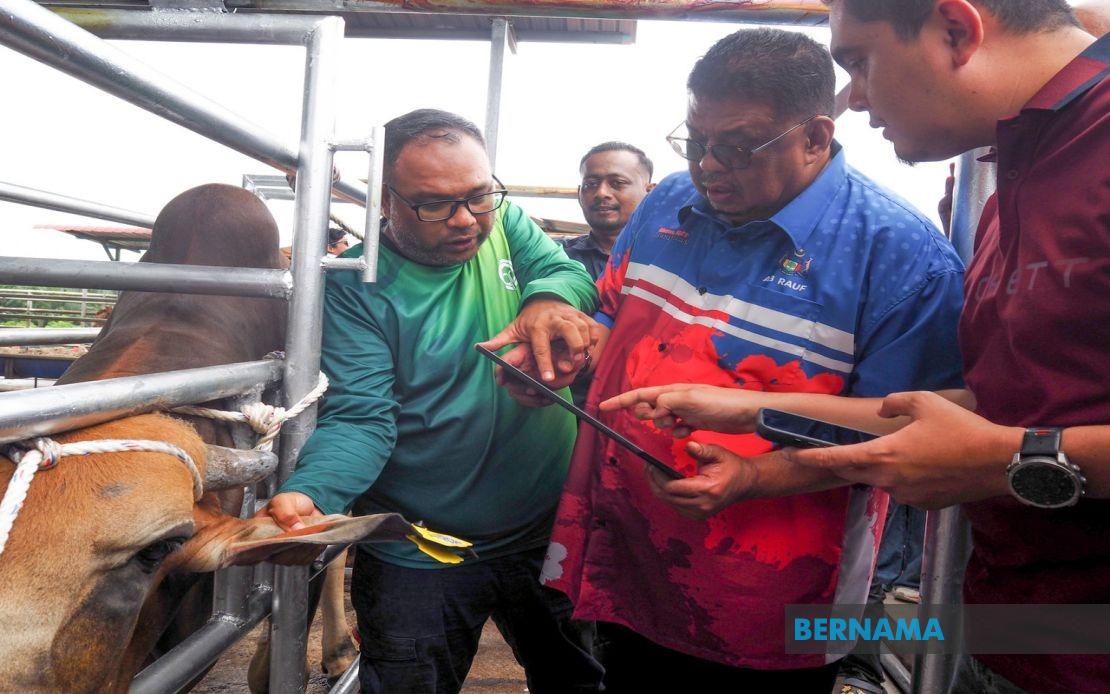
Melaka is modernising its approach to livestock management through a digital identification initiative that promises to reshape how authorities monitor and regulate the state's animal farming sector. The Livestock QR Tag system, unveiled by the state government in collaboration with the Melaka Veterinary Services Department, represents a significant shift towards smart governance in agricultural administration. Each participating animal receives a physical tag embedded with a QR code and unique identification number, enabling authorities and the public to access owner information instantly via smartphone. The scheme reflects a broader effort by Melaka to integrate technology into governance, moving beyond traditional paper-based record-keeping to create a more responsive and accountable farming ecosystem.
The initiative originated from Chief Minister Datuk Seri Ab Rauf Yusoh and was spearheaded by officials within the Melaka Chief Minister Department's Local Government Unit. According to Mahathir Mustafa, chief assistant secretary of the Local Government Unit, the system was designed to address a growing challenge: identifying livestock owners when animals stray or cause incidents. By digitising ownership records and making them instantly accessible, authorities can now respond swiftly to complaints and accidents, fundamentally changing how the state manages livestock-related public safety issues. This technological integration sits within Melaka's stated ambition to become a smart and livable state, positioning agricultural administration as a key component of digital transformation.
The rollout began modestly but with clear scalability targets. As of early June this year, approximately 2,000 livestock had been fitted with the QR Tags, establishing a proof-of-concept across the state. However, the state government harbours considerably more ambitious expansion plans, aiming to eventually tag the entire registered population of cattle and buffaloes in Melaka—estimated to exceed 32,000 animals. This phased approach allows authorities to refine processes, gather data on system effectiveness, and address any technical or logistical challenges before full-scale implementation. The gradual rollout also provides farmers time to adapt to the new registration requirements and understand the benefits of participation.
The urgency behind this initiative becomes clear when examining recent accident and complaint statistics. Since 2023, Melaka has recorded 835 incidents involving livestock and fielded more than 50 formal complaints regarding stray animals. These figures underscore a genuine public safety concern, particularly for road users who face unpredictable hazards from loose animals. Beyond accidents, stray livestock generate persistent community frustration and strain on local authority resources, as officials must respond to complaints without reliable means of locating and contacting owners. The QR Tag system directly addresses this operational bottleneck by providing immediate access to contact details and farm location information, dramatically reducing response times and enabling swifter resolution of incidents.
Functionally, the system operates through remarkably simple technology deployed for practical effect. When scanning a tag with a smartphone, users instantly retrieve the breeder's name, premises identification, and farm location—data sufficient for authorities to establish contact or conduct enforcement action. Critically, the tag remains permanently affixed to the animal throughout its lifetime, retaining its original identification number even if the animal is sold or transferred between owners. This permanence ensures that ownership chains remain traceable and prevents the deliberate obscuring of owner information. However, the system maintains flexibility: when livestock change hands, only the new owner's details require updating in the eVetPermit Malaysia database, ensuring records remain current without requiring physical tag replacement.
For breeders, the system introduces both accountability and potential protective benefits. By formalising ownership through the QR Tag, farmers can prove legitimate possession of animals, a safeguard against theft and unauthorised claims. Mahathir Mustafa noted that industry feedback has been encouraging, with breeders recognising the system as a means to strengthen their interests and enhance the reputation of Melaka's livestock sector. This positive reception suggests that when technology is perceived as serving farmers' interests alongside regulatory objectives, adoption rates tend to improve significantly. The industry's receptiveness also reflects growing recognition among producers that professional, transparent management practices ultimately benefit their standing and market position.
Enforcement capabilities expand substantially through this infrastructure. Authorities can now monitor livestock movement patterns, track disease outbreaks more efficiently across herds, and identify which animals belong to non-compliant owners. The system transforms stray livestock from an intractable management problem into a solvable enforcement challenge. When an animal is found straying, authorities can immediately identify the responsible party and, if necessary, pursue penalties or corrective actions. This capacity to identify and locate owners rapidly fundamentally alters the cost-benefit calculation for farmers inclined towards negligent animal management, as the prospect of swift identification and accountability becomes far more credible.
Financial arrangements reflect a deliberate policy choice to encourage rapid adoption during the implementation phase. Until the end of 2024, the state government bears the entire cost of tag installation, set at RM6.50 per animal. Farmers need only register livestock with the Melaka Veterinary Services Department to receive tags at no expense, effectively eliminating financial barriers to participation. This subsidy period functions as an incentive window, allowing the government to build a large installed base while demonstrating system benefits to the farming community. Beginning in 2027, the cost structure transitions: new tags and replacements will be charged at RM5 per head, reflecting a modest administrative fee rather than a commercial price. This tiered approach balances long-term financial sustainability with short-term adoption incentives.
The implementation framework emphasises collaborative governance across multiple state institutions. Successful deployment requires coordinated effort between the Local Government Unit, the Veterinary Services Department, and municipal authorities at the district level. Mahathir Mustafa stressed that this institutional coordination represents a critical success factor, as execution ultimately depends on field-level consistency across multiple agencies and local governments. The emphasis on cross-departmental cooperation signals an understanding that technology alone insufficient; sustainable systems require aligned incentives, clear protocols, and genuine commitment across all implementing agencies. This institutional design lesson holds relevance beyond Melaka, as many government digitalisation initiatives falter precisely when coordination breaks down between agencies responsible for different execution components.
The QR Tag system also embodies a broader policy philosophy about data accessibility and public engagement. By enabling any smartphone user to scan a tag and access owner information, the system effectively deputises the general public as auxiliary enforcement agents. Members of the public who observe stray animals can now independently identify owners and notify them directly, supplementing formal authority responses. This distributed enforcement model leverages the state's most abundant resource—the attentive citizens who experience problems first-hand—to reinforce behavioural compliance. The accessibility of information through ordinary smartphones, rather than restricted official databases, represents a deliberate design choice to maximise practical engagement and social pressure toward responsible ownership.
Regional and sectoral implications merit consideration, particularly as other Malaysian states observe Melaka's progress. If the system proves operationally effective and achieves its cost and safety targets, replication across other jurisdictions becomes plausible. States with comparable livestock populations and stray animal challenges could adapt the model, potentially accelerating the transition toward standardised, technology-enabled agricultural administration across Malaysia. The system also demonstrates how governments can harness relatively modest technological investment—QR codes are inexpensive and widely understood—to achieve significant management improvements. For other sectors beyond livestock, the Melaka approach offers a transferable template for digital identification and accountability mechanisms that could enhance oversight of regulated industries and service providers.
Longer-term prospects depend substantially on consistent enforcement and public perception. The system's effectiveness ultimately rests on authorities and farmers viewing it as legitimate, beneficial, and worth sustained commitment beyond the initial launch phase. If compliance rates remain low or if the promised safety improvements fail to materialise, enthusiasm may wane. Conversely, if early results demonstrate significant reductions in stray livestock incidents and faster resolution of complaints, the system could become politically popular and self-reinforcing, as positive outcomes justify continued investment. The coming years will prove instructive for Malaysian governance more broadly, illustrating whether technology-enabled agricultural administration can deliver measurable public benefits and encourage voluntary compliance from regulated industries.

