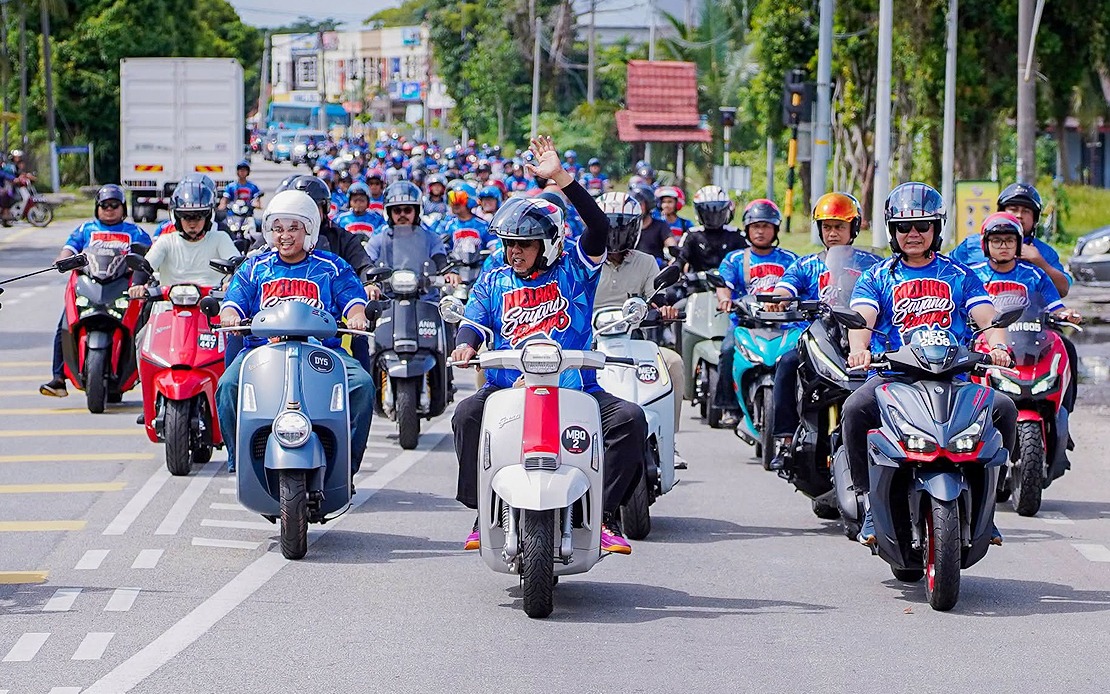
Melaka Chief Minister Datuk Seri Ab Rauf Yusoh has signalled a deepening commitment to neighbourhood-level governance with the latest rollout of the Tangga Batu parliamentary WRUR programme, a comprehensive outreach framework designed to address persistent grassroots concerns while strengthening the state government's institutional ties to constituent communities. The expanded initiative, branded Kampung Kita, will span the Pantai Kundor and Paya Rumput state constituencies through two distinct implementation phases, with the Chief Minister emphasising that the undertaking reflects an institutionalised approach rather than episodic political campaigning.
The scope of the revitalised programme underscores the breadth of contemporary governance expectations. Over 200 discrete initiatives will unfold across complementary thematic areas—welfare support, community infrastructure, educational advancement, youth development, and commercial enterprise enablement—alongside dedicated mechanisms for identifying and resolving persistent local friction points. This granular approach suggests recognition among state administrators that effective governance increasingly depends on the capacity to coordinate responses across multiple policy domains simultaneously, translating broad electoral mandates into concrete neighbourhood improvements.
Ab Rauf positioned the WRUR initiative as an entrenched policy instrument rather than a temporary electoral tactic, underscoring that the programme represents the continuation of an intensive ground engagement methodology maintained consistently across the preceding two years. This framing carries significance for Malaysian political observers, as it signals the formalisation of what might otherwise be dismissed as conventional campaigning into a more systematic governance framework. The Chief Minister's emphasis on continuity suggests awareness that Malaysian voters increasingly differentiate between performative political appearances and sustained institutional commitment to problem-solving.
The quantitative returns from previous WRUR implementations provide a measurable foundation for the current expansion. Across twenty-three prior implementation series, administrators documented receipt of more than 4,000 community complaints, with approximately seventy percent achieving successful resolution. Within the Tangga Batu parliamentary constituency specifically, earlier iterations conducted in the Sungai Udang and Kelebang state constituencies generated 359 formal complaints, of which 328 were resolved while thirty-one remained under active follow-up. These figures, though modest in absolute terms, demonstrate a systematic recording and tracking capability that remains underdeveloped in many Malaysian state administrations.
The distribution of targeted financial assistance during the sixth programme phase illustrates the granular approach to welfare delivery that characterises the WRUR framework. More than twenty distinct categories of aid, aggregating RM150,000 in value, reached differentiated beneficiary groups according to occupational and circumstantial criteria. Fishermen received RM22,000 distributed across 220 individuals, while boat owners affected by maritime incidents secured RM1,500 in support, and emerging entrepreneurs obtained RM14,000 in business equipment. These allocations demonstrate deliberate calibration of assistance levels to specific sectoral challenges, though the relatively modest per-capita disbursements raise questions about sustainability and sufficiency of support for long-term livelihood transformation.
Beyond direct cash transfers, the WRUR mechanism channels resources toward institutional strengthening, with contributions directed to religious education establishments, houses of worship, educational merit support, and residential rehabilitation. This diversified allocation reflects an understanding that community cohesion depends on sustained investment across multiple institutional nodes—spiritual, educational, and domestic—rather than isolated household welfare payments. For Malaysian policymakers across different states, the Melaka model presents a potentially replicable framework for integrating welfare provision with institutional development.
Infrastructural remediation constitutes a critical dimension of the current WRUR expansion, particularly given recent environmental vulnerability demonstrated by flash-flooding episodes. The Department of Irrigation and Drainage has mobilised RM50,000 in resources for cleaning and maintenance interventions along Sungai Seberang Gajah, addressing water management challenges that precipitated inundation affecting seventy-three residential units in Pantai Kundor. This rapid operational response suggests administrative capacity to translate constituent complaints into targeted infrastructure work, though the compressed completion timeline of one week raises durability concerns for remediation works in flood-prone environments.
The infrastructure pipeline extends beyond immediate flood mitigation, encompassing longer-term capital development that addresses structural vulnerabilities in the constituency's transportation and water management systems. The Department of Irrigation and Drainage has commenced procurement procedures for Sungai Lereh improvement works valued at RM100,000, while the Public Works Department has initiated federal approval processes for a substantially larger RM16 million project to upgrade crossing culvert infrastructure on the Jalan Tangga Batu-Tanjung Minyak corridor. These layered capital investments—ranging from preventive maintenance to major structural upgrade—suggest recognition that sustained community resilience requires integrated infrastructure planning across multiple administrative timeframes.
For Malaysian observers, the Tangga Batu WRUR expansion carries implications extending beyond Melaka's administrative boundaries. The initiative demonstrates how state-level administrations can systematise complaint resolution and targeted investment using relatively modest financial allocations distributed through multiple channels. The reported seventy percent resolution rate, while imperfect, suggests that structured institutional processes can translate community grievances into administrative action, a proposition increasingly important as Malaysian voters expect tangible governance responsiveness. Southeast Asian regional dynamics likewise warrant consideration, as similar grassroots engagement methodologies—particularly the combination of welfare assistance with infrastructure investment—increasingly characterise neighbourhood-level governance across emerging democracies facing electoral competitiveness.
The sustainability and scalability of the WRUR model remain open questions for Melaka administrators and observers elsewhere. While the demonstrated complaint resolution capacity and the integration of welfare and infrastructure investments suggest administrative maturation, the per-capita assistance levels and the reliance on episodic programme launches rather than permanent institutional structures raise durability concerns. Malaysian state governments seeking to replicate or adapt the Melaka framework must grapple with questions of permanent funding allocation, inter-departmental coordination capacity, and mechanisms for sustaining response systems beyond electoral cycles.

