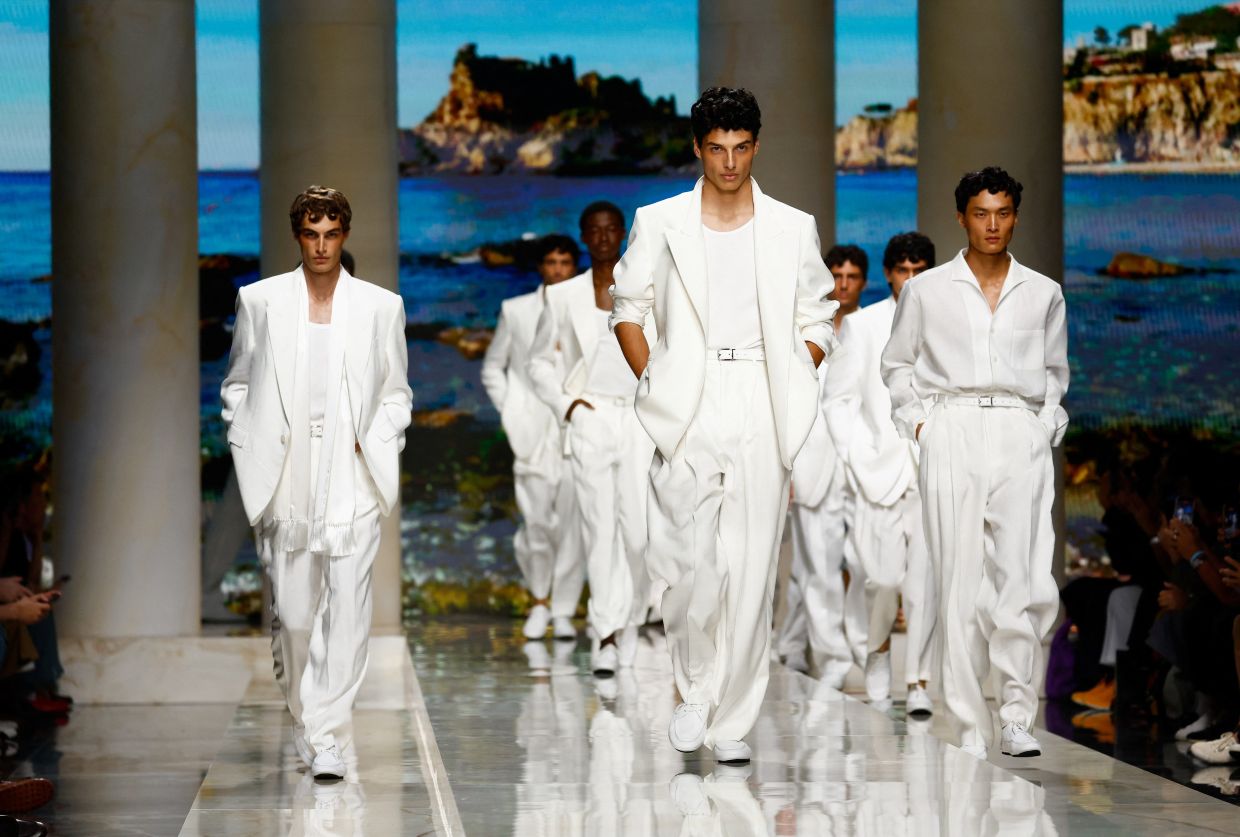
As the world wrestles with economic headwinds and mounting geopolitical pressures, Milan's menswear designers have responded by stripping their collections back to essentials. The Spring/Summer 2027 presentations that concluded on Monday demonstrated a marked shift towards restraint, with fashion's most prominent houses prioritizing clean silhouettes and reimagined proportions over the maximalist excess that has dominated recent seasons. This philosophical recalibration reflects a broader industry sentiment that in turbulent times, consumers gravitate towards clothing that feels grounded and purposeful rather than ostentatious.
Prada emerged as the spiritual leader of this minimalist movement, with co-creative directors Miuccia Prada and Raf Simons making a compelling case for simplicity as sophistication. Their approach hinged on stripping familiar garments down to their archetypal forms, then rebuilding them through precision tailoring and unexpected material choices. This strategy proved remarkably influential across the Milanese calendar, signalling that luxury in 2027 increasingly means restraint rather than excess. The philosophy extended beyond mere aesthetics; it represented a conscious rejection of the throwaway fashion culture that has dominated the past decade, suggesting that sustainability and durability have become genuine value propositions rather than marketing talking points.
Yet Milan presented a fascinating paradox: while designers championed simplicity, many refused to sacrifice comfort to the Milanese summer heat. The collections bristled with leather and densely knitted fabrics destined for next summer's warmest months, a contradiction that revealed the persistent tension between fashion's aspirational ideals and practical wearability. Prada's solution was particularly ingenious, drawing inspiration from the universal vocabulary of blue jeans. The house paired slim five-pocket leather trousers with cropped, flat-pocketed jackets that functioned as shirts, essentially deconstructing and recontextualizing a working-class staple within a luxury framework. This appropriation of denim's democratic appeal signals that the old hierarchies separating high and low fashion continue to erode.
Other designers tackled the breathability challenge through technical innovation. Perforated and woven leather techniques appeared throughout the week, transforming what might otherwise be an impractical material into something theoretically suited for warm climates. These experimental fabrications suggest that Milan's menswear elite anticipate their clientele will either inhabit climate-controlled environments, relocate seasonally to cooler regions, or possess sufficient resources to remain unbothered by meteorological realities. For Southeast Asian readers, this disconnect between design aspiration and tropical practicality merits observation; the region's emerging luxury markets may increasingly demand collections specifically engineered for humid, warm conditions rather than automatically adopting Northern Hemisphere fashion calendars.
A significant departure from recent precedent involved the wholesale return to body-conscious dressing after years of oversized, deliberately shapeless silhouettes. The pendulum has swung decisively back towards fitted tailoring that accentuates rather than obscures the wearer's physique. However, designers approached this recalibration with considerable nuance, avoiding the aggressive, punitive tightness that characterized 1990s minimalism. Instead, the new precision manifested as softened construction, lowered necklines, and experimental fabric choices that permitted greater airflow without abandoning formal structure. Dolce & Gabbana pushed this philosophy furthest with daring microshorts that exposed substantial leg, while other houses selectively revealed torsos beneath dramatically opened dress shirts.
The evolution of tailoring itself represented perhaps the most consequential development for menswear's immediate future. Rather than abandoning the suit—that foundational garment of masculine formality—designers reimagined it as a fundamentally adaptable template. Relaxed jacket constructions eliminated heavy interlining, broader necklines invited more generous air circulation, and fabrication experiments introduced unexpected textures and weights. American designer Thom Browne, operating under Zegna ownership and returning to Milan for the first time since 2008, demonstrated this adaptive approach through layered suiting constructed from summery seersucker and pleated elements drawn from skirt construction. Browne's collection embodied a radical proposition: that masculine elegance and gender-fluid design elements need not contradict one another, opening conceptual space for Southeast Asian menswear markets to similarly experiment with traditional formal wear.
Not every designer embraced the season's predominant aesthetic of measured restraint. Philipp Plein and Dolce & Gabbana both champions of unabashed embellishment presented collections that doubled down on decoration and visual excess. Plein's crystal-encrusted denim required days of intensive handwork per garment, representing fashion as labour-intensive luxury rather than practical clothing. Similarly, Dolce & Gabbana layered beaded accents reminiscent of coral formations across their presentations, proving that maximalism retains powerful advocates within Milan's hierarchy. This simultaneous embrace of competing philosophies—reduction versus ornamentation—suggests the market remains sufficiently fragmented that multiple narratives can coexist and prosper.
The lightened calendar structure of Milan Fashion Week itself facilitated visibility for emerging designers who might otherwise struggle for attention amidst the established houses. Copenhagen-based Martin Quad made his Milan debut with unconventional tailoring techniques that had already earned recognition in Scandinavia, while Domenico Orefice attracted notice through his confident manipulation of leather and richly textured woven materials within a co-ed collection framework. Japanese designer Shinya Kozuka's eponymous label delivered perhaps the most poetically coherent vision of the season, sending a bare-chested model down the runway in a billowing sheer teal coat paired with relaxed white trousers—an image that distilled the week's competing impulses toward both minimalism and sensuality.
For Malaysian and broader Southeast Asian fashion industries, Milan's Spring/Summer 2027 message carries several implications. The legitimization of lighter, more breathable tailoring approaches suggests opportunity for regional designers to develop collections specifically engineered for tropical climates rather than adapting imported Northern Hemisphere aesthetics. The demonstrated appetite for simplicity and proportion-based sophistication counters the assumption that emerging Asian markets inevitably desire ostentatious luxury, potentially positioning restraint-focused collections as markers of elevated taste. Furthermore, the growing influence of gender-fluid design elements and the experimental deconstruction of traditional menswear codes create space for Southeast Asian design traditions—many of which feature fluid silhouettes, lightweight fabrics, and non-binary dress codes—to inform global menswear conversations rather than perpetually following them. Milan's collections thus represent not merely fashion's response to global uncertainty, but an opening for alternative aesthetic traditions to claim international legitimacy.

