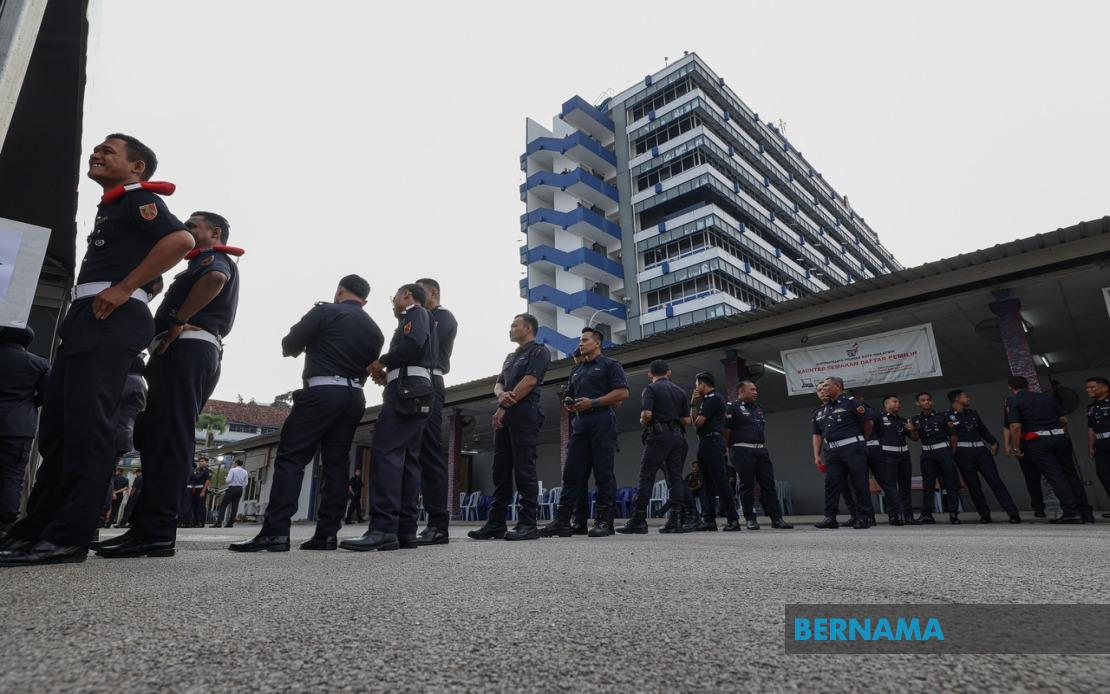
Armed forces and police personnel across Negeri Sembilan exercised their electoral rights on Sunday through an early voting mechanism, with 1,481 military personnel and their spouses participating at the Army Basic Training Centre (PUSASDA) in Port Dickson, while 979 officers and their families voted at the state police headquarters in Seremban. The dual voting exercise underscores the logistics and planning required to accommodate uniformed services personnel ahead of the 16th Negeri Sembilan State Election, scheduled for Saturday polling day.
The military contingent's participation in the early voting process involved 11 separate polling streams operating throughout the day from 8 am until 5 pm, with eligible voters representing the Bagan Pinang constituency. The organization reflects the Election Commission's efforts to facilitate voting among personnel who may have operational commitments or movement restrictions on the official polling date. Despite the early timing, prospective voters demonstrated keen participation, with several beginning to queue from 7 am—an hour before official commencement—indicating strong engagement with the democratic process among uniformed service members.
The Bagan Pinang contest presents voters with a competitive three-way race that cuts across Malaysia's major political coalitions. Abdul Fatah Zakaria represents Perikatan Nasional as the incumbent seeking to retain his seat, while Sheikh Junaidy Jamaludin carries Parti Pribumi Bersatu Malaysia's banner, and Pakatan Harapan fields Nasir Raman as its candidate. The presence of all three major political groupings reflects the increasingly fragmented electoral landscape that has characterized Malaysian politics since the 2018 general election. Military personnel in this constituency will thus play a potentially decisive role in determining the outcome, particularly if the contest remains close between establishment and opposition forces.
Army Chief Gen Tan Sri Azhan Md Othman planned to observe proceedings at PUSASDA during the mid-morning hours, reflecting institutional interest in ensuring smooth administration of the early voting exercise. Such observations by senior military leadership carry symbolic weight, reinforcing organizational commitment to the electoral process and demonstrating that voting participation aligns with institutional values. The presence of top-ranking officials at polling stations also serves to maintain discipline and order throughout the day's proceedings.
On the police side, operations proceeded simultaneously at the Negeri Sembilan Police Contingent Headquarters in Seremban, where the 979 eligible officers and their family members cast votes for the Temiang constituency. Assistant Superintendent of Police Harminder Singh Pritam Singh became the first voter to cast a ballot at Stream 1, symbolically opening the police voting exercise. The structured approach to administering multiple voting streams reflected careful planning to manage the large volume of personnel efficiently while maintaining election security and transparency standards.
Notably, high-profile security sector personnel participated in the voting exercise, including Datuk Ahmad Dzaffir Mohd Yussof, a Home Ministry-based Crime Prevention Board member who previously held senior positions at Bukit Aman and served as Negeri Sembilan's police chief. The presence of such officials among early voters underscores how the electoral exercise extends across institutional hierarchies rather than being confined to operational-rank personnel. Their participation legitimizes the process within security sector circles and suggests broad acceptance of the democratic mechanism across different career levels.
Temiang, the constituency where police personnel were voting, presents another closely-fought electoral battle. The race features Ho Weng Wah of Pakatan Harapan, Leaw Kok Chan representing Barisan Nasional, and Bersatu's Fazly Hamid. The three-cornered nature of this contest mirrors the pattern in Bagan Pinang, with police votes potentially carrying electoral significance should the final tally prove narrow. Negeri Sembilan's police chief Datuk Alzafny Ahmad visited the headquarters during the voting process to monitor operations, with plans to address the media at Nilai District Police Headquarters later in the morning.
The early voting framework operates across 38 polling centres throughout Negeri Sembilan, with voting periods varying by location. Eighteen centres closed at midday, two at 2 pm, and the remaining eighteen completed voting at 5 pm. This staggered approach reflects administrative geography and population distribution across the state, ensuring equitable access to voting regardless of operational location. In total, the eligible voting pool encompasses 16,884 military personnel and their spouses alongside 5,455 police personnel and their families—figures that collectively represent substantial constituencies whose votes could prove decisive in several closely-contested seats.
The implementation of early voting for uniformed services personnel reflects international best practice in electoral administration, recognizing that military and police commitments may create obstacles to participation on standard polling days. By establishing dedicated voting facilities and extended operating hours, electoral authorities remove practical barriers that might otherwise depress turnout among these groups. This accommodation also demonstrates commitment to inclusive representation, ensuring that citizens serving in security roles maintain full electoral participation despite operational demands.
For Malaysian electoral observers and analysts, the early voting results from these uniformed services constituencies will offer preliminary indicators of support distribution before the main polling day. Traditionally, voting patterns among military and police personnel have carried disproportionate analytical weight, sometimes signalling broader electoral trends or consolidation around particular political camps. The three-way contests in both Bagan Pinang and Temiang mean that no candidate can rely on automatic support from institutional voting blocs, potentially resulting in higher-than-expected fragmentation of the vote share.
The Negeri Sembilan state election occurs within Malaysia's broader context of political realignment and coalition reconfiguration. The presence of Bersatu candidates in both early voting constituencies reflects the party's assertive positioning since its formation and separation from the broader Mahathir alliance. The competition between three distinct political formations—Perikatan Nasional, Pakatan Harapan, and the government-aligned Barisan Nasional—suggests that Negeri Sembilan will serve as a genuine three-way contest rather than a straightforward incumbent-challenger battle. How uniformed services personnel split their votes across these options may indicate broader voter sentiment heading toward the Saturday election.
The logistical success of conducting early voting for over 2,400 military and police personnel across multiple polling streams in two separate venues demonstrates the Election Commission's institutional capacity and attention to operational detail. The coordination required to accommodate such numbers while maintaining security, transparency, and electoral integrity reflects lessons learned from previous elections and improvements to administrative procedures. As Negeri Sembilan moves toward Saturday's main polling day, results from these early voting cohorts will gradually become available, offering the first concrete data on how different voter blocs are leaning across the state's contested constituencies.

