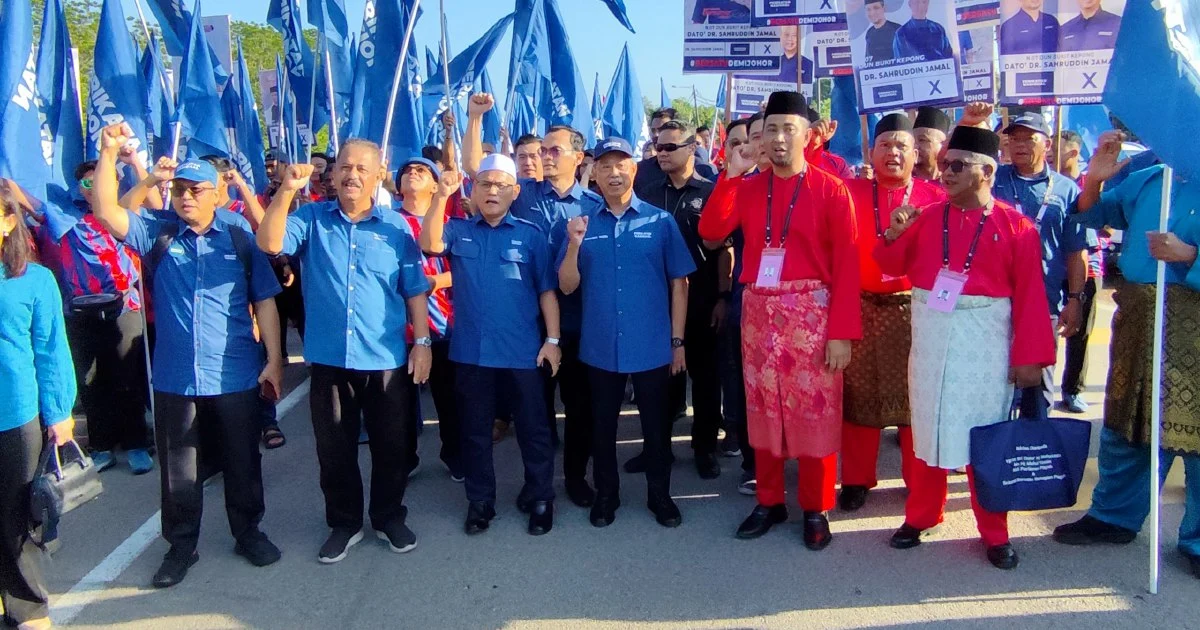
Bersatu president Tan Sri Muhyiddin Yassin made a high-profile appearance at the nomination centre in Pagoh on Monday morning, arriving at 8.45 am at the Sports Complex Hall to personally support the party's candidate for the Bukit Kepong constituency. The move underscored the party's determination to retain its foothold in Johor as the state election campaign enters a critical phase.
Muhyiddin's presence alongside Sahruddin carries substantial symbolic weight in Malaysian politics. As Bersatu's de facto leader since the party's formation in 2016, his personal campaigning sends a clear message about which contests the party views as winnable and strategically important. The decision to accompany the Bukit Kepong nominee rather than remaining at party headquarters signals confidence in the candidacy and a willingness to commit senior leadership resources to ground-level mobilisation.
Bukit Kepong represents a key battleground in the Johor electoral landscape. The constituency encompasses mixed urban and semi-rural voter demographics, making it the type of swing seat that often determines overall election outcomes. Bersatu's ability to hold or gain ground in such areas will significantly influence whether the party can strengthen its position in Johor's state assembly or faces contraction. The presence of the party president underscores how seriously Bersatu views this particular contest.
The broader context of Johor politics has shifted considerably in recent years. With Bersatu having pulled away from the Perikatan Nasional coalition to align more closely with Anwar Ibrahim's administration at federal level, the party's standing in state-level contests has become increasingly precarious. Several Bersatu representatives have defected or questioned their party allegiance, making internal unity and enthusiastic campaigning all the more critical for retention of current seats.
Muhyiddin's active campaigning also reflects broader concerns about voter turnout and momentum. State elections in Malaysia often see reduced participation compared to federal contests, meaning parties must work harder to energise their base and secure committed supporters. Personal appearances by senior figures help generate media attention and convey to grassroots activists that the party leadership is genuinely invested in the outcome, which translates into more robust canvassing operations.
For Sahruddin specifically, having the party president's endorsement at the nomination stage provides considerable credibility with undecided voters and reassurance to existing supporters. In Malaysian electoral culture, association with recognisable senior figures frequently influences voting patterns, particularly among less politically engaged segments of the electorate. This backing effectively communicates that Sahruddin represents not merely an individual candidate but the formal party machinery.
The nomination process itself marks a formal threshold in the electoral calendar. Candidates must be officially nominated during designated nomination periods, and the appearance of prominent party figures at these ceremonies serves multiple functions: it demonstrates party strength to media observers, energises volunteer activists, and allows for simultaneous media engagement. Muhyiddin's 8.45 am arrival suggests a structured campaign schedule, with the party likely organising additional events throughout the day.
Johor's electoral significance extends beyond state assembly dynamics into national political calculations. As one of Malaysia's most populous and economically developed states, electoral trends in Johor often presage broader national movements. Results here influence federal coalition arithmetic and provide barometers for measuring public acceptance of national government policies. This explains why national-level figures like Muhyiddin invest time in state-level campaigns.
The nomination centre location at a sports complex in Pagoh also carries practical advantages. Sports facilities typically possess adequate parking, meeting spaces, and security infrastructure necessary for managing political campaigns. The choice of venue reflects organisational competence and ability to accommodate supporters and media, matters that subtly influence voter perceptions of party professionalism.
Bersatu's strategy in Johor appears to centre on consolidating existing voter coalitions while attempting modest expansion into previously contested areas. By pairing senior leadership presence with on-ground candidacy, the party aims to demonstrate both stability and growth potential. Whether this approach proves sufficient against competitors will become clearer as polling day approaches and actual voting patterns emerge.
The nomination phase also allows rival parties to gauge Bersatu's confidence levels through examining which constituencies receive senior attention. The deployment of Muhyiddin specifically, rather than a more junior party official, suggests Bukit Kepong ranks among the party's defensive priorities or represents a genuine expansion opportunity. Such calculations influence how opposition parties allocate their own finite campaign resources.

