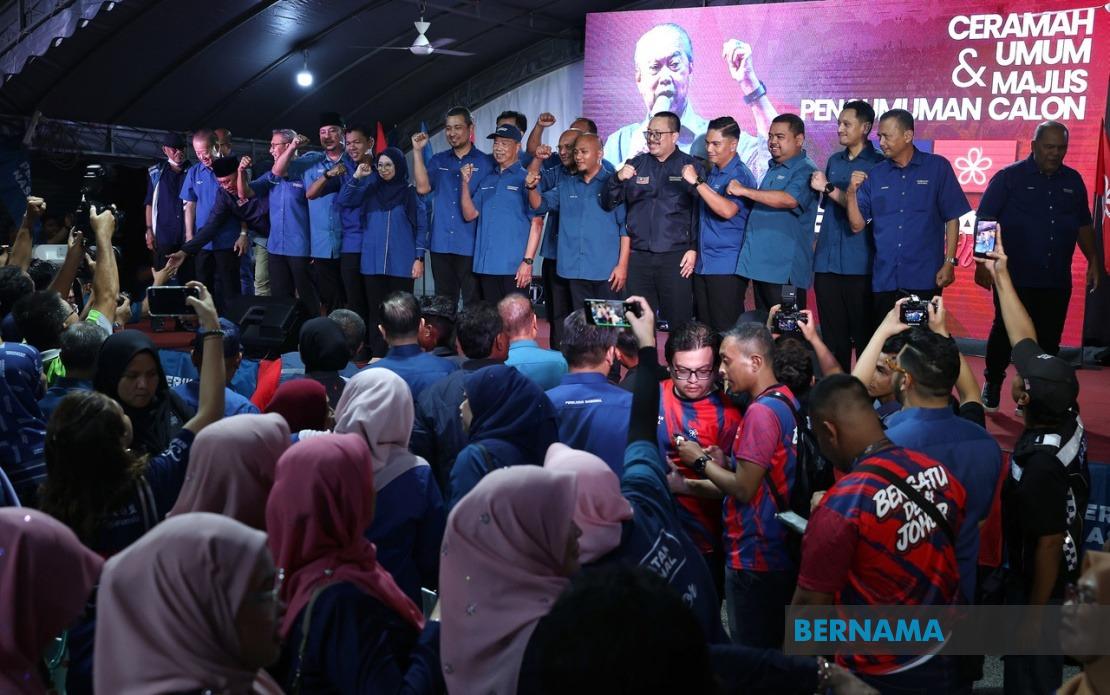
Tan Sri Muhyiddin Yassin, president of Parti Pribumi Bersatu Malaysia (Bersatu), unveiled the party's complete slate of 16 candidates for the upcoming Johor State Election during a public gathering in Muar on Tuesday evening. The announcement came at a dedicated event held at the Pagoh Parliamentary Service Centre in Taman Pagoh Jaya, where party officials and supporters gathered to hear the leadership's strategic positioning ahead of the state-level contest.
The Johor State Election represents a critical moment for Bersatu, which has maintained a significant presence in Malaysia's largest state by population despite ongoing political realignments at the federal level. The party's decision to field a full slate across all 16 contested seats signals its commitment to challenging for control of the state assembly, where coalitional mathematics will ultimately determine which bloc forms government. The inclusion of candidates across diverse constituencies reflects Bersatu's ambitions to establish grassroots support in both urban and rural voting blocs throughout Johor.
The Election Commission has structured the electoral timeline with precision, designating June 27 as the official nomination day when all parties must formally register their candidates and supporting proposers. This compressed schedule allows political machines less than two days to finalize their candidate registration after the evening's announcement, a demanding logistical requirement that tests each party's organizational capacity. The subsequent polling date of July 11 has been set as the culmination of a campaigning period that will unfold across the state's diverse constituencies, from the developed urban corridors around Johor Bahru to the more rural and agricultural regions inland.
The state assembly itself was formally dissolved on June 1, clearing the constitutional pathway for the election to proceed. This dissolution followed political developments that necessitated the return to voters rather than a continuation of the previous assembly configuration. For Bersatu, which has held several state seats in previous assemblies, the election offers an opportunity to either consolidate or expand its representation, depending on how voters respond to its campaigning and coalition positioning during the month-long lead-up to polling day.
Muhyiddin's public unveiling of the candidate list serves multiple strategic purposes beyond the mere announcement of names. The event functioned as a campaign launching pad, allowing the party president to articulate Bersatu's vision for Johor's governance and to build momentum among party grassroots ahead of the intensive campaigning phase. By holding the announcement in Pagoh, a constituency of historical and strategic importance within Johor politics, the leadership signaled the party's seriousness about contesting competitive seats and mobilizing support across different voter demographics.
For Malaysian political observers, Bersatu's full participation in the Johor election underscores the party's continued relevance in state-level politics despite its fluctuating fortunes at the federal level. Since its formation in 2016, Bersatu has positioned itself as a vehicle for regional political interests and leadership, particularly under Muhyiddin's stewardship. The party's commitment to fielding candidates across all contested seats demonstrates confidence in its ground organization and electoral machinery, even as broader coalitional partnerships shape the ultimate outcome of the election.
The Southeast Asian context adds another layer of significance to Johor's electoral contest. As the state most directly connected to Singapore through trade, labor migration, and daily cross-border movement, Johor's governance decisions carry implications for bilateral relations and regional economic integration. Bersatu's positioning in any post-election government will influence how Johor approaches issues ranging from infrastructure development to labor policy to environmental management—matters that affect not only Johor residents but also Singapore's economic planners and Southeast Asia's broader trade networks.
The candidate announcement also reflects Bersatu's internal party dynamics and power structures. The selection of individuals to represent the party across 16 different constituencies involved internal party deliberations, coalition negotiations, and assessments of electoral viability in different geographic and demographic settings. Muhyiddin's direct involvement in the public announcement reinforces his position as the party's ultimate decision-maker on electoral strategy, consolidating his leadership authority heading into what will be a demanding campaign phase.
For voters in Johor, the election presents a choice among competing visions for the state's development. Bersatu's campaign messaging will need to resonate with constituencies that include both highly urbanized areas and more rural communities, with diverse economic bases ranging from manufacturing to agriculture to services. The party's 16 candidates will carry messages about economic management, public services, infrastructure investment, and governance quality as they seek to persuade voters during the campaign period.
The election itself will be closely watched not only by Johor residents but by political analysts across Malaysia and the wider region. State elections serve as important barometers of voter sentiment and coalition strength, with results often influencing federal-level political calculations and leadership confidence. Bersatu's performance in Johor—measured both in the number of seats won and in the overall vote share achieved—will provide insights into the party's electoral resilience and its capacity to mobilize supporters around a coherent political message.
As campaigning intensifies across Johor's constituencies between now and July 11, the 16 candidates announced by Muhyiddin will become the visible face of Bersatu's campaign at the grassroots level. Their ability to connect with voters, address local concerns, and build support networks will ultimately determine whether Bersatu expands, maintains, or reduces its presence in the state assembly. The election represents both a test of the party's electoral machinery and an opportunity for Bersatu to demonstrate its relevance to Johor voters in an increasingly complex and competitive political landscape.

