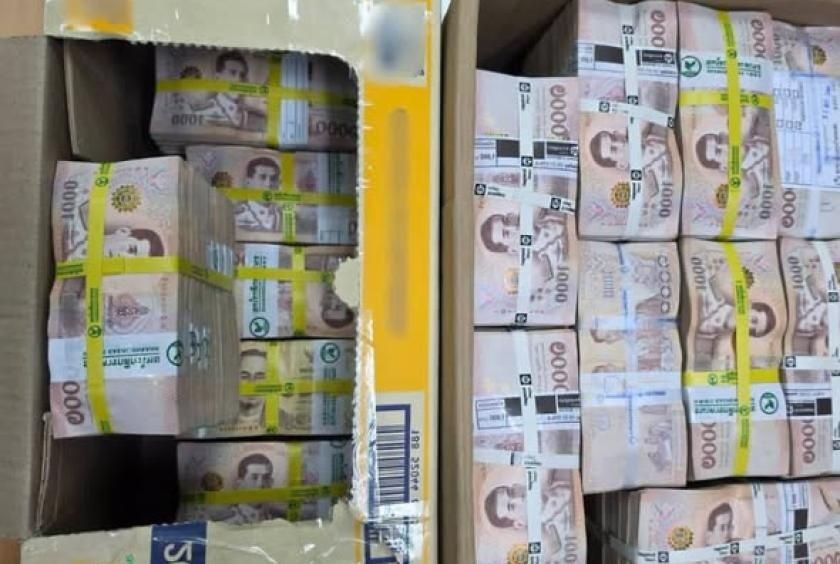
Customs enforcement at Thailand's Mae Sai checkpoint has apprehended a Myanmar driver suspected of orchestrating a significant currency smuggling operation. During a routine vehicle inspection at the Thai-Myanmar Friendship Bridge, authorities uncovered more than 23 million baht—equivalent to approximately US$689,077—concealed within ordinary food packaging. The discovery represents a substantial breach of Thailand's foreign exchange regulations and highlights persistent vulnerabilities in cross-border financial controls along one of Southeast Asia's busiest trade corridors.
The interception occurred when customs officials flagged a privately owned vehicle registered in Myanmar as it approached the border control point. Standard inspection procedures revealed an elaborate concealment method in which bundles of 1,000-baht notes had been strategically packed inside plastic bags and then inserted into cartons ostensibly containing dried fish and potatoes. The first carton contained approximately 17 million baht, while the second held an additional 6.023 million baht, bringing the total seized amount to 23.023 million baht. The sophistication of this packing arrangement suggests pre-planned coordination rather than spontaneous individual action.
The 31-year-old suspect, identified as the vehicle's driver, now faces charges under Thailand's Customs Act and foreign exchange control legislation. Being held at Mae Sai Police Station pending further questioning, he remains the focal point of an ongoing investigation that authorities suggest may extend beyond his individual involvement. Thai police have indicated that they are actively pursuing leads to identify potential accomplices or organisers who may have orchestrated this smuggling attempt, signalling that investigators suspect a broader network operating behind this single seizure.
This incident reflects longstanding challenges facing law enforcement agencies throughout mainland Southeast Asia. The Thai-Myanmar border, stretching across northern Thailand, remains a critical nexus for legitimate trade and illicit cross-border activities alike. Myanmar's economic instability and currency volatility have historically motivated attempts to move Thai baht—a comparatively stable currency—across borders for speculation or value preservation. Understanding the economic incentives driving such smuggling attempts provides crucial context for evaluating enforcement strategies and their effectiveness.
For Malaysia and other ASEAN nations, this seizure carries broader implications regarding regional financial security and money laundering controls. Thailand's efforts to interdict large-scale currency movements demonstrate the importance of coordinated customs and financial intelligence operations. However, the incident also underscores how determined smugglers continue adapting their methods, utilising innocent-appearing food products as cover for contraband. The reliance on visual inspection rather than advanced screening technologies at certain checkpoints remains a vulnerability that criminal networks appear willing to exploit.
The case arrives amid Thailand's ongoing crackdown on financial crime and efforts to strengthen compliance with Financial Action Task Force recommendations on anti-money laundering standards. Large unaccounted currency flows, particularly involving Thai baht moving outward, can indicate broader financial crimes including drug trafficking proceeds, corruption payments, or sanctions evasion. While this particular case remains focused on currency smuggling charges, Thai investigators will likely examine whether the movement of such substantial cash relates to other criminal enterprises operating across the porous Myanmar-Thailand border.
Mae Sai itself has become increasingly significant in regional security discussions as Myanmar's political instability has created safe havens for various criminal networks. The town serves as a crucial transit point for legitimate commerce between Thailand and Myanmar, but its position has also made it attractive to smugglers moving contraband in multiple directions. Authorities there have reported increases in both opioid trafficking and financial crimes, creating a complex enforcement environment where limited resources must address simultaneous challenges.
The arrest also raises questions about currency valuation incentives within Myanmar's economy. The Myanmar kyat has experienced significant depreciation relative to the Thai baht, particularly since the military coup in February 2021. This currency divergence creates arbitrage opportunities that motivate both legitimate and illegal financial flows. Individuals seeking to preserve value or move money across borders often prefer stable foreign currencies, explaining the appeal of Thai baht specifically in Myanmar's current economic context.
Thailand's customs and financial authorities have implemented enhanced monitoring protocols at major crossing points, yet seizures like this demonstrate that interdiction rates remain incomplete. The 23 million baht seizure represents merely one detected instance; law enforcement agencies acknowledge that undetected smuggling almost certainly continues operating at larger scales. Border communities often possess extensive knowledge of smuggling routes and methods, creating information asymmetries that complicate enforcement efforts.
Investigations proceeding from this seizure may eventually reveal connections to organized financial crime networks or potentially link to cases being pursued by authorities in Myanmar, Laos, or other jurisdictions. Coordinated intelligence sharing among ASEAN law enforcement agencies has improved incrementally, though significant gaps persist in real-time information exchange. The case demonstrates both the necessity and the limitations of individual border checkpoint effectiveness in combating transnational financial crime.
As Thailand continues strengthening its foreign exchange control mechanisms and updating border security protocols, cases like this provide valuable intelligence regarding smuggling methodologies and operational patterns. The carton concealment technique, while relatively straightforward, proved effective enough to warrant serious interdiction efforts. More sophisticated approaches—including use of mules, fragmented shipments, and financial system manipulation—likely account for far larger undetected currency movements. This arrest, while significant, probably represents only a fraction of attempted cross-border cash smuggling occurring throughout the region.

