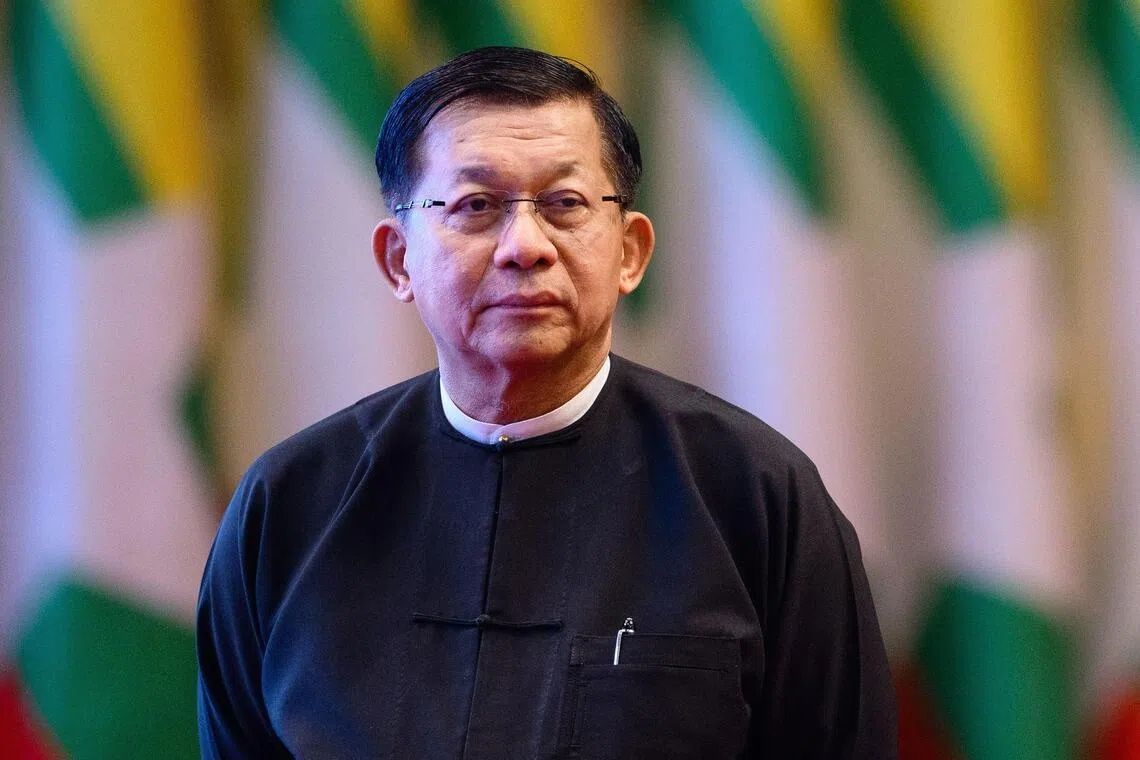
Myanmar's former military strongman Min Aung Hlaing is arriving in Thailand on Thursday for what amounts to a carefully choreographed rehabilitation effort, marking his inaugural foreign visit since trading his general's uniform for the civilian presidency. The journey underscores Bangkok's determination to restore Myanmar to the regional diplomatic mainstream, even as the country remains locked in a devastating civil conflict and its new leader faces international isolation and criminal accountability charges.
Min Aung Hlaing orchestrated the February 2021 military coup that toppled Myanmar's elected government and imprisoned democracy advocate Aung San Suu Kyi. The subsequent armed conflict has mushroomed into a multi-sided civil war that observers estimate has claimed more than 100,000 lives across all factions. Following elections dismissed by democracy monitoring groups and Western governments as theatre designed to legitimise military rule, he assumed the presidency in April under a constitution written to entrench armed forces dominance.
Thailand has positioned itself as the principal architect of Myanmar's regional rehabilitation, spearheading bilateral engagement and coordinating efforts through the Association of Southeast Asian Nations to bring Yangon back into the fold. The bloc had previously barred Myanmar's leadership from attending high-level diplomatic summits in the aftermath of the coup, though its foreign minister did participate in an informal gathering with regional peers in Thailand last month. This incremental thawing of relations reflects Bangkok's pragmatic assessment that engagement serves its strategic interests better than continued isolation.
Min Aung Hlaing has embarked on an intentional diplomatic circuit since assuming civilian office, visiting China, India, and Laos in succession to demonstrate that Myanmar remains a significant player in regional affairs despite international sanctions and ostracism from Western capitals. His Bangkok agenda includes a formal ceremony with honour guards at Government House, a bilateral meeting with Thai Prime Minister Anutin Charnvirakul, attendance at a business forum, and a state dinner. The two governments are expected to formalise a memorandum of understanding addressing labour cooperation, signalling normalisation across multiple domains.
Yet the visit exposes the fundamental contradictions embedded in Myanmar's diplomatic strategy. Independent analysts observe that Min Aung Hlaing's pursuit of restored Asean standing reflects a desire for international validation of his political legitimacy, a concern of paramount importance given the military establishment's foundational insecurity about its hold on power. Simultaneously, Myanmar's military leadership has rebuffed the regional bloc's so-called five-point consensus framework designed to broker dialogue among warring parties and move toward civilian-inclusive governance structures. This selective engagement with regional norms—embracing Asean membership benefits while rejecting its core conflict resolution mechanism—reveals the fundamental hostility of Myanmar's rulers to genuine compromise.
Thailand's motivation for hosting Min Aung Hlaing reflects hard-nosed strategic calculation rather than ideological sympathy. The long, porous border between the two nations has become a conduit for spillover violence, with armed clashes between Myanmar's military and diverse rebel organisations increasingly affecting Thai border communities. Thailand hosts multiple displacement camps sheltering hundreds of thousands of people fleeing Myanmar's violence, creating substantial humanitarian and security obligations. Beyond immediate border management, Bangkok faces particular anxiety about transnational organised crime networks operating from Myanmar's ungoverned spaces, particularly the cyberscam syndicates that have claimed thousands of Thai victims.
These concerns have elevated the agenda beyond ceremonial diplomacy. Thai Foreign Minister Sihasak Phuangketkeow publicly stated that Thailand intends to press Myanmar—alongside Cambodia—to intensify efforts against the cyberscam infrastructure entrenched in borderland regions. The minister's separate statement welcoming a Red Cross visit to Suu Kyi, who remains confined to her residence, signals Bangkok's desire to balance engagement with subtle pressure for humanitarian improvements. The visit thus functions simultaneously as both legitimation and leverage.
The timing of Suu Kyi's permitted meeting with International Committee of the Red Cross representatives on Monday carries symbolic weight. Her first documented contact with foreign officials since the coup, authorised just ahead of Min Aung Hlaing's Thailand departure, suggests the military administration's awareness that wholesale repression of the ousted civilian leader contradicts the image of stability and normalcy it seeks to project. The carefully calibrated concession represents the minimum gesture toward international humanitarian standards while maintaining her effective isolation.
International human rights advocates and civil society organisations have roundly condemned Thailand's diplomatic opening. Justice For Myanmar and comparable monitoring groups argue that extending state honours to Min Aung Hlaing amounts to rewarding rather than holding accountable a leader credibly accused of crimes against humanity. The International Criminal Court has issued a wanted notice for the Myanmar leader, and multiple Western nations maintain targeted sanctions against him and his associates. From this perspective, Bangkok's red-carpet reception provides unearned legitimacy to a government perpetuating mass atrocities.
The broader geopolitical context shapes Thailand's calculations. Myanmar represents a crucial buffer state in regional power politics, and prolonged instability invites unwanted external interference or state collapse with catastrophic refugee consequences. China's substantial strategic interests in Myanmar—encompassing economic corridors, resource access, and counterbalance to Western influence—align with Thailand's preference for a stable, internationally engaged Myanmar government regardless of its authoritarian character. Asean's consensus-based decision-making framework, which privileges non-interference and national sovereignty, institutionalises preference for engagement over isolation regardless of a member state's internal governance.
Meanwhile, the military junta's civil war shows no signs of abating. Armed resistance movements, including both ethnic armed organisations with historical grievances and urban guerrilla formations representing the pro-democracy movement, control substantial territory and enjoy popular support in civilian-populated areas. The regime's refusal to engage seriously with the Asean five-point framework suggests military leaders believe they can suppress opposition through force rather than negotiation, a calculus that threatens to prolong the conflict indefinitely. Min Aung Hlaing's diplomatic offensive thus masks a fundamental unwillingness to address the political crisis at its root.
For Malaysian and broader Southeast Asian observers, the Myanmar situation illustrates the tensions inherent in regional engagement strategies. Thailand's approach prioritises managing immediate border consequences and maintaining Myanmar as a functioning member of the regional system over conditioning relationship normalisation on meaningful democratic or humanitarian progress. This pragmatism addresses real security challenges but potentially enables continued oppression by removing consequences for non-compliance with international norms. The balance between realpolitik and principle remains contested within Asean itself, with different member states emphasising engagement versus conditionality in different contexts.

