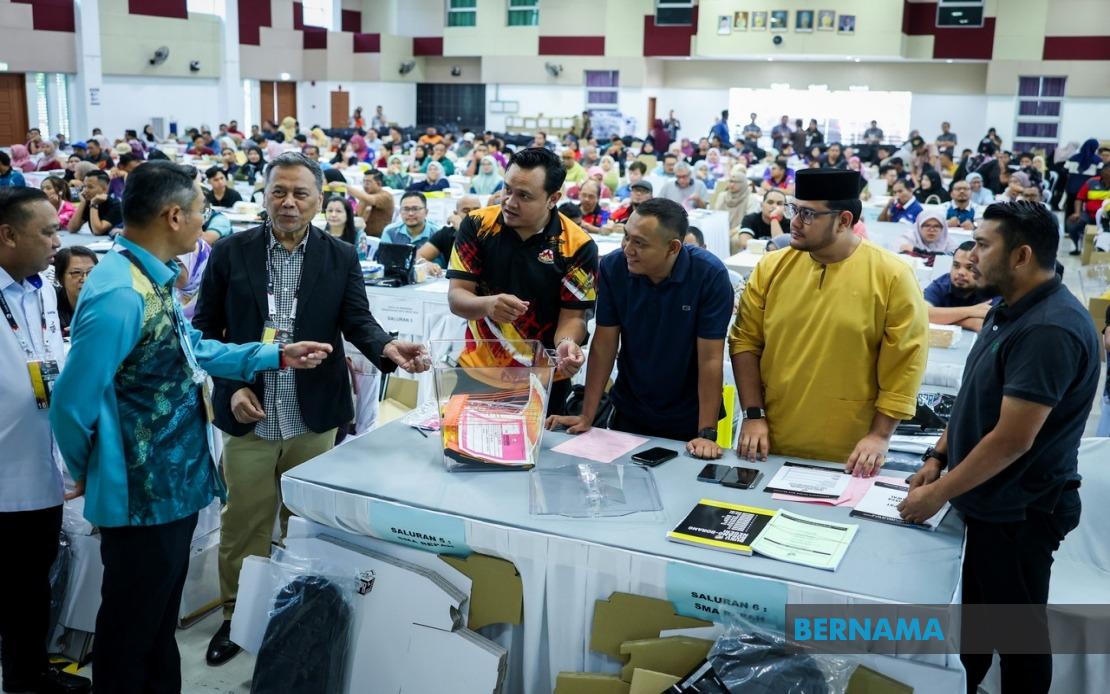
Voters in Negeri Sembilan will head to the polls tomorrow for the state's 16th general election, with 859,760 registered electors eligible to participate in selecting representatives for 36 State Legislative Assembly seats. Election Commission chairman Datuk Seri Ramlan Harun confirmed the figures during a visit to the Official Vote Counting Centre at Dewan Perdana Tampin on Wednesday, noting that the exercise will include 7,391 postal voters casting their ballots remotely.
The logistical operation underpinning the election spans 401 polling stations across the state, each equipped with 1,668 voting channels to manage the expected volume of electors. The infrastructure reflects months of planning by electoral authorities to accommodate voter demand while maintaining the integrity of the democratic process. Polling stations will operate for a full ten-hour period beginning at 8 am and closing at 6 pm, giving voters adequate opportunity to cast their votes across the working day.
The Election Commission has deployed 15,344 election officers to oversee all aspects of voting, from voter verification and ballot distribution to maintaining order at polling centres. This substantial workforce underscores the commitment to ensuring smooth operations and preventing irregularities. The scale of personnel deployment demonstrates that authorities view the conduct of this election as a high priority, with adequate staffing to address any challenges that may emerge during the voting window.
Regarding the timing of results disclosure, the Election Commission is targeting the release of preliminary findings by 10 pm tomorrow evening, with a complete tally anticipated before midnight. This accelerated timeline reflects improvements in vote-counting procedures and data management that have become standard practice in Malaysian elections in recent years. The commitment to provide results efficiently allows both political parties and voters to understand the outcome promptly, though full verification of all votes takes precedence over speed.
Tampin district, which encompasses three assembly seats—Gemas, Gemencheh, and Repah—will see 77,725 registered voters participate in the election. As a longstanding political battleground within Negeri Sembilan, Tampin's outcome carries significant implications for overall state control. The district's competitive nature is evident in the structure of contests within its constituent seats.
The Gemas seat presents a three-way competition featuring incumbent Ridzuan Ahmad of WAWASAN, Siti Aishah Seman @ Othman representing the opposition Pakatan Harapan alliance, and Azman Abdullah contesting on behalf of Parti Pribumi Bersatu Malaysia. This multi-candidate contest means no candidate will benefit from a straightforward incumbent advantage, with Pakatan Harapan positioned to capitalize on any fracturing of government-aligned votes.
Gemencheh offers a simpler two-candidate race between sitting assemblyman Suhaimizan Bizar of the Barisan Nasional coalition and Abd Latib A. Tambi fielded by Pakatan Harapan. The incumbent status traditionally provides organizational and resource advantages, though these can be offset by strong local dissatisfaction or effective opposition campaigning.
The Repah seat similarly features a direct contest between MCA representative Koh Kim Swee and incumbent S. Veerapan from Pakatan Harapan. This seat represents the ongoing competition for Indian-majority electoral divisions, a demographic that has demonstrated shifting voting preferences across recent electoral cycles in Malaysia. The incumbent's presence may be decisive, particularly if local development and welfare concerns have been adequately addressed during the current term.
Observations at the vote counting centre indicated that final preparations for tomorrow's election were advancing without significant impediment. Poll officials were conducting dry runs of counting procedures, verifying equipment functionality, and ensuring all documentation was in order. These routine but essential tasks lay the groundwork for efficient results processing once voting concludes.
The Negeri Sembilan election carries particular significance for national politics, as the outcome will shape the state government's composition and influence the broader political dynamics within Malaysia's federal structure. With coalitions competing across multiple seats and several contests remaining competitive, the results may trigger discussions about potential post-election alliances and coalition adjustments. The election provides an intermediate barometer of electoral sentiment before any future national polling, making it closely watched by analysts and political strategists throughout the country.

