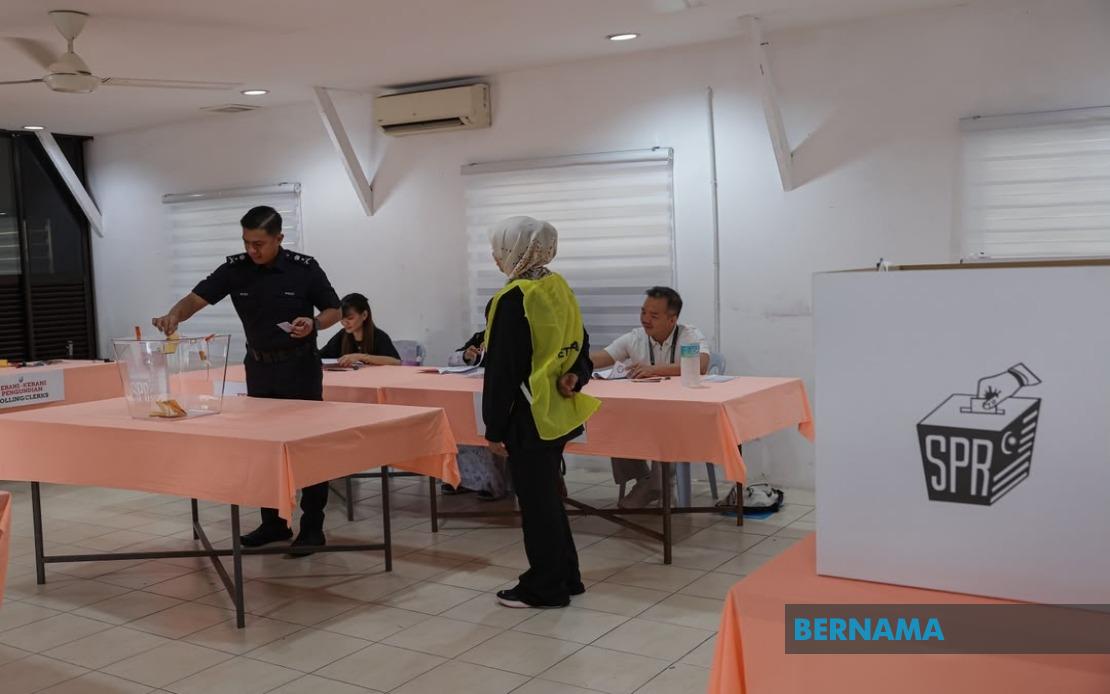
Early voting commenced across Negeri Sembilan on July 28 as the state's Election Commission opened 38 polling centres to allow security forces and their families to cast ballots ahead of the 16th Negeri Sembilan State Election scheduled for August 1. The initiative accommodated 22,339 eligible voters from Malaysia's military and law enforcement communities, reflecting standard electoral procedures that grant such personnel priority voting given deployment constraints during general polling days.
The Malaysian Armed Forces contingent represented the larger portion of early voters, with 16,884 military personnel and their spouses utilising eight dedicated polling stations across the state. The Royal Malaysia Police and their families made up the remainder, totalling 5,455 voters distributed across 30 additional centres. This bifurcated arrangement acknowledged the different logistical requirements of Malaysia's security apparatus, with police officers often stationed in urban centres while military personnel maintain a more dispersed footprint. The Election Commission's scheduling permitted centres to close progressively from noon onwards, with final closures occurring by 5 pm, allowing administrators to process the ballot count methodically.
Weather conditions favoured the early voting exercise, with meteorological observations indicating predominantly clear skies across most districts—a significant factor in Negeri Sembilan's tropical climate where afternoon thunderstorms frequently disrupt outdoor activities and voter movement. Favourable weather ensured smooth logistics for the security personnel navigating between duty stations and polling locations, potentially improving turnout within this organised voting bloc.
The scale of the 16th state election reflects Negeri Sembilan's status as a consequential electoral battleground within peninsular Malaysia's political landscape. When the state assembly was dissolved on June 5, it triggered a competitive contest for control of the 36-seat legislative chamber, with August 1 marking the formal polling day for approximately 889,490 ordinary voters who would ultimately determine the state government's composition. This voter pool dwarfs the early voting figures, underscoring how security personnel represent a managed subset within the broader electorate.
Political competition for Negeri Sembilan's mandate proved notably fragmented, with 103 candidates from nine registered entities or independent candidacies contesting the state election. Pakatan Harapan fielded the maximum representation possible, offering candidates in all 36 state seats, reflecting the coalition's strategic prioritisation of this state as a stronghold or battleground worth full resource commitment. Barisan Nasional, the incumbent coalition historically dominant in rural Negeri Sembilan constituencies, fielded 25 candidates, signalling a selective rather than comprehensive contest strategy. Bersatu, having emerged from UMNO following the 2020 political realignment, presented 24 candidates, positioning itself as a credible alternative within the Malay-Muslim political space.
Perikatan Nasional's participation through 11 candidates represented the coalition's attempt to penetrate peninsular state politics beyond its strongholds in the east coast. Four independent candidates sought election outside formal party structures, demonstrating individual ambitions or rejection of existing party platforms. Representation from Berjasa, ASLI, and PSM—each fielding a single candidate—highlighted the diversity of Malaysia's registered political landscape, though their electoral viability remained modest given resource constraints and limited grassroots machinery compared to established coalitions.
Negeri Sembilan's electoral dynamics carry implications extending beyond the state itself. As a swing state historically contested between competing coalitions, its election results signal broader peninsular sentiment regarding governance and national-level political trajectories. The state's relatively balanced population distribution between urban areas like Seremban and rural constituencies produces electoral outcomes sensitive to both urban policy preferences and rural economic concerns, making Negeri Sembilan an effective microcosm of suburban and semi-rural Malaysian voter behaviour.
The early voting arrangement for security personnel represents institutionalised practice within Malaysian electoral administration, recognising operational realities of government services that cannot be fully suspended on polling days. By permitting advance voting, the Election Commission maximises security forces' democratic participation while maintaining operational readiness—a calibrated approach balancing civil and security imperatives. The relatively large cohort of 22,339 early voters indicates substantial security force deployment concentration within Negeri Sembilan, whether from military barracks or police headquarters and district stations.
Southeast Asian observers monitoring Negeri Sembilan's election may assess the result as an indicator of peninsular Malaysian political stability and coalition durability. Regional analysts track Malaysian state elections for insights into electoral trends, particularly whether Pakatan Harapan consolidates support following its 2018 federal breakthrough and subsequent fragmentation, or whether traditional coalitions recover ground. Negeri Sembilan, as a bellwether state, would provide meaningful data regarding these trajectories as voters registered their preferences on August 1.

