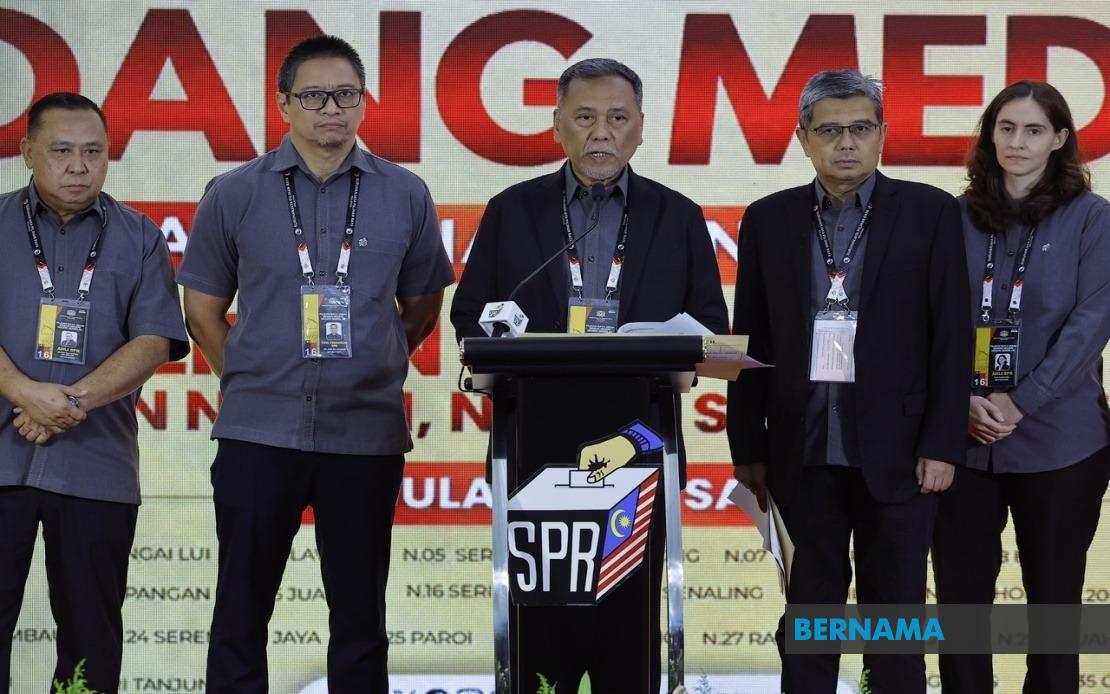
The 16th Negeri Sembilan state election is shaping up to be a contested affair, with the Election Commission confirming on July 18 that 103 candidates have passed verification and are eligible to contest across all 36 state assembly seats. The large field of contenders reflects not only competition between Malaysia's major political coalitions but also the growing role of smaller parties and independent candidates in state-level politics. Commission chairman Datuk Seri Ramlan Harun announced the verified candidate list following the close of nominations at ten nomination centres throughout the state, setting the stage for what promises to be a competitive August 1 polling day.
Pakatan Harapan maintains a commanding presence in the candidate race, fielding 36 contenders—enough to put forward representatives in all 36 seats. Barisan Nasional has submitted 25 candidates, positioning itself as the second-largest contingent, though notably below PH's total. The composition of candidates reveals the fractured nature of Malaysia's current political landscape, with Bersatu and Perikatan Nasional (PN) together putting forward 35 candidates between them: Bersatu with 24 and PN with 11. These numbers underscore the complex three-way and four-way contests that have become increasingly common in Malaysian state elections, particularly as Bersatu and PN have positioned themselves as alternatives to the traditional BN-PH binary.
Smaller parties and independent voices are also contesting the election, adding further diversity to the ballot. Barisan Jemaah Islamiah Se-Malaysia (Berjasa), the Malaysian Orang Asli Party (ASLI), and the Socialist Party of Malaysia (PSM) have each fielded single candidates, while four independent aspirants are running without party affiliation. This emergence of micro-parties and independent candidates reflects growing political fragmentation and the willingness of voters to consider options beyond the established coalitions, a trend particularly notable at the state level where local issues often resonate more strongly than national party politics.
The contest structure reveals significant fragmentation across constituencies. Twenty-one of the 36 seats will feature three-cornered battles, meaning voters in these areas will choose between at least three candidates from different parties. A further 11 seats are set for straight contests between two candidates, offering clearer binary choices. However, four seats present even more complex scenarios: Nilai and Sri Tanjung will each see five-cornered fights, while Jeram Padang and Rahang face four-way contests. This degree of division matters significantly for electoral outcomes, as it can fragment support and allow candidates with plurality—rather than majority—support to prevail, potentially affecting whether the winning coalition commands a genuine mandate.
The candidate pool itself reflects both established political structures and gradual shifts in representation. Among the 103 candidates, 94 are male and nine are female, continuing a pattern of male dominance in Malaysian electoral politics despite growing advocacy for women's participation. The age range spans from a 23-year-old Bersatu representative contesting in Sri Tanjung to a 70-year-old Pakatan Harapan candidate in Gemencheh, indicating the presence of both newcomers and experienced politicians in this cycle. The relatively small number of female candidates—less than nine percent of the field—highlights persistent barriers to women's political participation at the state level.
Negeri Sembilan's electorate comprises nearly 890,000 eligible voters spread across the state's constituencies. The Election Commission has registered 867,151 ordinary voters, alongside 16,884 military personnel and their spouses and 5,455 police officers, demonstrating the state's diverse demographic composition. Early voting has been scheduled for July 28, providing voters unable to cast ballots on polling day with an alternative opportunity to participate. The election itself follows the dissolution of the state assembly on June 5, triggered by political developments that made holding the election necessary to establish a new government.
The electoral dynamics in Negeri Sembilan carry implications beyond the state itself. As a moderate-sized state with a diverse voter base spanning urban and rural areas, it often serves as a barometer for broader political trends in Malaysia. The strength of Pakatan Harapan, the resilience or decline of Barisan Nasional's traditional base, and the inroads made by Bersatu and Perikatan Nasional will offer insights into how Malaysia's political landscape continues to evolve at the subnational level. Particularly significant is the three-way competitive dynamic, which reflects the reality that no single coalition currently dominates Malaysian politics unambiguously.
The presence of multiple smaller parties contesting reflects broader changes in Malaysia's political culture. Voters are increasingly willing to consider alternatives to the two main coalitions, particularly when local issues dominate state elections. Berjasa's participation, as an Islamic-focused party, and ASLI's focus on Orang Asli interests represent attempts to mobilize specific constituencies with tailored platforms. The Socialist Party of Malaysia's participation, meanwhile, represents a left-wing perspective rarely seen in Malaysian electoral contests. These additions enrich the political conversation, even if they face significant structural disadvantages in competing for seats.
For Malaysian observers and regional analysts watching state-level developments, Negeri Sembilan's election represents a microcosm of contemporary political competition. The fragmentation across multiple parties, the prevalence of three-cornered and four-cornered contests, and the substantial electorate of nearly 890,000 voters mean that the election outcome will depend not merely on party strength but on tactical voting patterns, local issues, and the ability of each coalition to mobilize its base effectively. The August 1 polling day will reveal how these 103 candidates translate their campaigns into actual electoral support and which coalition emerges to form the next Negeri Sembilan government.

