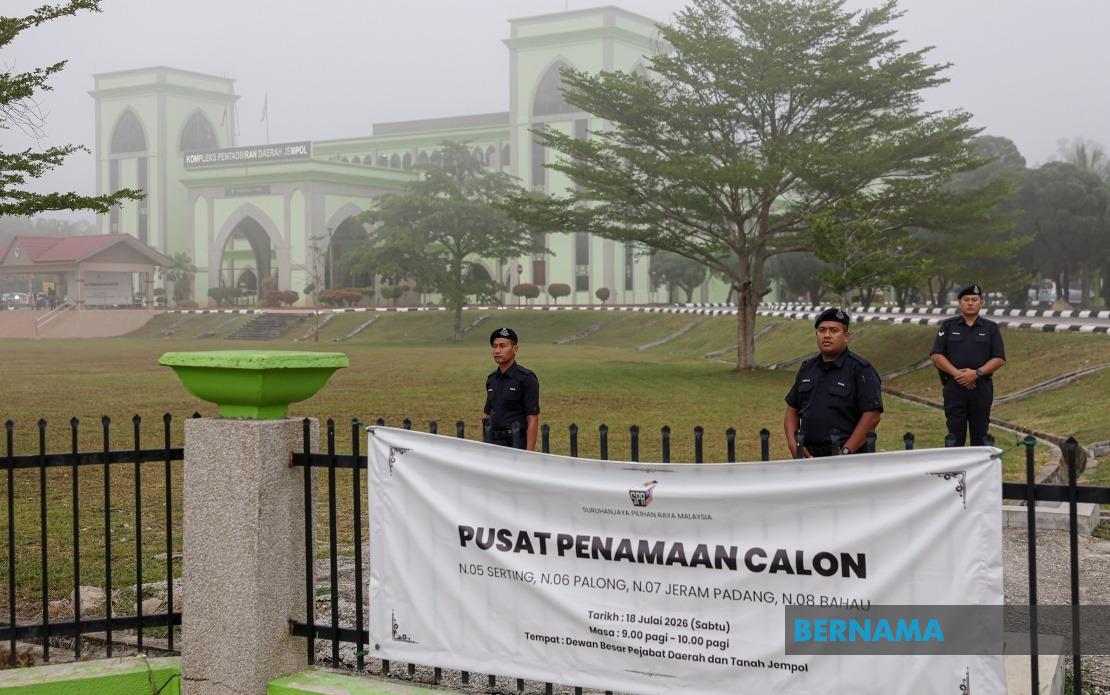
Nominations for the 16th Negeri Sembilan state election got underway on schedule yesterday with all eight polling centres commencing operations at 9 am across the state's seven districts. The simultaneous opening of these nomination centres represented the official commencement of what will be a tightly contested electoral cycle in the state. The one-hour window allocated for candidate registration—closing at 10 am—allowed election officials to process entries before subsequently announcing the verified roster of candidates eligible to contest.
The nomination day itself unfolded under favourable conditions, with weather across Negeri Sembilan remaining clear and stable throughout the morning, facilitating smooth logistics for candidates, party representatives, and election staff. State police leadership deployed substantial force to ensure the process remained orderly and secure, with Datuk Alzafny Ahmad, the Negeri Sembilan police chief, confirming that 2,393 uniformed personnel were stationed at and around the eight centres to manage crowds and prevent any disturbances during what is traditionally a high-profile political occasion.
This election was triggered by the dissolution of the Negeri Sembilan State Legislative Assembly on June 5 following formal approval from Tuanku Muhriz Tuanku Munawir, the Yang Dipertuan Besar of Negeri Sembilan. The dissolution marked a decisive moment in state politics, setting in motion a compressed electoral calendar that will culminate in voting less than three weeks later. The timing reflects both constitutional procedures and the practical necessities of returning to the ballot box when governing coalitions fracture or their mandates expire.
The election campaign itself will span exactly 14 days beginning immediately after officials announce the final candidate roster, concluding on July 31 at 11.59 pm. This relatively brief timeframe will place significant pressure on political parties to maximise their ground game and media presence, compressing months of usual campaigning into a fortnight of intensive politicking. The condensed schedule may advantage better-organised parties with stronger grassroots infrastructure, while presenting challenges for newer political forces attempting to build momentum from scratch.
The electoral landscape heading into this contest reflects the fractious nature of Malaysian state politics in recent years. In the 2023 state election held during the previous cycle, Pakatan Harapan secured dominance by capturing 17 of 36 available seats, positioning itself as the leading faction in the legislature. Barisan Nasional garnered 14 seats, maintaining its presence but in a secondary position, while Perikatan Nasional claimed five seats, securing a foothold despite relative weakness. These results will serve as the baseline from which analysts assess any shifts in voter sentiment or coalition dynamics when results come through next month.
The Election Commission has structured the voting process to accommodate multiple categories of voters and their varied circumstances. Early voting has been scheduled for July 28, specifically designed for military personnel, their spouses, and police officers who cannot attend on the main polling day due to operational commitments. This arrangement recognises the logistical challenges faced by uniformed services while ensuring their democratic participation remains uncompromised. The official polling day itself is set for August 1, giving voters a full week to cast their ballots through one mechanism or another.
The registered voter roll for this election, updated as of June 4 this year, documents a total of 889,490 eligible participants across Negeri Sembilan. This figure comprises 867,151 ordinary citizens registered on the standard electoral roll, alongside 16,884 military personnel and their spouses, and 5,455 police officers designated as early voters. The overall size of the electorate, approaching 900,000 voters, underscores the substantial political stakes involved in this contest and the significant mandate that any winning coalition will derive from the ballot.
For Malaysian observers and analysts, the Negeri Sembilan election serves as an important bellwether for state-level politics in the Federation, coming at a moment when both Pakatan Harapan and Barisan Nasional continue jostling for dominance across various state capitals. The result will provide fresh insight into voter preferences, coalition viability, and the enduring appeal of competing political narratives among a diverse electorate. Perikatan Nasional's performance, in particular, will be closely watched given its ambitions to expand influence in state politics despite remaining a relatively junior force outside its strongholds.
The administrative machinery supporting this election has clearly been mobilised to ensure credibility and orderliness. Beyond police deployment, the Election Commission's detailed planning—from staggered voting arrangements to verified voter rolls—demonstrates the institutional capacity required to manage democratic contests at this scale. The smooth opening of all eight nomination centres yesterday suggested that the logistical groundwork has been competently laid, though the real test will come when voters begin casting their ballots later this month.

