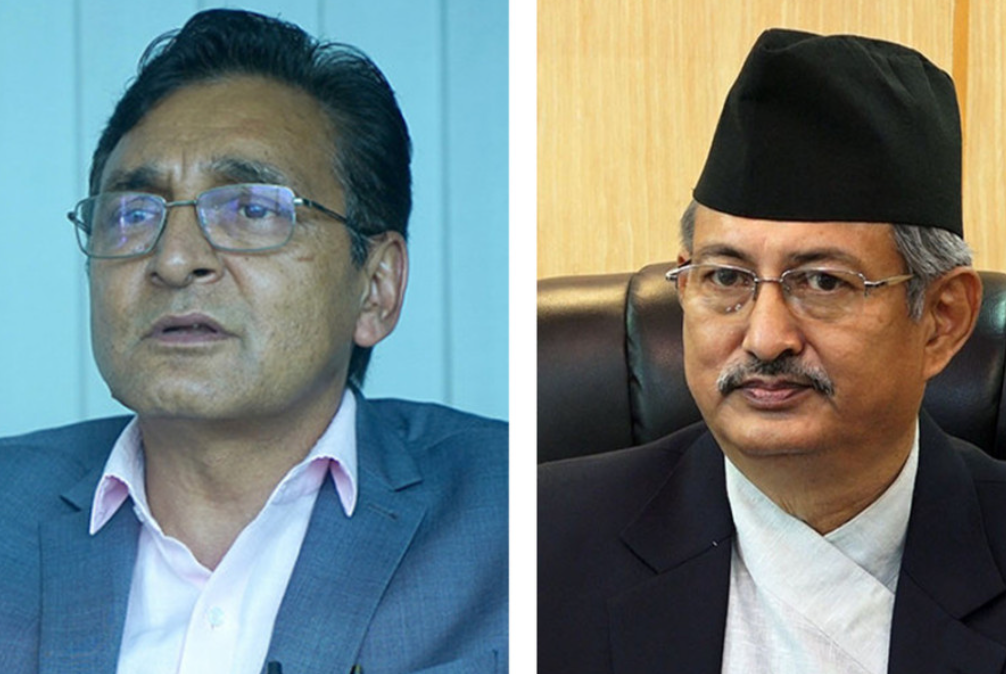
A Kathmandu district court has convicted two former Nepali government ministers of orchestrating a scheme to forge documents and illegally facilitate the resettlement of Nepali nationals in the United States under false pretences, marking a significant legal reckoning in a case that exposed vulnerabilities in refugee verification systems across multiple countries. Top Bahadur Rayamajhi, who previously served as Deputy Prime Minister and Energy Minister, received a four-year prison sentence on charges including offences against the state, fraud, and involvement in organised crime, while former Home Minister Bal Krishna Khand was sentenced to two years imprisonment as an accomplice to the scheme. The verdicts were delivered late on Tuesday by the district court, with both men maintaining previous denials of involvement in what has become a high-profile corruption case highlighting systemic weaknesses in document authentication and refugee processing procedures.
Rayamajhi is currently in custody following his conviction, whereas Khand remains free on bail pending appeal proceedings. Legal representatives for both former ministers have signalled their intention to contest the court's decision, with Dharma Raj Regmi, Rayamajhi's counsel, asserting that his client was uninvolved in refugee policy formulation and that the verdict will be challenged in higher courts. Khand's attorney, Pankaj Karna, similarly pledged to pursue appellate remedies, suggesting the case will likely continue through Nepal's judicial system for an extended period. The sentencing represents one of the most visible accountability measures taken against high-ranking officials implicated in the fraud.
Beyond the two former ministers, the court has also handed down convictions against fourteen additional defendants, including a former senior bureaucrat from the home ministry and a former leader among Bhutanese refugee communities in Nepal. These co-conspirators received sentences ranging up to four years, indicating the court's assessment that the scheme involved a network of individuals across government agencies and community organisations. The breadth of convictions suggests the fraudulent operation was not an isolated incident but rather a coordinated effort spanning multiple institutional levels, raising serious questions about oversight mechanisms that failed to detect the irregularities during active government operations.
The precise number of Nepali nationals who successfully obtained US resettlement through fraudulent Bhutanese refugee claims remains unclear, with authorities unable to definitively establish whether any individuals were actually transferred to the United States under false documentation. This ambiguity underscores a critical gap in tracking and verification procedures that would normally flag discrepancies between applicant identity documentation and refugee status claims. The scam itself surfaced in 2023, well after Rayamajhi and Khand had departed government positions, suggesting the investigation process was lengthy and that discovery occurred only after the individuals responsible were no longer in official positions to obstruct inquiries.
The case must be understood against the backdrop of Nepal's complex refugee history with neighbouring Bhutan, a relationship shaped by decades of political tension and human displacement. Beginning in the early 1990s, approximately 120,000 individuals of Nepali ethnicity fled Bhutan, a predominantly Buddhist monarchy with a population below 800,000, citing inadequate political freedoms and ethnic discrimination within their homeland. This exodus created one of South Asia's longest-running refugee crises, with displaced communities languishing in camps across eastern Nepal whilst their home government and Nepal's leadership failed to negotiate acceptable repatriation arrangements. The inability of the two neighbours to establish mutually agreeable resettlement terms opened space for third-country interventions.
Western nations, particularly the United States, stepped into this diplomatic vacuum by establishing third-country resettlement programmes designed to provide permanent solutions for stranded refugee populations. Washington has been the primary destination, accepting approximately 100,000 individuals from Nepal's refugee camps since the formal resettlement initiatives commenced. Canada and Australia have also participated in accepting smaller numbers of applicants, whilst nearly 113,000 Bhutanese-origin refugees from Nepal have been distributed across multiple Western countries through these coordinated programmes. The document forgery scheme appears to have exploited the scale and relative invisibility of this large-scale humanitarian operation, where the volume of applications may have exceeded the administrative capacity for rigorous verification.
Thousands of individuals still reside in sprawling camps across eastern Nepal, maintaining their stated preference to return to Bhutan despite the passage of three decades. The persistence of these camps represents an ongoing humanitarian challenge and a vivid reminder of unresolved regional tensions. The camps have become semi-permanent settlements with generational populations born within their boundaries, creating social and psychological complications that extend beyond conventional refugee policy frameworks. Many residents express scepticism about repatriation prospects and have adapted to extended displacement, whilst others retain aspirations for eventual homecoming.
The fraud case emerges within a broader context of anti-corruption mobilisation within Nepal itself. Youth-led anti-corruption protests erupted in September the previous year, resulting in 76 deaths and catalysing the collapse of the sitting government—a dramatic demonstration of public frustration with institutional corruption and administrative dysfunction. These demonstrations reflected generational anger at pervasive graft and the perception that political elites were systematically enriching themselves whilst basic governance functions deteriorated. The uprising proved consequential, fundamentally reshaping Nepal's political landscape and creating space for new leadership.
Following these upheavals, Nepal held elections in March that brought to power a fresh administration led by Balendra Shah, a 36-year-old former musician turned politician whose campaign was substantially supported by youth constituencies and anti-corruption advocates. Shah's government has explicitly prioritised prosecuting corruption allegations against predecessor administrations, viewing accountability as essential for restoring public confidence in state institutions. The conviction of Rayamajhi and Khand aligns with this stated commitment to investigating high-level malfeasance, demonstrating that the new administration is willing to pursue legal action against prominent figures regardless of their previous positions. The refugee scam prosecutions signal that no former official will escape scrutiny provided sufficient evidence emerges.
For Malaysia and the broader Southeast Asian region, this case carries several instructive lessons. The vulnerability of refugee verification systems to document fraud highlights risks that extend beyond Nepal's specific circumstances, potentially affecting processing procedures across multiple nations. As resettlement programmes continue expanding to address displacement crises in Myanmar, Afghanistan, and other regions, the technical and administrative frameworks supporting them require continuous refinement. Southeast Asian countries hosting refugee populations or participating in burden-sharing arrangements must examine their document authentication capabilities and institutional safeguards against fraudulent claims. The case demonstrates that even sophisticated third-country acceptance procedures can be compromised by coordinated conspiracy involving government insiders and community facilitators.
Moreover, the political dimension of the convictions merits attention from observers of South Asian governance trends. Nepal's willingness to prosecute former high-ranking officials represents an important precedent for institutional accountability, though the extended timeline between commission and conviction raises concerns about investigative efficiency. For Malaysia, where corruption remains a persistent challenge despite recent anti-graft initiatives, the Nepali experience offers both encouragement that legal systems can eventually produce results and cautionary reminders that institutional reform requires sustained political will and adequate investigative resources. The alignment of public anti-corruption sentiment with prosecutorial action, as demonstrated by Nepal's transition to Shah's administration, suggests that electoral politics can create openings for accountability measures that bureaucratic systems alone might struggle to achieve.
The broader implications for regional security and migration management should not be overlooked. Fraudulent refugee claims undermine the legitimacy of genuine resettlement programmes and create political vulnerabilities that anti-immigration movements exploit to restrict humanitarian access. Countries like the United States may become more sceptical of applications originating from regions associated with documented fraud, potentially affecting legitimate refugees from Nepal and neighbouring countries. This collateral damage represents an unintended consequence of the scheme, transforming what appeared as individual benefit extraction into systematic harm affecting entire vulnerable populations. Southeast Asian nations dependent on third-country resettlement arrangements for their own displaced populations must therefore view the prevention of fraud not merely as administrative necessity but as strategic interest in preserving the viability of humanitarian programmes that their own citizens may require.

