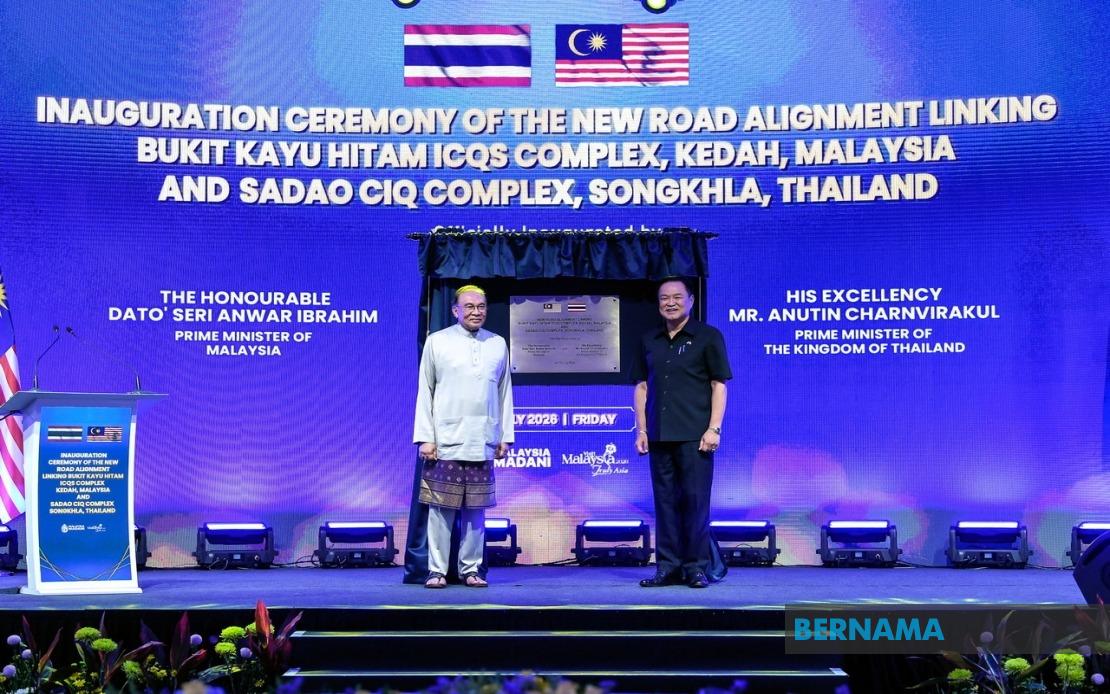
Prime Minister Datuk Seri Anwar Ibrahim has unveiled a strategically significant infrastructure project at the Malaysia-Thailand border, with the joint launch of a new road alignment linking the Bukit Kayu Hitam Immigration, Customs, Quarantine and Security Complex in Kedah to the Sadao Customs, Immigration and Quarantine Complex in Thailand. The ceremonial inauguration, co-presided with Thailand's Prime Minister Anutin Charnvirakul, marks what both leaders view as a watershed moment in bilateral relations that transcends conventional diplomatic protocols and ventures into tangible economic partnership.
The initiative carries profound implications for Malaysia's northern states, which have historically struggled to compete with more developed regions in the country. Anwar framed the infrastructure development as essential to addressing the economic aspirations of communities in Peninsular Malaysia's north, while simultaneously unlocking untapped potential in southern Thailand. The two governments perceive the new road as more than a mere transportation link; it represents a foundational tool for stimulating growth and improving living standards across a deliberately designated geographic zone that spans both nations' border regions.
At the heart of the initiative lies an ambitious proposal to establish a special economic border zone encompassing Perlis, Kedah, Kelantan, Perak and Penang on the Malaysian side, working in concert with adjacent Thai provinces. This conceptual framework extends well beyond simple tariff agreements or customs facilitation. Instead, it envisions integrated development where both governments employ coordinated policy tools to attract investment, streamline regulatory frameworks, and foster business ecosystems that benefit from dual-country advantages. Anwar acknowledged that such transformational change requires sustained effort and cannot be rushed, yet both leaderships have signalled unwavering commitment to realising this vision.
The bilateral trade dimension adds concrete urgency to the project. Malaysia and Thailand have established a target of USD30 billion in annual bilateral trade by 2027, a figure that underscores the scale of economic integration both nations seek to achieve. The new road alignment directly supports this objective by reducing transit times, lowering logistics costs, and enhancing the reliability of cross-border supply chains. For Malaysian exporters and importers, particularly small and medium enterprises operating in northern states, the infrastructure improvement could translate into measurable competitive advantages when trading with Thai counterparts.
Beyond infrastructure, the two prime ministers have committed to expediting resolution of longstanding bureaucratic and regulatory obstacles that have impeded seamless commerce. These include outstanding matters related to customs procedures, immigration protocols, fisheries management, and trade administration. Anwar emphasized that accelerating solutions to these cross-border friction points would generate immediate practical benefits for traders and business communities on both sides. The fact that previously intractable issues—some requiring years or decades of negotiation—have been addressed with newfound speed demonstrates a shift in political will and operational approach.
The timing and location of the launch carry symbolic weight for Malaysian politics. By conducting this ceremony at the border rather than in Kuala Lumpur or Bangkok, both leaders underscored their commitment to understanding and serving communities outside major urban centres. Anwar's appreciation for Anutin's willingness to travel to the frontier region reflected recognition that border communities often feel marginalised by national capitals. This visibility sends a signal to Kedah and nearby states that their economic development merits high-level attention and coordinated cross-border solutions, potentially shifting investor perceptions about the viability of the northern corridor.
For the broader Southeast Asian context, the Malaysia-Thailand border initiative represents a template for regional integration that respects national sovereignty while recognising geographic complementarities. Unlike mega-regional frameworks that often prioritise large economies, this bilateral arrangement specifically targets smaller economies and peripheral regions within each nation. The success or failure of this special economic zone model could influence how other neighbouring countries approach comparable border development challenges.
The launch also reflects the diplomatic strategy Anwar has pursued since assuming office, emphasising practical cooperation on issues affecting ordinary citizens rather than remaining confined to high-level protocol. His administration has positioned itself as willing to tackle difficult cross-border issues through sustained dialogue and creative institutional design. The presence of both prime ministers' spouses at the ceremony further reinforced the personal dimension of the partnership and suggested this represents more than transactional bilateral business.
For Malaysian investors and businesses, particularly those with operations in the northern states, the implications are substantial. The new road reduces geographical distance and temporal barriers that have historically disadvantaged northern Malaysian manufacturers and traders competing against those based closer to the central economic corridor. Companies involved in logistics, agriculture, food processing, and light manufacturing stand to benefit from improved access to Thai markets and Thai supply chains. Similarly, Thai businesses gain easier access to Malaysian ports and distribution networks reaching Singapore and beyond.
The resolution of outstanding customs, immigration, and fisheries matters requires technical implementation at operational levels below the prime ministerial tier, yet the public commitment from both leaders creates political pressure for bureaucratic agencies to translate intent into concrete procedural changes. Traders and transport operators have consistently cited unpredictable delays at border crossings as a primary impediment to cross-border commerce. Streamlining these procedures could reduce transaction costs significantly, making regional trade more attractive relative to alternative arrangements.
The proposed special economic zone framework also opens possibilities for coordinated industrial policy, where both nations might designate specific areas for particular manufacturing sectors or services, reducing duplication and encouraging specialisation. For instance, Malaysian financial services and digital capabilities could combine with Thai agricultural and processing expertise to create integrated value chains serving the broader Southeast Asian market. Such complementary development would be substantially harder without explicit bilateral coordination at the border zone level.
Looking ahead, the real test of this initiative lies in implementation. The infrastructure investment in the new road is concrete and measurable, but the special economic zone concept requires sustained administrative coordination, consistent policy application, and continued high-level political support through inevitable implementation challenges. Both governments' demonstrated ability to resolve previously stalled issues, as Anwar noted, provides cautious optimism that bureaucratic obstacles might not derail progress as they have historically done with other cross-border projects in Southeast Asia.

