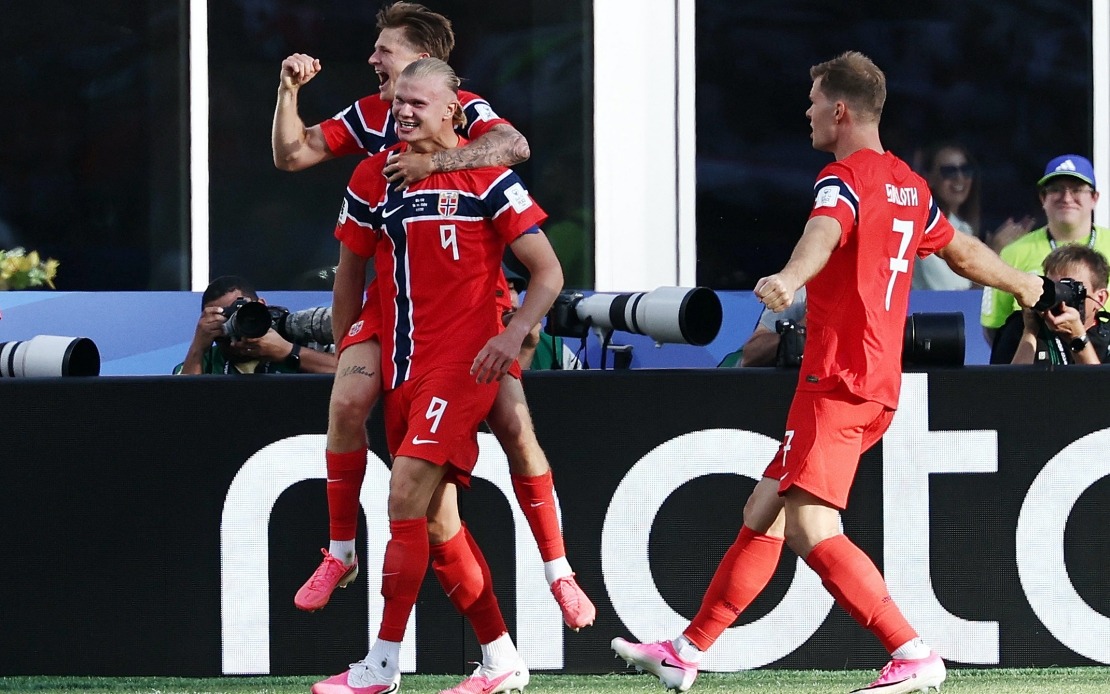
Norway's campaign at the World Cup has taken on a distinctly generational character, with three of the team's most influential players driving the nation's ambitions while carrying the unfinished business of their fathers into the tournament. Erling Haaland, Alexander Sørloth and Kristian Thorstvedt represent a unique narrative in modern football—each following a parent who represented Norway at the 1994 World Cup in the United States, where the Scandinavian side exited at the group stage despite respectable performances. The convergence of these family connections provides Norway's current squad with an intangible but powerful motivation as they seek to penetrate deeper into the competition than their predecessors managed three decades ago.
Norway's opening performance demonstrated considerable promise, delivering an emphatic 4-1 victory over Iraq that immediately established the team as a genuine contender in their group. This commanding display set the tone for what the Haaland-led contingent hopes will be a transformative tournament compared to the 1994 experience that concluded for their fathers' generation with disappointment and early elimination. The contrast between that earlier outcome and Norway's immediate impact in the current edition underscores how substantially the programme has evolved under contemporary management, with the tactical sophistication and individual talent now at the national team's disposal seemingly capable of delivering sustained progress.
The symmetry between Haaland's trajectory and his father's is particularly striking. Alf-Inge Haaland represented Norway during that 1994 campaign, and now his son, having established himself as one of world football's most fearsome strikers at Manchester City, carries the responsibility of advancing Norwegian football's World Cup narrative. When presented with photographs of his father from that earlier tournament, Haaland reflected with amusement on the passage of time, remarking on his father's youthful appearance and notably longer hair from that era. This personal connection to the 1994 tournament remains vivid within the Haaland household, grounding the current player's World Cup experience within a broader family sporting context that extends beyond individual achievement.
Gøran Sørloth's journey parallels Haaland's in significant ways. The Atletico Madrid forward, who developed his craft at one of European football's most demanding clubs, recently articulated the profound satisfaction of participating in a World Cup tournament just as his own father had done. Sørloth has publicly credited his father with foundational coaching and mentorship, describing him as the source of everything he understands about the sport's fundamentals and strategic dimensions. This filial acknowledgment reflects a common pattern among elite athletes whose parents also competed at the highest level—the transmission of technical knowledge, tactical awareness, and mental resilience across generations creates an inheritance that transcends mere genetics.
Sørloth's earliest World Cup memory, however, derives not from 1994 but from the 2002 tournament hosted by Japan and South Korea. During that earlier competition, his family happened to be holidaying in Denmark, and the young Sørloth watched the unfolding drama alongside his father, absorbing both the matches themselves and his father's informed perspective on the international game. This formative experience planted seeds that would eventually mature into Sørloth's own professional career in elite football, demonstrating how parental influence operates not merely through direct instruction but through the creation of emotionally resonant shared experiences that shape a child's sporting identity.
Kristian Thorstvedt completes this generational triumvirate, carrying forward the legacy of his father Erik Thorstvedt, who represented Norway during the 1994 campaign. Like his contemporaries, Thorstvedt now has an opportunity to achieve what his father's generation could not—advancing beyond the group stage and proving Norwegian football's capacity for sustained World Cup success. The presence of three such players within the squad suggests a conscious continuity in Norwegian football's development, where experience and institutional knowledge pass through family lines into the contemporary professional environment.
Norway's immediate fixture list presents a critical juncture for the squad's World Cup aspirations. The encounter with Senegal on Monday offers a genuine opportunity to secure knockout round qualification, contingent upon the team replicating or approaching the performance standards demonstrated in the opening victory. A successful outcome would substantially strengthen Norway's positioning ahead of their concluding group match against France, currently regarded as one of the tournament's pre-eminent contenders. The sequence of matches—already displaying competitive quality against Iraq—tests whether Norway possesses the consistency and resilience required for extended tournament participation.
The squad's trajectory resonates deeply within Norwegian society, extending far beyond the football pitch itself. Royal patronage has already materialised, with hereditary Princess Ingrid Alexandra and Prince Sverre Magnus, children of Crown Prince Haakon and Crown Princess Mette-Marit, anticipated to attend Monday's fixture in New Jersey. This elevated level of institutional support underscores the significance attached to Norway's World Cup campaign within the national consciousness and demonstrates how sporting endeavours frequently intersect with broader cultural and political symbolism.
Norwegian supporters have embraced traditional Viking-derived ceremonial expressions of collective identity and support, with these distinctive demonstrations of solidarity spreading beyond stadiums into the halls of government. Members of Parliament from across the political spectrum participated in organised shows of support for the national team, reflecting the rare capacity of international football competitions to transcend partisan divides and generate unified national sentiment. This parliamentary engagement signals the degree to which Norway's World Cup performance matters to the nation's political establishment and general population alike.
The psychological dimension of competing whilst honouring paternal legacies introduces additional layers of complexity to the squad's challenge. Haaland, Sørloth and Thorstvedt must simultaneously manage their personal aspirations for World Cup success whilst navigating the historical weight of their fathers' unfinished tournament narratives. This dual responsibility—playing for oneself whilst implicitly playing for family honour—represents a distinctive psychological burden that few players encounter. However, the three have demonstrated through their careers considerable mental fortitude and competitive excellence, suggesting capacity to transform generational motivation into sustained performance improvement.
Norway's prospects ultimately depend upon maintaining the intensity and tactical discipline demonstrated in the opening victory whilst adapting to the elevated quality of opposition they will progressively encounter. The presence of Haaland-led attacking prowess, complemented by Sørloth's experience and Thorstvedt's contributions, provides the squad with sufficient individual quality to compete effectively throughout the group stage. Whether these players can collectively advance Norwegian football beyond the historical ceiling established in 1994 remains the tournament's defining question for supporters back home, with each subsequent match offering clarification regarding the contemporary generation's capacity to exceed their fathers' achievements.

