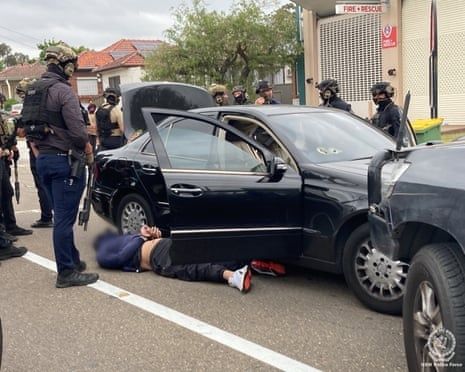
New South Wales police have detained 356 individuals and initiated charges against them following a intensive three-day crackdown on violent and sexual crime across the state's public transport system. The enforcement action, representing the sixth iteration of Operation Waratah, deployed more than 400 uniformed officers daily across trains, buses, light rail trams and ferries between Thursday and Saturday. The operation reflects growing institutional focus on transit safety in Australia's most populous state, where commuter security concerns have prompted escalating police presence and strategic interventions.
Operation Waratah itself was formally established in 2024 with a clear mandate: to systematically identify and apprehend individuals perpetrating violent assaults and sexual offences within NSW's public transport infrastructure. Since its inception, the program has yielded more than 1,800 arrests cumulatively, demonstrating both the scale of persistent transit crime and the resource commitment authorities now consider necessary. The latest phase represents a continuation of this sustained enforcement approach, with police methodically targeting high-traffic zones and peak-use periods.
During the three-day operation, officers conducted patrols across 539 train services, 127 bus routes and 29 light rail tram journeys, suggesting a systematic sampling approach rather than blanket coverage. This strategic deployment appears calibrated to maximize police visibility and deterrence while managing the logistical constraints of comprehensively policing an entire state network. The scale of coverage demonstrates the Queensland and NSW governments' determination to reclaim public confidence in mass transit systems as safe environments for all users.
The material seizures recorded during this phase underscore the weapons dimension of public transport crime. Officers confiscated 28 knives and other weapons from arrested individuals, pointing to the prevalence of armed threats that passengers and transit workers increasingly navigate. Contemporaneously, police documented 137 drug-related offences, indicating that narcotic possession and distribution also constitute significant elements of transit criminality addressed through Operation Waratah's framework.
Charged against the 356 detainees were 645 separate offences, indicating that many individuals faced multiple charges reflecting diverse criminal conduct. This prosecutorial breadth suggests that police arrest decisions have extended beyond singular offences to capture broader patterns of antisocial and criminal behaviour within transit environments. The charging strategy appears designed to facilitate more comprehensive legal accountability rather than isolated incident responses.
For Malaysian observers, the NSW experience offers instructive perspective on public transport security governance and resource allocation. While Malaysia's own public transport systems—including the Klang Valley's extensive rail network and rapid-transit corridors—have developed sophisticated security infrastructure, the Australian model reveals both the intensity of ongoing police investment required and the persistent challenge of transit crime prevention despite technological and personnel enhancements. The cumulative 1,800 arrests under Operation Waratah since 2024 suggests that enforcement-intensive approaches, while generating significant statistical output, may address symptoms rather than underlying drivers of transit-environment criminality.
The operation's methodology also reflects contemporary policing philosophy emphasizing visible, concentrated enforcement campaigns designed simultaneously for crime reduction and public reassurance. By deploying officers across multiple transit modes within defined timeframes, NSW Police signal organizational commitment while generating media attention that theoretically amplifies deterrent effects. Whether such intermittent, high-visibility operations produce sustainable behavioural change or merely displace criminal activity to unmonitored periods remains an open empirical question.
Regional contexts matter substantially here. New South Wales encompasses Sydney, Australia's largest city, where dense urban conditions, substantial homeless populations and drug-related dysfunction intersect with mass transit dependency. Comparable Southeast Asian cities managing similar pressures might anticipate analogous transit security challenges as urbanization and population concentration intensify across the region. The resource requirements evident in Operation Waratah's deployment of 400-plus daily officers across a single state operation underscore the fiscal commitments that comprehensive transit security demands.
The operation's targeting of sexual offences alongside violent crime reflects evolving safety frameworks that increasingly centred passenger vulnerability and personal security concerns. For women commuters and vulnerable transit users across Malaysia and the broader region, the prioritization of sexual offence detection signals institutional recognition of gendered dimensions of public space insecurity. Whether enforcement approaches effectively deter such crimes, however, requires examination extending beyond arrest statistics to outcome data on conviction rates and community safety perception shifts.
Moving forward, the NSW Police Force's sustained iteration of Operation Waratah—now in its sixth phase—suggests that public transport crime remains sufficiently persistent to warrant continuous institutional attention. The cumulative 1,800 arrests indicate neither resolution nor decisive suppression of underlying problems. For Southeast Asian transit authorities contemplating security enhancement investments, the Australian experience suggests that enforcement alone, however intensive, may require complementary interventions addressing root causes of transit criminality including substance abuse treatment, mental health services and socioeconomic vulnerability. The quantitative success of Operation Waratah in arrest generation should thus be contextualised within broader, more analytically rigorous assessments of whether such operations meaningfully improve genuine passenger safety outcomes and community wellbeing.

