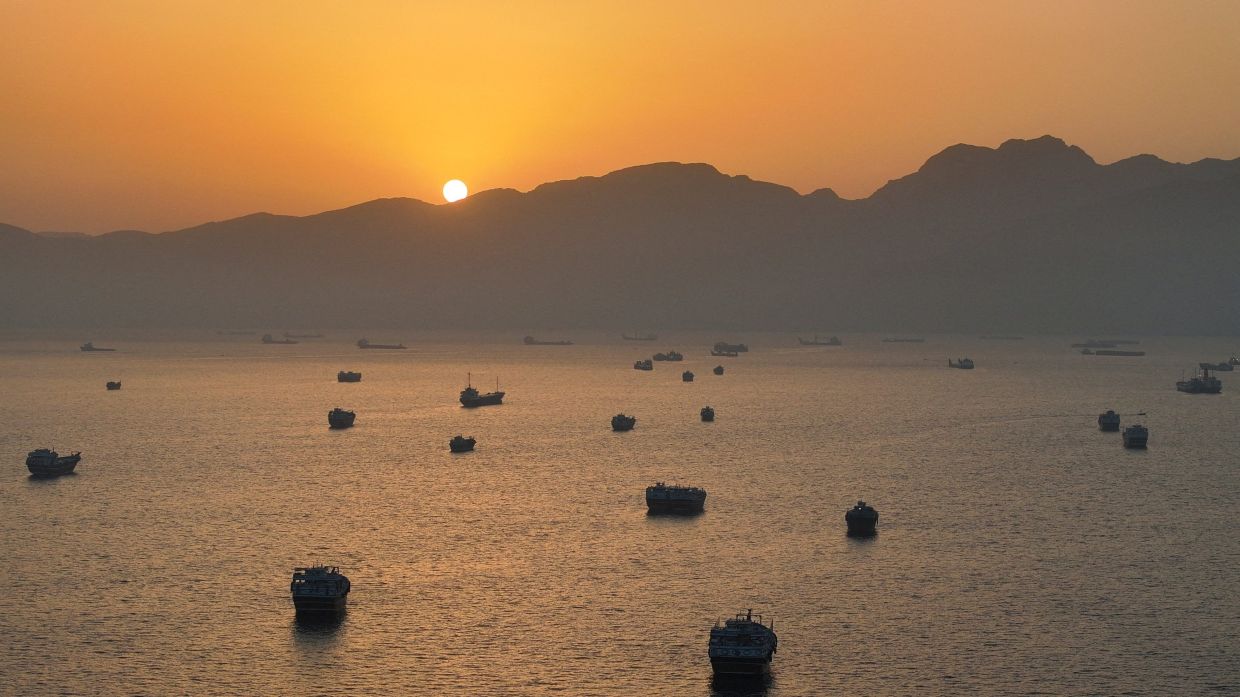
The Strait of Hormuz, one of the world's most critical petroleum arteries, is showing signs of renewed traffic as three major oil tankers carrying approximately 5 million barrels of crude departed the strategically vital waterway on Wednesday. The resumption of shipments through this chokepoint—which channels roughly one-third of globally traded seaborne oil—reflects growing confidence that an interim agreement between Iran and the United States is beginning to unlock supplies that have been bottled up in the Persian Gulf since the escalation of Middle East hostilities. For Malaysian energy consumers and refiners, the movement of these vessels carries immediate implications for fuel prices and energy security across Southeast Asia, where crude imports remain a central economic concern.
Among the vessels clearing the strait was the VL Breeze, a South Korean-flagged Very Large Crude Carrier operating under charter to Hyundai Oilbank. This supertanker, one of the massive ships that dominate the long-haul crude transport sector, was navigating toward the South Korean port of Daesan with a cargo of 2 million barrels comprising Qatari condensate and Abu Dhabi crude. The cargo represents a tangible return to normal shipping patterns—condensate and conventional crude from Gulf producers heading to refineries in Northeast Asia, a flow pattern that has been severely disrupted since Middle East tensions began to paralyse regional logistics.
Two additional vessels completed their departures from the Gulf during the same period. The Plata Carrier, sailing under Liberian registry while chartered by India's state-owned Oil Corporation, exited with 2 million barrels of Saudi Arabian crude destined for Indian refineries. Simultaneously, the Suezmax tanker Prudent Warrior, also Liberian-flagged, cleared the strait carrying 1 million barrels of Iraqi Basrah crude bound for the Sohar terminal in Oman. The involvement of both Indian and South Korean energy companies underscores the pan-Asian dimension of Gulf supply disruptions; when Hormuz chokes, energy flows to the region's most populous economies face immediate pressure.
The broader context for these departures becomes clearer when examining the scale of the supply bottleneck that has accumulated in the Persian Gulf. Analysts at shipping data firms Kpler and Vortexa had estimated that as of the previous week, close to 90 million barrels of crude remained trapped within the Gulf, either anchored in waiting areas or moving cautiously through contested waters. This represents an enormous inventory of petroleum essentially stranded at origin, unable to reach refineries across Asia, Europe, and beyond. The systematic release of this backlog, should the interim diplomatic agreement hold, could materially dampen global crude prices by flooding markets with supplies that have been artificially scarce due to geopolitical uncertainty rather than any fundamental production shortage.
South Korea's maritime ministry confirmed on Wednesday that four vessels operated by South Korean shipping companies had successfully transited the Strait of Hormuz and were proceeding toward their respective destinations. One vessel was heading directly to South Korea itself, while the others had been routed to unspecified third countries. However, the picture remains far from normalized; the ministry simultaneously disclosed that of 26 vessels that had been stranded since the beginning of the Middle East conflict, 18 remained trapped within the Gulf. This means that while initial breakthroughs are occurring, the majority of stranded tonnage has yet to resume passage, suggesting the interim accord is still in its early implementation phase.
The passage of these tankers has been facilitated by newly established maritime corridors created through coordination between Oman and the International Maritime Organization. These temporary routes have been designated both north and south of the conventional shipping lane transiting the Strait of Hormuz, providing vessel operators with alternate pathways designed to enhance safety and reduce exposure to regional hazards. Oman, which sits strategically at the entrance to the Gulf, has committed to maintaining the Strait of Hormuz as an open passage for commercial shipping while explicitly foreswearing any toll charges—a public pledge that aims to assure the international maritime community that normal commerce can resume without additional financial burdens imposed by the regional custodian of this critical waterway.
Beyond the crude oil movements, an equally significant development is unfolding in the liquefied natural gas sector. Two empty LNG tankers—identified as the Shandong Redwood and Milaha Qatar—have recently been observed west of the Strait of Hormuz and are reportedly positioning to load export cargoes from Qatar. These LNG vessels represent only the latest arrivals in what has become a conspicuous trend; shipping intelligence now indicates that nine empty LNG carriers in total are transiting the strait to load at Qatari terminals. This figure marks the highest concentration of ballast LNG tonnage heading to Qatar since the outbreak of regional conflict, suggesting that confidence in the security and stability of the LNG export corridor is visibly strengthening.
Qatar's energy production plans have been explicitly tied to this diplomatic thaw. According to reporting by the Financial Times, Qatar's Prime Minister Sheikh Mohammed bin Abdulrahman al-Thani announced that the nation expects to return to normal levels of LNG production within a matter of weeks. This timeline is significant because Qatar, as one of the world's largest LNG exporters, plays an outsized role in global gas markets, particularly for countries in Southeast Asia and East Asia that have grown dependent on Gulf LNG supplies for electricity generation, industrial processes, and residential heating. Any sustained disruption to Qatari LNG exports reverberates through Asian energy markets far more acutely than equivalent disruptions would in other regions.
The strategic implications of these shipping movements extend well beyond simple commodity flows. For Malaysia, positioned as both an energy importer and a regional financial centre with significant exposure to global energy markets, the unfreezing of Gulf supplies carries dual significance. First, increased crude availability should moderate the global petroleum prices that Malaysian consumers and industries must pay, providing some respite from the elevated energy costs that have persisted throughout the Middle East conflict. Second, the visible success of diplomatic efforts to restore shipping normalcy in one of the world's most contested waterways offers a template for how regional actors—in this instance, Oman and the IMO—can cooperate to preserve global commerce even amid profound geopolitical tensions.
Yet the cautious nature of these developments should not be overlooked. The interim nature of the Iran-US agreement suggests that further negotiations remain ahead, and the continued stranding of 18 of the original 26 vessels indicates that confidence in sustained stability has not yet fully returned. Shipping companies remain hesitant to commit vessels to the route in normal commercial patterns; the movement of empty tankers and LNG carriers toward loading terminals suggests operators are willing to take calculated risks, but are not yet deploying their fleets with the abandon that would characterize a fully normalized situation.
For Malaysia's energy sector and broader economy, the trajectory of these developments deserves close monitoring. If the interim accord proves durable and the interim maritime corridors prove effective in facilitating normal shipping volumes, the ensuing supply normalization could contribute meaningfully to moderating global energy prices and reducing supply chain risks that have plagued Asian economies since regional hostilities began. Conversely, any deterioration in the diplomatic situation or setbacks in the shipping corridor arrangement could rapidly reverse these tentative gains, throwing vulnerable supplies back into bottlenecks and reigniting price pressures that would ripple through regional economies dependent on stable energy inputs.
The role of Oman in orchestrating these temporary corridors and guaranteeing passage without tolls deserves particular recognition, as it demonstrates how smaller regional powers can exercise constructive influence over global commerce when armed with strategic geography and diplomatic skill. The International Maritime Organization's coordination in establishing these alternate routes reflects the international community's vested interest in maintaining the free flow of energy supplies through the Strait of Hormuz, an interest that transcends the immediate parties to the Iran-US agreement and encompasses the collective prosperity of energy-importing nations worldwide, particularly across Asia.

