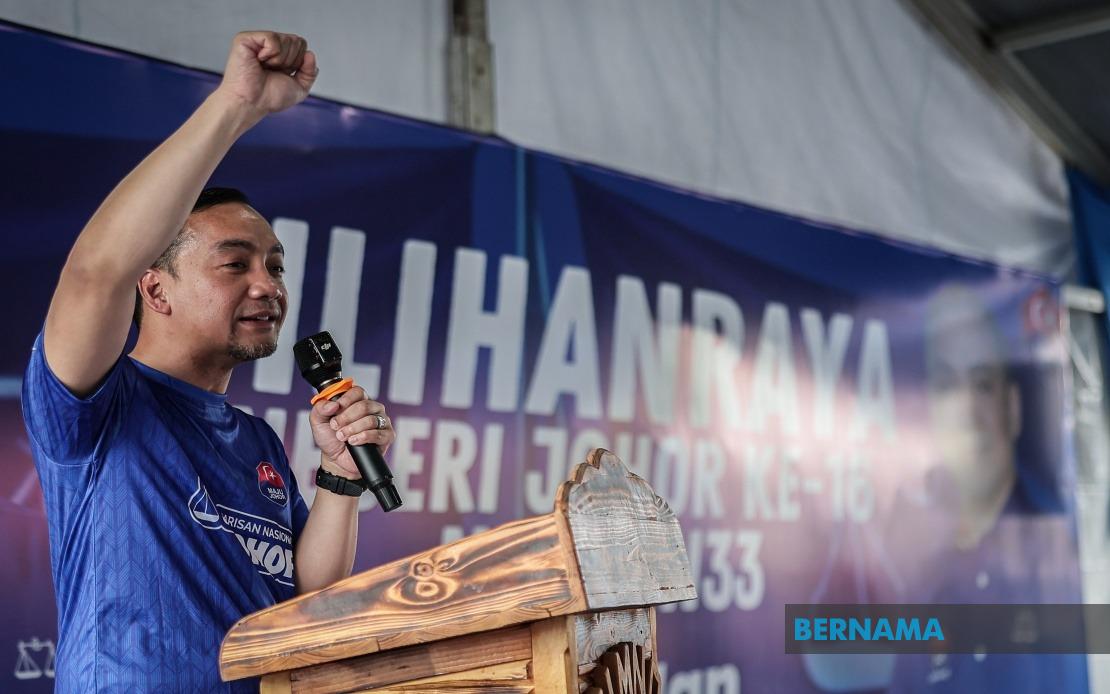
Barisan Nasional's Johor leadership is banking on sustained grassroots momentum to secure victory in the Endau state seat, with party officials citing encouraging community reception towards their candidate Alwiyah Talib as the coalition heads into the final stretch before polling day on July 11. The positive sentiment captured during campaign activities in the Mersing constituency signals growing acceptance of BN's slate, according to party strategists weighing the competitive state election contest.
Datak Onn Hafiz Ghazi, who chairs Barisan Nasional and serves as Johor Menteri Besar, characterised the local community's response to Alwiyah—known colloquially as "Kak Awi"—as markedly enthusiastic throughout the campaigning period. Speaking during a community engagement session in Endau, Onn Hafiz stressed that this receptiveness demonstrated voter readiness to support the coalition's slate of candidates across multiple constituencies. The senior politician's upbeat assessment reflects BN's broader confidence in reversing opposition inroads in Johor, a historically important state within the national political landscape.
Alwiyah's candidacy carries particular symbolic weight within BN's broader political messaging. Her transition from Perikatan Nasional back to Barisan Nasional exemplifies what UMNO president Datuk Seri Dr Ahmad Zahid Hamidi has termed the "Rumah Bangsa" concept—a framework emphasising coalition unity and open-door inclusiveness that seeks to portray BN as a welcoming political home. The notion of bringing former opposition members into the fold resonates with BN's attempt to project itself as a broad-based political movement rather than a narrow factional arrangement, particularly important as the coalition rebuilds its image following the 2018 general election defeat.
Onn Hafiz publicly acknowledged Alwiyah's prior affiliation with the opposition movement, framing her return to BN not as a betrayal of principle but as a continuation of her commitment to Johor's welfare. His comments attempted to neutralise potential criticism from voters who view party-switching as opportunistic, instead positioning her career trajectory as evidence of consistent service to constituents. This messaging strategy targets swing voters who may harbour doubts about defectors but remain persuadable if convinced that candidates prioritise local development above factional loyalty.
Alwiyah's electoral record provides substantial grounds for BN's confidence. In the 2022 Johor state election, while contesting under Perikatan Nasional colours, she retained her Endau seat with a plurality of 3,041 votes despite a five-way contest fragmeting the electorate. Her earlier success as a BN representative in the 14th General Election demonstrated her ability to accumulate genuine voter support across different political contexts. Such credentials make her a potentially stronger performer in Endau compared to newcomer candidates who may lack established community networks.
The strategic importance of Endau within Johor's political map should not be understated. Smaller constituencies frequently prove decisive in determining overall state government composition, particularly when larger urban seats deliver mixed results. BN's organisational focus on Endau, coupled with emphasis on Tenggaroh through candidate Mohd Youzaimi Yusof, suggests the coalition is targeting peripheral constituencies where personal networks and service records matter considerably to voters. This granular approach reflects lessons learned from previous electoral contests where seemingly secondary seats determined coalition control.
Onn Hafiz's assertion that party machinery in both Endau and Tenggaroh appears fully mobilised and committed signals internal confidence regarding ground-level campaign execution. The quality of party organisation—volunteer activation, voter contact intensity, and ground intelligence gathering—often determines electoral outcomes in marginal constituencies where opinion remains fluid. BN's reported readiness in these areas indicates the party has allocated resources strategically to consolidate potential gains and defend against opposition encroachment.
The campaign environment has reportedly proceeded without significant disruption or controversy, according to the Menteri Besar's assessment. Electoral contests characterised by peaceful competition and issue-based debate rather than personality clashes or institutional challenges typically favour incumbents and better-resourced coalitions. BN's apparent absence of internal public disputes or major campaign incidents suggests disciplined messaging and coordinated party leadership, factors that can translate into voter confidence in institutional stability.
Johor's state election occurs within Malaysia's broader political flux, where Barisan Nasional seeks to demonstrate renewed electoral viability after losing federal power in 2018. Victory or strong performance in Johor would substantially enhance BN's credibility heading into future national contests and reinvigorate its base. Conversely, disappointing results would confirm narratives of the coalition's decline and embolden opposition forces nationally. For Malaysian observers monitoring coalition dynamics and potential realignment patterns, the Johor outcome carries implications extending well beyond the state's borders.
Early voting was scheduled for July 7, providing opportunity for advance balloting that may favour organised party machinery able to mobilise supporters efficiently. The compressed campaign period between the election's announcement and polling day compressed strategic planning and voter contact efforts into concentrated timeframes. Parties succeeding in this environment typically combine strong organisational depth with persuasive messaging, qualities BN claims to possess through its veteran campaign infrastructure.
Regional observers watching Malaysian electoral developments should note that state contests increasingly function as barometers of coalition strength and opposition momentum between general elections. Johor's scale and historical significance within Malaysian federalism amplifies the weight attached to its electoral outcome. Whether BN's expressed confidence translates into tangible seat gains will substantially influence perceptions of the coalition's capacity to rebuild electoral dominance in subsequent national contests.
The political narrative surrounding Alwiyah's candidacy encapsulates broader themes animating contemporary Malaysian politics: coalition adaptability, defector absorption, grassroots satisfaction with development outcomes, and organisational capacity. Her success or failure in Endau will provide a test case for whether BN's Rumah Bangsa framework genuinely appeals to voters or functions primarily as tactical rebranding. Electoral observers across Southeast Asia monitoring Malaysia's political evolution will scrutinise the July 11 results for insights into coalition dynamics and electoral resilience in a region where dominant parties face unprecedented competitive pressures.

